I was driving Sunday and Monday, and my full boost dropped right down to 140 kpa, about what it is with the wastegate actuator disconnected, so I figured that was it. I checked the wastegate actuator, it was all good, check the downpipe, it's all good, turbo spins smoothly and freely, visible parts of the blades look good, etc. I do more digging and eventually knock on the catalytic converter to hear a rattle. Turns out the cat broke up and had plugged up the exhaust pretty good. I removed the exhaust and shake it all around for a few hours, getting more and more pieces out of the cat, muffler, etc. I shook it until nothing else rattled, and used a rubber mallet gently on the cat and muffler bodies, shook more until nothing came out, and no rattles, and couldn't see any cat material left stuck in the cat with a mirror. Took it for a drive today, and was instantly back to where it was, maybe better, I didn't drive much. If there are any other pieces in the muffler, etc. it should break up over time and find it's way out, and if not, there shouldn't be anything big enough to cause any problems for now.
Interesting, I will have to try to figure out more research on this, because if 10w30 synthetic has a better shear strength at temperature than 10w40 non synthetic, then I might as well get that. I will also look more for synthetic or semi synthetic 10w40 around here.
This is one of the semi synthetic I use that has outstanding protection.
Alright, I checked at my work, and got some Petro Canada supreme semi synthetic 10w40 ordered in for me, $36 for 5 quarts at employee pricing, that's definitely a price range I can handle easily haha.
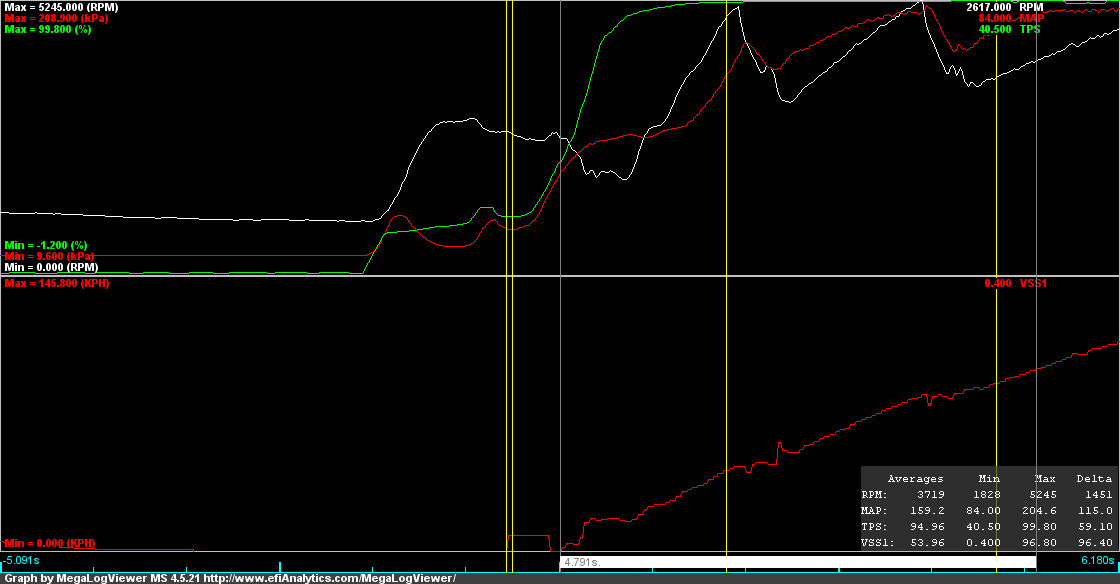
I also did a couple zero to 60 runs with my freshly free flowing exhaust, I also experimented with flat shift (and to a small degree, launch control, I haven't tuned that per-se, I still do some foot work in first to balance between spin and bog). I also enabled open loop boost control using an EGR solenoid (works pretty well as far as I can tell) to get to 200 kpa, wastegate only at the moment is 175. My quickest run was 4.791 seconds per the datalog, which felt great and was pretty crazy breaking pretty far into the 4 second category! ECM calculated horsepower averages about 240 at 200kpa, and torque at 265ft/lbs, I have the standard Fiero notch back/aero frontal area and drag coefficient entered for the ECM calculation, and I had 2600 lbs, although now that I think of that, I think it should be higher, but I don't know for certain, anyhow, a higher weight would only increase the horsepower number, as it's harder to accelerate. So it should be an accurate number or a bit on the low side.
I'm very impressed at how this car performs and feels, and that it still "looks" like a Fiero under the trunk!
This winter I will get a real turbo, as this one right now works perfectly at 175 kpa, but when I turn it up to 200, above 4000 rpm it makes the 2 tone sound that indicates a turbos dying or out of balance or something, so I'll not raise the boost for the rest of the summer, and I'll install a better one over the winter, this cheap one was intentionally just proof of concept, I didn't expect it to last a long time, but for what it is it's pretty good.
I was looking at Mamba turbos, they seem pretty well reviewed as a Garrett knockoff or whatever, they're made in Taiwan, not China, so that's a little better, and every turbo comes with its own balance report. The one I was looking at is ceramic ball bearing, billet compressor wheel, oil/water cooled, and comes with PTFE braided lines (as opposed to my cheap China one with melty fiery rubber lines), and an adjustable piston style wastegate actuator. $1200 cad shipped, which seems to be the price of most Garrett journal bearing turbos I can find, so if it's similar or better (ball bearings?) then I might get one.
Do you have datalogs to compare with/without flat shift? I guess you have a clutch pedal switch?
It seems unlikely that the included PTFE lines would happen to be the right length, so I would look into getting those separately.
Yes, I've done a few runs with and without flat shift at 175kpa, all in the 5s, all the time, I did a couple at 200kpa without flat shift and it was low 5s, and the 3 specific 0-60 runs I did with flat shift and turned up to 200kpa was 4.9ish, 4.8ish, and 5ish. I'm pretty sure my turbo has more lag than yours/is less efficient, etc. so keeping the throttle open through the shifts really makes noticeable seat of the pants difference.
I'm using a spare non cruise brake switch on the clutch pedal (engages as soon as the clutch is pressed more than about a half inch), and I've also found that having the engine cut ever so slightly before the clutch is actually released has sped up the actual shifting speed as well, maybe just a placebo, I don't know. I have the pedal switch wired in series with the cruise control on/off switch (no cruise, just have it for extra buttons), so I can disable flat shift and launch control entirely (otherwise sometimes it would activate on more mild accelerations, and be jerky from the switch activating before the clutch is actually disengaged. Thinking about it I could probably raise the tps threshold, that should keep it from activating unless I'm accelerating harder.
From what I can tell, the coolant lines are just short ~1 foot lines with a barb on one end, to connect to other lines of your choosing, that way you can use standard silicone or rubber coolant lines, but not worry about running them right to the extremely hot turbo. The oil lines I already have in PTFE and they should be fine to remain.
Been a while, I'm at 3900kms now on the turbo engine, it's been driving just about flawlessly, I'm continuing to dial in idle, accel enrich, no throttle clutch starts (idle settings), etc, etc, etc. my fuel table is pretty good, still rather rich under boost, but not as much as it was to start with. Today I just did my 3rd oil change (first at 500, second at 1,300, now third at 3900kms), now with the Petro Canada semi synthetic 10w40 oil. I had a slow leak from the timing cover area that has gotten worse over time, so I lowered the oil pan half an inch, and removed the timing cover, the issue was the front main seal was very worn on one side, obviously I didn't center the timing cover to the pulley well enough. So I replaced the timing cover seal and front main seal and loosely put it on while I put the harmonic balancer on, then tightened down the timing cover, then tightened down the oil pan. Hopefully it is properly centered now and will not find any more places to leak oil from.
Speaking of oil, somehow oil is getting into the engine at times, because I've had some blue smoke clouds under certain circumstances. If I turn it off somewhat hot (no cooldown idle after driving, although not spiritedly), then restart it after only a few minutes, it can smoke sometimes for a little bit, usually a bit of a rev or raising the rpms will "clear it out". Another time I had it smoke was right after pulling in for work (engine brake decel down to first, then a 180* right turn ending in a very steep, short hill, maybe 8 foot height change, and steep enough to be nearly impossible to walk in the winter, anyhow that needs some throttle and then immediately back to idle parked on flat ground). I'm thinking maybe either the turbo is leaking oil into the intake or exhaust, or perhaps valve seals. The way my turbo drain is, I could see it backing up a bit in a right turn going up a steep hill, perhaps that's just enough of a restriction to leak some oil that then burns, or it could be the engine braking sucking oil in from the valves, then the hill and throttle application drawing it in and burning it. The hot shutdown makes me think residual oil is leaking when the engine/turbo is shut down, but a cold start will burn it off slowly enough to not be noticed, where an immediate hot start just turns it into smoke, but that could be from anywhere.
Taking the timing cover off I had to refill my cooling system, the old fluid looked perfect and wasn't low at all, so the coolant at least is/was sealed, old oil was pretty low and dark (not super low but noticeably low), but not black, it was super cheap conventional stuff, and likely didn't like the turbo, I'll see how this new oil looks after 2600kms eventually.
I also got my rear control arms bent apart a little bit so my alignment should be more precise without the control arms moving forwards and backwards, I'll take it in Monday and do some more work on the alignment then.
Nearly 5000 kms on my swap now, it has snowed and the roads have been salted but it's been raining all day today, so Remembrance Day (Veteran's Day?) will likely be the last drive for the season. There are many things I intend to improve, rework, or fix over the winter, but overall I'm very pleased with the performance of this engine swap so far!
Sounds like you've gotten through the tough bit of the "bathtub reliability curve".
As the weather got colder, did you find the tuning got more tricky?
Is turbo replacement still in your winter plans?
Through the whole summer I've had a bit of an exhaust leak immediately before the turbo, whether it was a cracked pipe or a bad weld or a leaking gasket or catalytic converter chunks still closing the muffler and making the exhaust fine somewhere else to escape (I do think that has something to do with it), anyhow it has gotten worse as the weather cooled down, to the point that boost is down to 150kpa max. Because of that I haven't encountered any extra issues with the tune, which has been mostly untouched for at least a month, cold, hot and in between it usually starts immediately, maybe 50% of the time when it's around freezing and a cold start, the priming pulse isn't enough to fire it right off, so it cranks for an extra half second until the cam sensor syncs, then fires and runs great. I can start it and immediately hit the road, acceleration enrichment isn't dialed in when cold (I'd say my tune probably works consistently well down to 100*f coolant temp, below that the are still some issues), so it can have some hesitation, but I don't give it much gas until the engine is a little warmer, so that's ok for now. Idle control is perfect in all conditions, smooth, no hunting under varying electrical load, and responds quickly enough to be 100% confident on the steepest of hills to either ease off the clutch and let the IAC start pulling the car, or to come off it quickly and quickly hit the throttle, and have no hesitation, no inconsistencies, no problems (except for the hesitation when the engine is cold still).
My ve table and Afr are still not perfect, I haven't really used any of the ve tuning functions, just manually compared actual ve to targeted, and tried to adjust to match, doing that in broad sweeps, then making note of any problem areas when I'm driving and fix that up, keeping an eye on the gauges to note areas that aren't right, I'll say it's gotten me 85-95% of the way there. The tables are pretty smooth, and I enabled closed loop control once a couple weeks ago, and when cruising at all speeds it was basically spot on, mostly just with throttle fluctuations does it say it was off and needed correction.
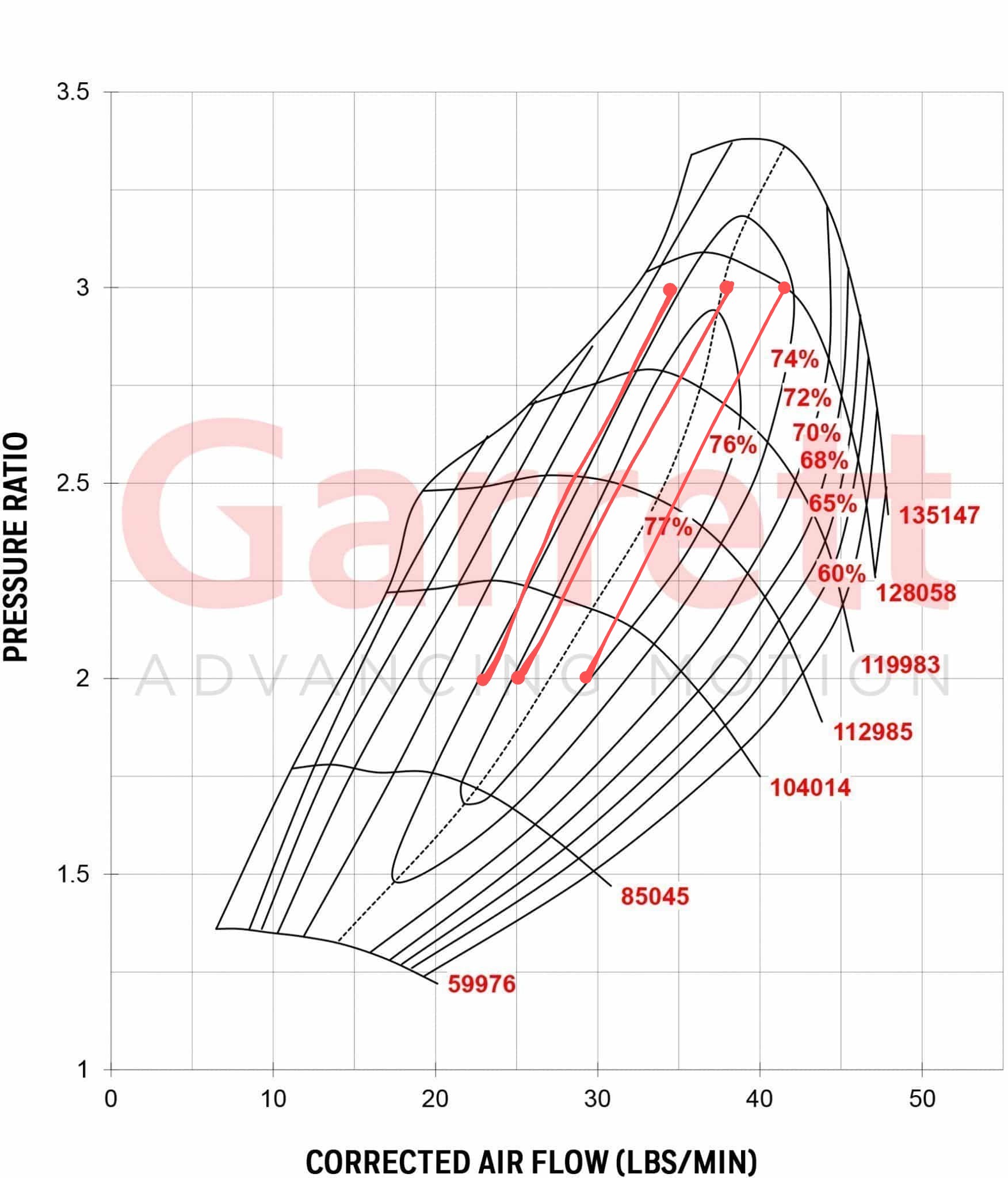
Turbo replacement is certain, I am now slightly more understanding of the compressor maps etc. so I'm looking at a smaller turbo, right now thinking of maybe the Mamba version of the GTX2871r. This is the Garrett compressor map, the 3 lines I drew are estimations, the bottom dots are for 230, 250 and 280hp at 200kpa. The ECM calculations were around 230hp, but that was at the wheels, so the engine is making more which is why I added the second line at 250, and for the purpose of potential upgrades that make more power with less boost (cam, etc), the 3rd line which is the highest level within the peak efficiency island. Assuming 200kpa boost is double na power, 300kpa is triple, that's the top 3 dots, with a line drawn to very roughly estimate how much power it's making at x boost. With the 2871 turbo, it looks to be peak efficiency between 250-280hp@200kpa, and all the way up to 275kpa. After reading on the 60* v6 forums of the apparent reliability and power potential of the gen 3 engines (my 3400), I'm going to be more likely to turn the boost up over 200kpa, maybe work up slowly to 240kpa max (20psi seems to be a common peak number for 3400s, and if anything the bad flowing iron heads should increase reliability because not all that air is getting to the cylinders, 240kpa on iron heads will make less power and less force on the actual pistons than the same boost on the less restrictive aluminum heads).
The 2871 turbo wheel sizes are 54/71mm compressor, 47/54mm turbine, my current t3/t4 eBay Turbo is 52/76mm compressor, 56/65 turbine. Significantly bigger, and I like it, and don't need full boost at 1500 rpm or anything crazy low, but there is a lot of lag, more than I would like if it's as simple as a sizing change to fix.
I was also looking at the camshafts wot tech has, and am considering starting on my better engine build up (the second block I have, taking it to a machine shop and getting it cleaned up properly, put a cam and new lifters in, basically build it up completely ready to drop in when either this junkyard "rebuild" kicks the bucket, or I decide swap it out anyway), that would be a higher budget thing, or maybe partially drop the cradle and put the cam in this engine this winter, I don't know. That I'm considering but not set on yet. I'll keep the turbo where it is, I like it being under the decklid vent, but I might turn it around so the turbine is at the back and the intake at the front, that will simplify the pre turbo intake routing, and I'll be doing something different with the exhaust, probably bringing it straight back and down into the muffler instead of down, across the front of the cradle then back to the muffler. I'll put the intercooler in front of the transmission where the exhaust downpipe is now. That will also keep the rear window temps down a bit, with the turbine right there and some exhaust leaks, it was getting a bit warm behind my head haha.
Yes, the iron heads won't flow like aluminium, however, the iron is less conductive than aluminium, so there could be more hotspots, and hence tendency for detonation.
I suspect that the power limit will be more related to avoiding detonation, than it is about not exceeding strength limits (assuming normal combustion) of the parts.
Besides the full power points which you have plotted on the graph, you should also estimate how little power you might generate for pressure ratios of 2, 3, etc.
You want to make sure that in low-RPM, high-boost situations, the compressor is not operating in the surge region to the left of the efficiency islands.
Besides the full power points which you have plotted on the graph, you should also estimate how little power you might generate for pressure ratios of 2, 3, etc.
You want to make sure that in low-RPM, high-boost situations, the compressor is not operating in the surge region to the left of the efficiency islands.
Ok, looking into it further, I found THIS thread with a wheel to flywheel calculation based off THIS thread with a dyno chart. Based off that, at 2500 rpm, a 2.8 is 65hp, times that by 1.17 for flywheel HP is 76hp. 76x2 for 2 bar of boost is 152. On the compressor map for the 2871 turbo, 150hp at a pressure ratio of 2 is right on the line for 68% efficiency, very close to the surge region, but not there yet. So that would mean I would have full boost (200kpa for now) at 2500 rpm or slightly below? That's significantly better than it was at 3200 or above. Do I need a still smaller turbo than that?
[This message has been edited by 1985 Fiero GT (edited 11-19-2025).]
Originally posted by 1985 Fiero GT: On the compressor map for the 2871 turbo, 150hp at a pressure ratio of 2 is right on the line for 68% efficiency, very close to the surge region, but not there yet.
If you want the turbo to operate there with the engine at 2500 RPM, then it doesn't look like a good choice. A smaller compressor, such as 2860R, looks like it would fit more with your goals of having more boost down low.
quote
Originally posted by 1985 Fiero GT: So that would mean I would have full boost (200kpa for now) at 2500 rpm or slightly below?
No, plotting that point on the compressor map does not mean you will have full boost at that RPM. It's just saying that if the engine happens to run there, then you will be at/near the surge limit.
Whether the engine/turbo combination will actually make "full boost" there depends on whether there is enough exhaust gas to spool up the turbo. In a trial/error process, you can try turbine housings with different A/Rs to find the balance between boost threshold and top-end power. I am not sure how to predict a boost threshold on paper; perhaps try a turbine housing with a small A/R to begin?
[This message has been edited by pmbrunelle (edited 11-19-2025).]
If you want the turbo to operate there with the engine at 2500 RPM, then it doesn't look like a good choice. A smaller compressor, such as 2860R, looks like it would fit more with your goals of having more boost down low. No, plotting that point on the compressor map does not mean you will have full boost at that RPM. It's just saying that if the engine happens to run there, then you will be at/near the surge limit.
Whether the engine/turbo combination will actually make "full boost" there depends on whether there is enough exhaust gas to spool up the turbo. In a trial/error process, you can try turbine housings with different A/Rs to find the balance between boost threshold and top-end power. I am not sure how to predict a boost threshold on paper; perhaps try a turbine housing with a small A/R to begin?
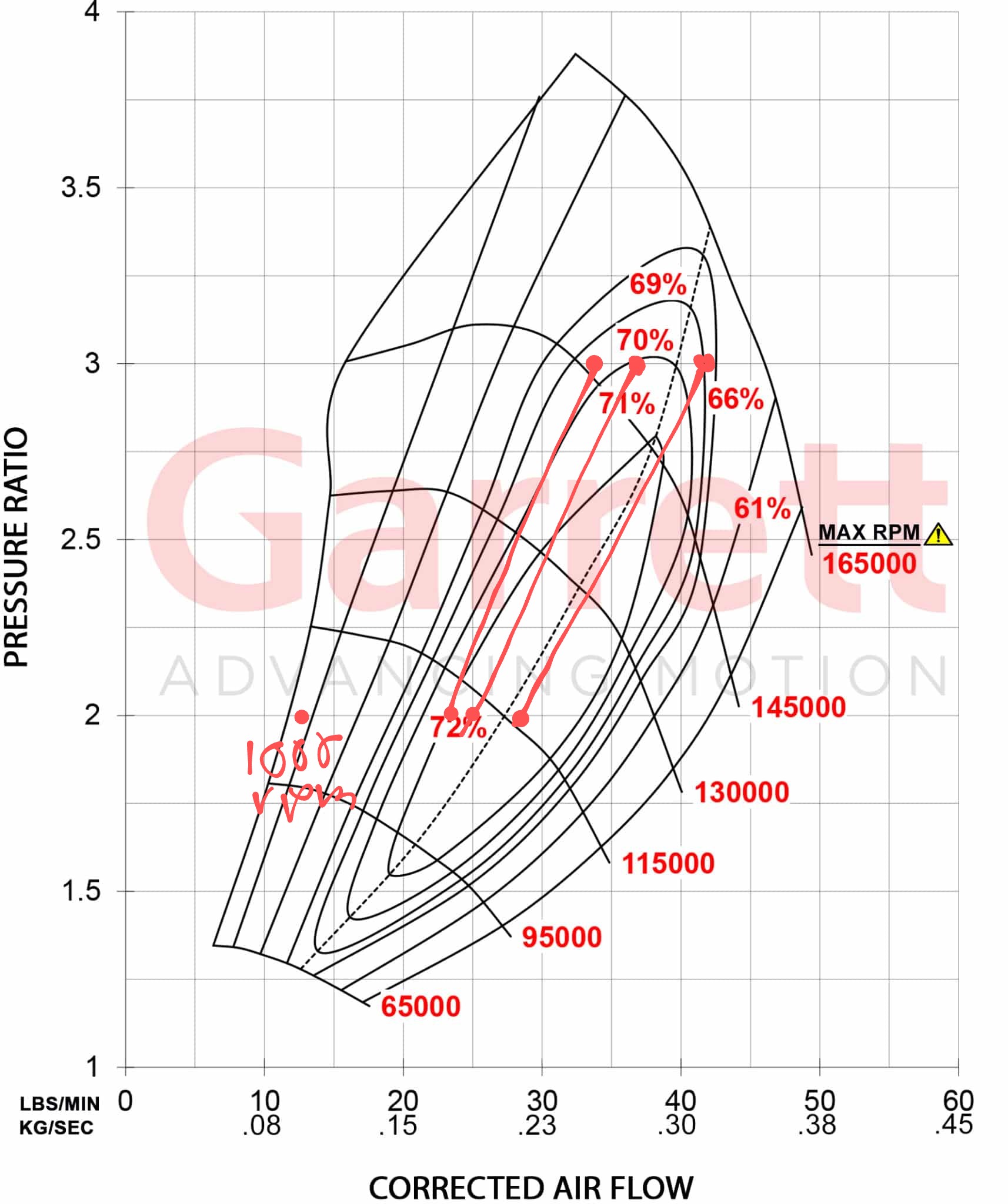
The 2867 is the next step down, assuming 50hp na at 1000 rpm (I think that's what that blurry dyno picture says), that would be 117 @ the flywheel at 200kpa, which is within the map still. So that would put every engine operating point on the map somewhere, down low is still near the surge limit, but considering what I'm using currently is, it'll be much different. I'm not specifically looking for full boost right from idle, but I would like to lower the rpm needed a little bit. As a comparison, the closest map I could find for my eBay Turbo (just some map for a t04e compressor) puts the surge line at 16 lb/min@200kpa, the 2867 is at like 11 lb/min@200kpa, so the compressor can't do anything until the engine can take in and put out 160vs110hp. The dyno chart had 80hp @ 3000 rpm, which is around the time I would have just started building boost, so there's a bit of a coincidental correlation there, 55hp was somewhere between 1000 and 2500 rpm on the chart, that would likely be fine for me, while keeping peak power in the most efficient area, and leaving room in that peak efficiency island for upgrades and more boost. Looking at the 2860 map, it definitely puts my current peak power/boost nicely in the middle of the peak efficiency, and excels more at the lower power/rpms. It doesn't cut to much off of the potential high end, certainly nothing I'd miss right now, and unlikely anything I'd ever get to: 400hp@325kpa for 2867 vs 375hp@300kpa for 2860, both unlikely numbers.