LOVE both of those planes. I can see the Blackbird from my desk, (its parked on top of the Intrepid) And we have a Warthog not too far from our home, taking a nap in a hangar.
Been into aircraft my whole life- my father worked on aircraft at NAS Alameda. The A-10 is just amazing- Fairchild/Republic always built the toughest warplanes; P-47 Thunderbolt, the F-105 Thunderchief.....An F-105 came back to base missing most of it's vertical, most of it's horizontal tail, and the afterburner....and the rocket motor from the missile that did all of this damage wedged between the engine and the fuselage skin.
An A-10 was hit over Iraq (2003)- one engine died, the other had debris, and a 6 foot diameter hole in the wing! The pilot was about to bail but the one engine spit out the debris so "maybe reach Saudi!".....The plane's systems started working better so "Maybe reach the base"....Finally landed at the base. By the way, the name of the pilot is Kim Campbell. (Yes, a lady!)
The SR-71 engines are ram jets; The INTAKES develop most of the thrust at speed- the shock wave from the cone point hits the inner wall of the intake and begins to decelerate-which causes higher pressure creating thrust...the actual jet engines basically keep the intakes from "Clogging" with air- They have actually measured reverse pressure on the engine mounts at mach 3.
Personal favorite aircraft; Military, the A-5 Vigilante....Civilian, the BD-5J
[This message has been edited by cvxjet (edited 12-16-2021).]
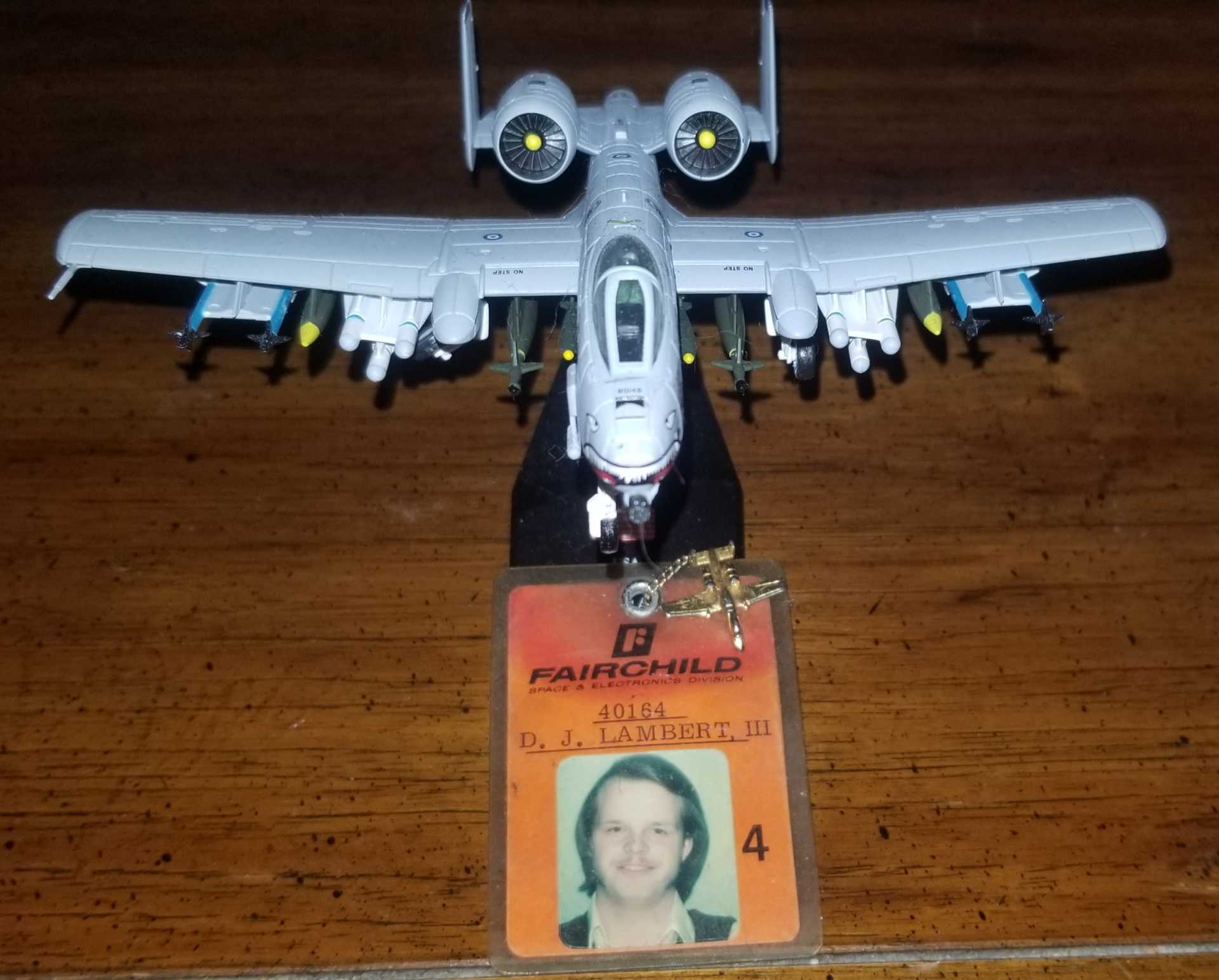
Love the A10, I actually worked on the production line building parts of the A10's from 1977 to 1982. Proud that the equipment we built is still in use.
The plant I worked at was located in Germantown MD, we built the pilots weapon control modules allowed pilot to choose from the gun or select wing bomb pods, had mechanical analog counter that keeps track of rounds left, that was the technology used back then. Also built aircraft test sets. Other lines built F14 weapon control systems.
Later I was promoted to production control expeditor, in charge of monitoring the A10 production and moving the units thru various stages of production, testing, shipping.
They have updated the cockpit controls & jammed more technology in the given space. The weapons control unit is all new & is able to broadcast it's status to other planes. That was never even thought of back in the original design.
[This message has been edited by CoolBlue87GT (edited 08-23-2026).]
The A-10 was my first choice out of pilot training. I never was lucky enough to find one with my name on it. Still a favorite.
The F-15 has to be my all time favorite that I have actually flown. Absolutely amazing aircraft with amazing capabilities to this day. I can’t imagine how well more modern aircraft like the F-22 perform.
My all-time favorite plane/story; The RB-51....It was WW2 fighter (P-51) that was used for racing- Cleveland air races and other locals...finally at Reno and Mojave Air Races. It was modified numerous times during it's racing career. Clipped wings, smaller canopy, etc. Finally bought by Ed Browning (Red Baron Flying service, Idaho Falls).....More mods but the really wild mod was replacing the Merlin V12 with Griffin 57 Bomber engine- including Counter-rotating propellers.
In this setup it won numerous races and even set the world speed record at 499.018......With better conditions they believed they could hit 530 mph.
At Reno in 1979, Steve Hinton was racing when something went wrong with the ignition, which then led to the Supercharger shaft sheering- shutting off the oil pump- which supplied oil pressure to the pitch control for the propellers- they went to FLAT pitch (Rather than Feathered).
Steve was trying to make the emergency runway but the RB-51 was falling...His last words as the plane fell were "Tell Karen I love her" (His fiancé who was in the pits)
The plane dropped below the end of the runway and a huge ball of flame and smoke erupted! Everyone knew he was lost....
His pit crew jumped in their old station wagon and raced down the runway- just below the edge of the runway was a chain-link fence- they cleared that fence by driving off the end of the runway- destroying the car (Lucky they did not get hurt)
They found Steve alive; The engine had dragged the fuselage clear of the fireball (Fuel tanks in the wings)...By the time he stopped the fuselage had disintegrated; They had STRENGTHENED the cockpit area the year before!
He did survive, married Karen, and came back to Reno with a Super Corsair (With a Corncob 4360)...Won the title again in 1985.
And to update the story, his son, Steve, Jr, was the youngest pilot to ever win the Reno Unlimited title in 2009.
Here is a picture of the RB-51....
They should make a movie about this (I think Roger Donaldson (World's Fastest Indian director) should take it on)
The ones that I personally had a part in designing:
SR-71 Blackbird My very first assignment as a new engineer at Pratt & Whitney Aircraft Florida in 1984 was to redesign and replace much of the tooling for the J-58 engines that had been scrapped in accordance with the monstrously stupid "SALT II" agreement that the moronic Carter administration had agreed to with the Soviet communists in 1979. (Both the tooling and the plans for them had been destroyed under SALT II). The USAF had nearly run out of spare parts and was starting to cannibalize operational aircraft. I was honored to work on an aircraft / propulsion program that began when I was just a child.
F-15 Eagle I was a member of the nozzle and augmenter, ("afterburner"), design team for the F-100-PW-220 engine upgrade.
F-16 Falcon / Viper I was a member of the nozzle and augmenter, (afterburner"), design team for the F-100-PW-229 engine upgrade
F-22A Lightning II / Raptor I was a principal engineer on the vectoring nozzle team for the F-119-PW-100 engines.
I could include my work on the RL-10 rocket engine series and the Shuttle main engine turbo-pumps and a few other interesting projects but you specified "planes".
[This message has been edited by randye (edited 12-17-2021).]
The ones that I personally had a part in designing:
SR-71 Blackbird My very first assignment as a new engineer at Pratt & Whitney Aircraft Florida in 1984 was to redesign and replace much of the tooling for the J-58 engines that had been scrapped in accordance with the monstrously stupid "SALT II" agreement that the moronic Carter administration had agreed to with the Soviet communists in 1979. (Both the tooling and the plans for them had been destroyed under SALT II). The USAF had nearly run out of spare parts and was starting to cannibalize operational aircraft. I was honored to work on an aircraft / propulsion program that began when I was just a child.
F-15 Eagle I was a member of the nozzle and augmenter, ("afterburner"), design team for the F-100-PW-220 engine upgrade.
F-16 Falcon / Viper I was a member of the nozzle and augmenter, (afterburner"), design team for the F-100-PW-229 engine upgrade
F-22A Lightning II / Raptor I was a principal engineer on the vectoring nozzle team for the F-119-PW-100 engines.
I could include my work on the RL-10 rocket engine series and the Shuttle main engine turbo-pumps and a few other interesting projects but you specified "planes".
I'm happily retired now but when I look back on my engineering career the time I spent in aerospace was some of the best and the most personally fulfilling years. I would have stayed in aerospace and not transitioned to biomedical if it hadn't been for that rat bastard Clinton and the end of the cold war.
We had over 8,000 scientists, engineers and special technicians on campus at UTC P&W Florida until the Clinton defense cutbacks started. I survived 14 rounds of massive layoffs until they finally gutted the entire facility.
We will probably never see another collection of the extraordinary level of talent, knowledge and skill all in one place that we had back then and we did some incredible things.
Many that are still secret.
Here is a photo of the J-58 / SR-71 engine on a test stand at night at our facility in Florida. Yes the entire aft end of the engine always glowed bright yellow / orange like that at full military power.
This a view of a small part of the P&W Florida facility back in the day.....way out in the swamps back then. (It was a real PITA walking to the main building from your car out in one of those massive parking lots when it was raining...and it rained a lot...and there were often gators from the lake under cars...you always had to look as you approached your car... ) We had our own airport, fire department, armed security force, power plant, water and sewage treatment, etc. It was a small city.
This the F-119-PW-100 engine that is in the F-22A Raptor. I was a principal engineer on the 2D vectoring nozzle circled in red.
Fun years remembered fondly.
[This message has been edited by randye (edited 12-18-2021).]
The Avro Canada CF-105.....a really great aircraft that was cancelled so that Canada would buy US missiles and aircraft.
By the way, if you want to take the time, an interesting read is the book "Boyd; The fighter Pilot Who changed the art of War"......He was a fighter pilot in the Korean war, but after that he developed new theories of warfare, which the Marines adopted in the Gulf war. The Marines think very highly of him. He also struggled to get the Air Force to develop a smaller fighter than the F-15- which led to the F-16, small and extremely maneuverable.
The Air Force had decided that dogfights were a thing of the past- there was actually talk of using 737-size aircraft with large crews at control consoles and a rotary missile launcher- which would shoot down all of the enemy aircraft. Boyd (And others) kept pointing out that any technology we developed would be cancelled by the enemy at some point, so that air fights would degenerate down to dogfights quite often. (The same stupidity that led to NAVY F-4s not having a gun (They later carried POD guns mounted under the wings)
The Last One, great stories. Columbine 2 Lockheed Super Constellation Many times a day they flew overhead on the flight path south over Lake Ontario, taking off westbound from Malton Airport. When the Arrow went over it was so very different, higher, faster, louder, a white triangle roaring in bright sunlight, sparkling. Victory Aircraft Malton A.V. Roe, Malton.
[This message has been edited by Valkrie9 (edited 11-13-2026).]
Used to be a Super Connie sitting at the north end of YYZ, on the way into Piedmont (now world). No idea if its still there but it was kind of cool to drive by it every day.
Bird dogs and Broncos are among my favorite fixed wing aircraft.
Not glorious or superfast or the choice of hotshot seat jocks but they saved a LOT of lives and put a lot of ordinance on target.
quote
there was actually talk of using 737-size aircraft with large crews at control consoles and a rotary missile launcher- which would shoot down all of the enemy aircraft.
Unfortunately, this idea hasn't completely disappeared but using KC-130Js with Harvest Hawk instead. USMC has been using it on a limited basis for a number of years with some success.
Originally posted by 2.5: Thought this was cool One Wing Wonder
! I'll watch it after I check my aerodynamics primer. .....3,2,1 Yep! A wing off is bad! F-15E Barrel Roll Now, at full thrust burning, a steady low g barrel roll is controllable, keeping the nose above the horizon. An exciting rtb! ' There we were, pulled up to recce the target we had just totaled, when I heard a loud bang! '
Originally posted by maryjane: Bird dogs and Broncos are among my favorite fixed wing aircraft. Not glorious or superfast or the choice of hotshot seat jocks but they saved a LOT of lives and put a lot of ordinance on target. Unfortunately, this idea hasn't completely disappeared but using KC-130Js with Harvest Hawk instead. USMC has been using it on a limited basis for a number of years with some success.
Bronco...hmmn mmmn, yep. Worked a lot on a version, piston power, floats, wood, steel, grp. To this day I still think it would work well, no more than a design exercise, a 'pie in the sky' scribble on a few sheets of paper. TwinJAG, beautiful. The wonderful culmination of a dream. \_______________(-- --)________________/
I read about that XB-70 crash.....they never were able to fully explain why the F-104 pilot collided with the '70's vert.
The next step was going to be nuclear powered bombers- but the invention of SLBMs and the critical question; "What happens when a nuclear powered bomber crashes?" killed the program. I was in the middle of Nowhere in Idaho and spotted a sign "EBR-1"..."What the heck is an EBR-1?" Experimental breeder reactor number 1......The first reactor to generate electricity, in the world. I went on the free tour- and stood on top of that reactor (No, I do not glow in the dark)
Out in the parking lot they have the two Nuclear Jet Engine test cells.....
The XB-70 was mach 3 capable but was not designed to CRUISE at mach 3 for extended periods. The SR-71 was specifically designed to maintain mach 3 during most of it's flight. The engines were a major leap forward in technology. The real innovation was the intake which created 70-90% of the thrust above mach 3.
Not sure about the XB-70 but most aircraft that are "mach 3" capable are only able to >>Sprint<< at mach 3 for short periods of time. A lot of fighters can get close to mach 3 but A) would run out of fuel rapidly at '3 and B) suffer structural damage due to heat>>melting...
To give you an idea how dangerous mach 3 flight is, the SR-71's shock cones at the front of the intake move forward and back to align the shockwave (Depending on actual speed) inside the lip of the engine intake. If the cone moves improperly, the actual shockwave can come out of the intake and impact the wing. This actually happened- the impact of the shockwave forced the '71 to twist sideways- the pilot was thrown through the side of the cockpit!
Also, the SR-71 became so hot during flight that the skin would expand; The plane would take off, leaking fuel, then do a high-speed dash to heat the skin, which expanded to the point of sealing the fuel tanks, then the '71 would refuel and could then do it's mission.
The A-12 is (Basically) the predecessor to the SR-71 and extremely similar....The SR-71 was a 2-seat version with updated technology and materials.














 __(-- --)__


