I don't know that it's any worse than it was. Don't think it's any better, though.
Gonna be hard to tell, since whatever is coming out is still under extremely high pressure.
I dont think they can tell either.
quote
BP Subsea operational update: • There are no technical developments to report at this time. We will provide an updated flow rate and any new technical information at 9am Sunday morning.
5 June 2010 5:30pm CDT
EDIT:Page 4 is mine
[This message has been edited by Silentassassin185 (edited 06-05-2010).]
IP: Logged
10:20 PM
jetman Member
Posts: 7811 From: Sterling Heights Mich Registered: Dec 2002
Dunno, since this is a special setup, but, I wouldn't think so. Drill pipe is usually +- 31 ft each--casing was the same back in my day. It has to be short enough to be trucked from plant to port. No, I wouldn't think so at all.
Here are all the views at once...http://www.jtnog.org/
Excellent find Shananigans!
That's so much better than the link I posted on the previous page, these are tiled and you can double click for a full screen view on any cam. I just sent the link to my Dad and brothers!
I still don't understand why they cannot cap this off. Isn't it common practice for the well to be capped off until BP is ready to access the oil? You would think that all these oil cpmpanies would have contingency plans or procedures. Isn't there someone smart enough to figure this out?
Ok then, if the hydrates will freeze up, why not go ahead and let them freeze up, wouldn't that stop the flow?
That's so much better than the link I posted on the previous page, these are tiled and you can double click for a full screen view on any cam. I just sent the link to my Dad and brothers!
I still don't understand why they cannot cap this off. Isn't it common practice for the well to be capped off until BP is ready to access the oil? You would think that all these oil cpmpanies would have contingency plans or procedures. Isn't there someone smart enough to figure this out?
Ok then, if the hydrates will freeze up, why not go ahead and let them freeze up, wouldn't that stop the flow?
Anyone else getting frustrated like I am?
Yes, it's common practice to "cap" one off. Either temporarily when the rig gets thru drilling or permantly if the well is no longer producing. Plug and abandon (p&a) but that is completely contingent upon 1 thing. That you have control of the well.
quote
Ok then, if the hydrates will freeze up, why not go ahead and let them freeze up, wouldn't that stop the flow?
Maybe--but: They would only remain frozen as long as the well was flowing..exhibiting velocity--then "thaw" and flow again etc etc--repeating cycle in a violent hammering fashion that would most likely blow casing and wellhead out of the ground as it pulled the casing completely apart. OILCANO!!
[This message has been edited by maryjane (edited 06-06-2010).]
IP: Logged
09:34 AM
jetman Member
Posts: 7811 From: Sterling Heights Mich Registered: Dec 2002
Originally posted by maryjane: Yes, it's common practice to "cap" one off. Either temporarily when the rig gets thru drilling or permantly if the well is no longer producing. Plug and abandon (p&a) but that is completely contingent upon 1 thing. That you have control of the well.
Yeah, maybe I've seen too many movies of the big oil gusher and everyone celebrating then they cap it off. Didn't they cap off or put valves on all those burning wells after the Iraq war? Why couldn't they put another section of pipe with a valve on the riser package? Another question is why are they using a much smaller pipe now on that well, wouldn't a larger pipe capture or contain more oil? Please be patient with me, I'm not smart enough to understand all of this, I guess that's why I'm getting so frustrated.
IP: Logged
09:46 AM
Raydar Member
Posts: 41656 From: Carrollton GA. Out in the... country. Registered: Oct 1999
I'll try... From what I've been able to gather from all of this, there is no way to securely fasten another pipe/valve to the top of this. The bolts are too large/tight to be removed. Cutting them is not an option. The cap is the best that can be done. The pipe is smaller because, apparently, anything larger would overwhelm the capacity of the containment ship that is recovering the oil. Also, since the seal at the well is not perfect, some leakage must be allowed in order to prevent seawater from being drawn into the pipe. Earlier, they were having problems with ice formation, related to seawater.
Don mentioned that the wellhead appears to be damaged, or at least leaning over. There appears to be at least a chance that the well itself could be ripped out of the ground if too much stress is placed upon it.
I'm sure I'll be corrected if I've mis-spoken.
IP: Logged
11:42 AM
84fiero123 Member
Posts: 29950 From: farmington, maine usa Registered: Oct 2004
Yeah, maybe I've seen too many movies of the big oil gusher and everyone celebrating then they cap it off. Didn't they cap off or put valves on all those burning wells after the Iraq war? Why couldn't they put another section of pipe with a valve on the riser package? Another question is why are they using a much smaller pipe now on that well, wouldn't a larger pipe capture or contain more oil? Please be patient with me, I'm not smart enough to understand all of this, I guess that's why I'm getting so frustrated.
The wells in Kuwait were completed and producing wells. 'Completed' means the well is drilled to Total Depth by the big rig, cased and cemented, along with at least one cement plug, with heavy mud left in the hole. A smaller, usually mobile rig comes in, sets up on the well left behind by the big rig, This rig will run production pipe inside the casing left by the drilling rig. Perforate as neccessary, flow the well forBbls/day test purposes and to clean out any debris left from drilling thru the plug. When they are done, they will leave behind, a valve assy on top of the well, called a Christmas Tree, or a pump if the well doesn't flow on it's own. This Christmas Tree valve is what the Iraqi's blew off with explosives, leaving the production casing hanging in the wellhead. It was a relatively simple matter for wild well control guys to extinquish the fire, replace the tree and then close the well in and again get it ready for production.
The Maconoda has none of those things done yet--no perfs--no production pipe--no plug--no Tree. It was drilled to TD, cased, cemented (barely) and a non-production liner set but that was it. There is no valve to close below the wellhead--just the BOP assy above the wellhead. They hadn't even set the top plug---they were getting ready to when the well blew out.
If you have a home water well, think of it as you having a drilled well, with just your outer casing set, but no riser tube from bottom to top. But, it comes in as an artesian well (free flowing). Yoh have absolutely no way to shut it off.
IP: Logged
05:46 PM
jetman Member
Posts: 7811 From: Sterling Heights Mich Registered: Dec 2002
Originally posted by maryjane: ,,,,snip,,,, no way to shut it off.
Wow, a very good explaination, I'm getting the idea now. This is where the blow out preventer is such a critical piece of equipment. A functioning BOP should have prevented this from happening right?
IP: Logged
06:57 PM
Raydar Member
Posts: 41656 From: Carrollton GA. Out in the... country. Registered: Oct 1999
Check out Viking Poseidon R1... They're trying to get a socket wrench on a nut. While it's normally a simple task, it's not going well. Perfect illustration of what a PITA this whole undertaking is.
IP: Logged
08:05 PM
jetman Member
Posts: 7811 From: Sterling Heights Mich Registered: Dec 2002
Check out Viking Poseidon R1... They're trying to get a socket wrench on a nut. While it's normally a simple task, it's not going well. Perfect illustration of what a PITA this whole undertaking is.
OMG. Been watching that! WTF, is that metric? on a SAE?!!! Here we go again!
IP: Logged
08:46 PM
PFF
System Bot
jetman Member
Posts: 7811 From: Sterling Heights Mich Registered: Dec 2002
I see the ROV got the second socket tool. They can't attach to the nut, the handle of the tool is hitting the assembly. They need to use a slim profile socket tool or move the handle 90 degrees on the tool in order to clear the assembly. Years of working on Fiero manifold bolts taught me that trick.
Wow, a very good explaination, I'm getting the idea now. This is where the blow out preventer is such a critical piece of equipment. A functioning BOP should have prevented this from happening right?
Yes, but understand, many blowouts are controlled/prevented by good mud practices and procedures. The BOP is the last line of defense and if you have to close them--especially the shear rams--you're already in trouble. Ic an't stress the importance of a good mud program and sometimes--in fact often, it is a matter of just 10ths of a pound/gal. They walk a fine line all the time. Not enough mud weight/gal and the well comes in on you--too much, and you fracture the formation, sending mud out into the strata, which again results in a loss of hydrostatic head above the reservoir. People see these roughneck shows on TV and think it's just muscle and brawn--and lots of it is, but there is also a huge amt of data to consider for the mud logger and mud engineer. Technical things that are really beyond my education, but mud is your friend, your savior, but it's fickle and will turn on you in a minute.
I'm getting some info together on the relief wells, to explain better, what (hopefully) will take place, but I expect to see Relief 1 ready to intercept that 13,000psi zone around July 1. When they do, it's my understanding, that a contracted team will pretty much take over, and that team has never lost a well. They are the absolute best in the business and originally traine under and worked for Red Adair--this is Boots and Coots. They don't work cheap, but I saw an interview early on in this debacle and they said they would have taken this one for free. Told BP, "You just get us down there--we'll take it from there."
I would NOT want the mud engineer's job on Relief 1 for any amt of $$.
IP: Logged
09:50 PM
84fiero123 Member
Posts: 29950 From: farmington, maine usa Registered: Oct 2004
Steve http://wilkyway.org/default.aspx ------------------ Technology is great when it works, and one big pain in the ass when it doesn't. Detroit iron rules all the rest are just toys.
[This message has been edited by 84fiero123 (edited 06-06-2010).]
Doesn't matter how many there are or were. 1. There was insuffecient hydraulic pressure to close them. The very 1st explosion knocked it out before the rams were engaged. When they did engage them, the panel said they were activated, but near zero pressur available, 2. They were not designed to cut thru casing and drillpipe. 3. The flow, is coming from the anulous. Shear rams won't stop that--period.
IP: Logged
11:49 PM
Jun 7th, 2010
spark1 Member
Posts: 11159 From: Benton County, OR Registered: Dec 2002
See the size of that socket being used by Poseidon – ROV 1? (3 11/16") I think the bolt they are trying to turn is metric, the socket won't fit. edit: They finally made it home.
Wow, they were working on that all night long, over 6 hours or something like that. You know, at some point I may have been tempted to try the next fraction of a size larger, compensate for scale build up and such. I did notice that they kept switching tools to get one that could articulate closely against the body of the pipe.
I don't know, at one point I felt like I was suffering some kind of obsessive disorder, couldn't turn away from the web cam, addictedly watching that ROV get soooooooo close only to repeatedly fail to secure onto that nut. Man alive, I had to yank myself away and shut the computer down.
IP: Logged
09:27 AM
spark1 Member
Posts: 11159 From: Benton County, OR Registered: Dec 2002
Originally posted by maryjane: Yes, but understand, many blowouts are controlled/prevented by good mud practices and procedures. The BOP is the last line of defense and if you have to close them--especially the shear rams--you're already in trouble. Ic an't stress the importance of a good mud program and sometimes--in fact often, it is a matter of just 10ths of a pound/gal. They walk a fine line all the time. Not enough mud weight/gal and the well comes in on you--too much, and you fracture the formation, sending mud out into the strata, which again results in a loss of hydrostatic head above the reservoir. People see these roughneck shows on TV and think it's just muscle and brawn--and lots of it is, but there is also a huge amt of data to consider for the mud logger and mud engineer. Technical things that are really beyond my education, but mud is your friend, your savior, but it's fickle and will turn on you in a minute.
I'm getting some info together on the relief wells, to explain better, what (hopefully) will take place, but I expect to see Relief 1 ready to intercept that 13,000psi zone around July 1. When they do, it's my understanding, that a contracted team will pretty much take over, and that team has never lost a well. They are the absolute best in the business and originally traine under and worked for Red Adair--this is Boots and Coots. They don't work cheap, but I saw an interview early on in this debacle and they said they would have taken this one for free. Told BP, "You just get us down there--we'll take it from there."
I would NOT want the mud engineer's job on Relief 1 for any amt of $$.
It's called: "We will get this right, and we will be gods."
IP: Logged
11:37 AM
PFF
System Bot
pokeyfiero Member
Posts: 16246 From: Free America! Registered: Dec 2003
It's called: "We will get this right, and we will be gods."
Will be?
In that business, they already are--they're the bar everyone else shoots for. We'll see, if they can hold that title...one thing's for sure, humility isn't their strong suit.
Doesn't matter how many there are or were. 1. There was insuffecient hydraulic pressure to close them. The very 1st explosion knocked it out before the rams were engaged. When they did engage them, the panel said they were activated, but near zero pressur available, 2. They were not designed to cut thru casing and drillpipe. 3. The flow, is coming from the anulous. Shear rams won't stop that--period.
This is what is strange to me. From a safety standpoint a person would think that as a "fail safe" device the rams would close when there is a lack of hydraulic pressure, the same way a semi trailer would work.The hydraulics should be holding them opened, and as soon as the pressure drops they close. Why would the ram be closing around the casing? It should be designed to go through whatever could be around it, it is made to stop disaster from happening right? Why bother having it if it's "not designed" for whatever can happen?
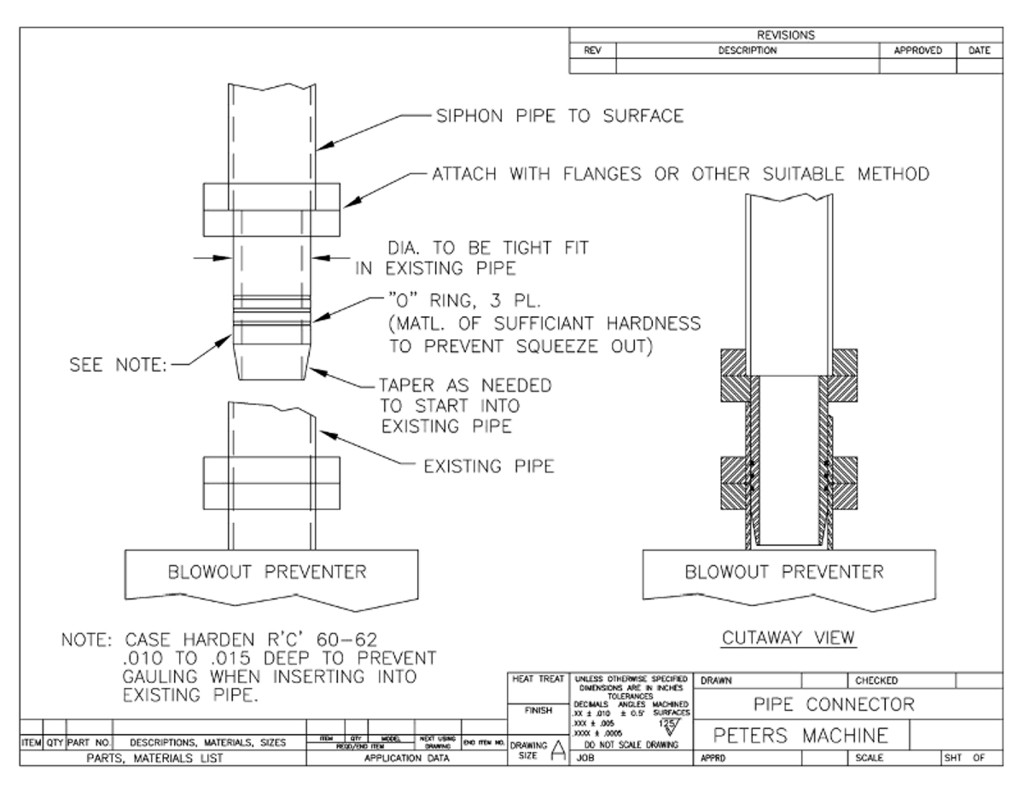
I understand that when they sheared the pipe it distorted more than they anticipated. Then when they went to saw it, they realizes there wasn't enough sticking out of the flange to cut off and get rid of the portion that was distorted. Now they can't get a complete seal. As long as it is not sealed they cannot close off the vents or else ice will form because of the water mixing with the methane gas. Called my engineer brother to ask what he though about what to do now. He said that he had already contacted BP asking for an application in order to submit his idea on the next step. They emailed him the app and he submitted it last Friday via email. Here is the drawing he submitted. Don't have his explanation he sent but he told me the details over the phone. Will post them later, too busy now and I type slow.
Nice print Partfiero. It would be perfect, if the BOP/riser stub were sitting in a fab yard or big shop somewhere, but that isn't the case. Just off the top off my head, in about 15 seconds, several realworld problems come to mind.
1. The cutoff riser pipe is not round--it is a very rough eggshape. 2. Even if it were not egged, no one knows what the current ID is. Extereme cold, abrasive and hydraulic scouring has undoubtedly occured within the id from high pressure-hi velocity outflows, carrying sand and sediments from the formation where the flow originates.. 3. Your drawing shows a perfectly vertical riser/bop assy--which doesn't exist now. The etire bop/wellhead assy stands off vertical about 15 degrees. (rough estimate) You will have heck getting that stabbed in with that much offset, and attempts to do so may very easily break the wellhead off subsurface. 4. Inside the cutoff riser stub, sit 2 pipes. Undoubtedly drillpipe. How can there be 2? Either the DP elbowed itself up in there, or broke in 2 downhole, with both broken pieces ending up in the riser/BOP. These may-or may not--hinder stabbing anything down inside that bore. 5. The biggest no-nos you will encounter, are: a. You will place tremendous hydraulic pressure on the BOPs and wellhead, which currently see very little backpressure. While oil/gas do want to move upward, they want to do so only in reference to the heavier seawater. Once you issolate the hydrocarbon flow from that heavier environment, by encapsulating it in your stab-on and a closed pipe going to surface , that natural upward tendency dissappears, replaced instead, with a 5000' hydrostatic head above your connection. There is a very very real possiblity of blowing the bop/wellhead right off the casing it is attached to or even worse, rupturing the questionable ingtegrity of the casing somewhere below the mudline. Game over at that point. b. By hard piping the full flow. pressure, and velocity of this well up to the Drillship Enterprise, you have just exposed that vessel and it's crew to the full venom of this out of control well.
1. It can handle only about15-20,000 bbls/day flow. You would overwhelm it's liquid handling capacity leaving it only one option--closing it's topside valves, resulting in the same scenario as in (a.) above. 2. Out of control wells do not flow at a constant force. Sometimes the flow is more--sometimes less. Sometimes it is all oil--sometimes it shoots out a big slug of gas. Right now, that is being thwarted by venting some of the flow to the sea--a relief valve of sorts. 3. Keep in mind, that what caused the diasterous explosion on Deepwater Horizon to begin with, was a huge bubble of methane forming within the 5000' riser, traveling up that riser and finding it's way on to the drillship. I do not know the flare capacity of Enterprise, but it undoubtedly has it's limits.
OTOH, I have to say this is one of the best thought out plans I have seen here at PFF and among the best I have seen elsewhere--in spite of it's drawbacks, engineering misses and potential dangers. It will NOT make it into the coffee table book being put together called: "Stupid and asinine ideas to control the Macondo blowout "
Yeah, yeah , yeah old timer. My second year in the oilfiled I made a tick over 77k, and that was before the raises.
I didn't finish that. There were intangible benefits back then.
Why, back in the days when we had men of iron and wooden derricks..............when we moved on a new location, the local girls would meet us at the end of the board road with mattresses on their backs.
I think part of the problem lies in them not using a large enough pipe to siphon the oil out, I don't care how well they connect, the size pipe they have going up to surface right now is too small to handle the flow out of the well.
What if they ran two, or even three pipes into the well head, and had them all sucking to beat the band?
I think the current method they are using would work if they simply added more flow, and pumped something in to prevent ice.