when grounding the sensor with a pin the guage and light work but the car wont read the sensor
1987 Gt 2.8l V6
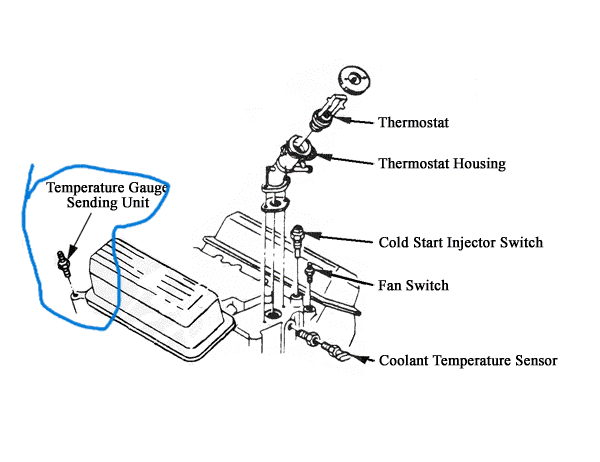
By car do you mean the ECM? There's a seperate sensor for the ECM, below the thermostat housing, if you mean the gauges, then if you ground the pins and the light and gauge work as expected, then either the sensor is bad, or you reversed the wires and are sending the gauge signal to the light and the light signal to the gauge, which would make the gauge appear to not work.
By car do you mean the ECM? There's a seperate sensor for the ECM, below the thermostat housing, if you mean the gauges, then if you ground the pins and the light and gauge work as expected, then either the sensor is bad, or you reversed the wires and are sending the gauge signal to the light and the light signal to the gauge, which would make the gauge appear to not work.
I have tried a known good sensor and im replacing and testing the one just below the distributor
I never saw one near the thermostat housing?
Also its a resistor on both sides does it affect it if its the wrong way around?
I have tried a known good sensor and im replacing and testing the one just below the distributor
I never saw one near the thermostat housing?
Also its a resistor on both sides does it affect it if its the wrong way around?
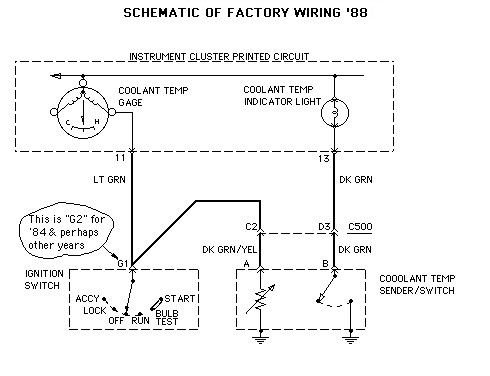
Ok, and what are your symptoms, is it that the gauge isn't working? Or that the ECM doesn't see the right signal and triggers a check engine light for the temp sensor, if it's ECM, it's a different sensor, if it's your gauge, your testing the right sensor. It's not a temperature variable resistor on both pins, that's only the one pin for the gauge, the second pin is a simple on/off temperature switch, like for the fan, to turn the light on and off, if the switch is wired to the gauge, you'll have no signal (like the wire is cut) until it overheats and the switch turns on (supposed to turn the light on, in this instance it would then peg the gauge all the way over past hot). My guess is the wires are swapped, one pin on the sensor should be open (not connected to ground), one should have a resistance to ground, ground the wires individually to identify them, the one that turn the light on should be connected to the open pin, the one that pegs the gauge should be connected to the pin with resistance to ground.
After trying both ways on the sensor and 3 different sensors one being known working out of a iron duke fiero
Still nothing.
I jumped the connections at the sensor again just to confirm the wiring is working when grounding each side one pegs the gauge and the other turns the light on.
Does the sensor ground to the engine block??? should i clean the threads???
I took the sensor out cleaned the threads in the block and on the sensor with a copper brush
Put the sensor back together and drove it til the thermostat opened (180 therm)
gauge didnt move so i parked it left the ignition on cut the wires and tried every possible combination even putting both leads to the gauge wire and still didnt move
I jumped the connections at the sensor again just to confirm the wiring is working when grounding each side one pegs the gauge and the other turns the light on.
If the sensor wiring is working when grounded on the engine {one wire pegs the coolant gauge to the right and the other wire turns the hot light on} then your sensor is bad.....
{Or the wire connections on the top of the sensor aren't connecting to the unit}
[This message has been edited by Vintage-Nut (edited 05-27-2025).]
Orileys sold me the wrong sensor 6 times thank you all though!!
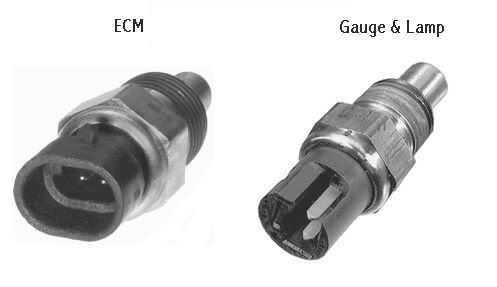
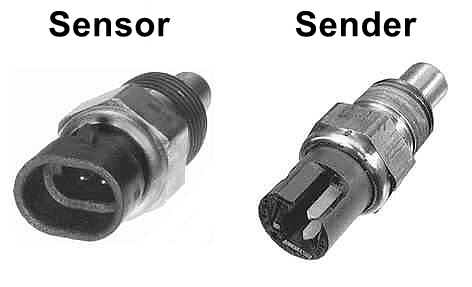
It's not the first time a store has sold people a Temperature Sensor for ECM instead of the Temperature SENDER for gauge and light. As soon as you said you "replaced the connector" I suspected as much.
[This message has been edited by fierosound (edited 06-04-2025).]
As soon as you said you "replaced the connector" I suspected as much.
If I was told by a parts counter guy that I needed to change the "connector" (pigtail) when buying a replacement sensor/sender, I think I'd do a bit of research first before doing so. There has been a lot posted in this forum over the years showing the differences between the Temperature Gauge Sender and the Coolant Temperature Sensor (for the ECU).
If I was told by a parts counter guy that I needed to change the "connector" (pigtail) when buying a replacement sensor/sender, I think I'd do a bit of research first before doing so. There has been a lot posted in this forum over the years showing the differences between the Temperature Gauge Sender and the Coolant Temperature Sensor (for the ECU).
Another thing to remember is that the old connector likes to disintegrate, he might have just bought the sensor and pigtail (either because the old connector was known bad, or just because a new one was cheap, I've done that before), then it's harder to notice that there's a definite difference between the two.