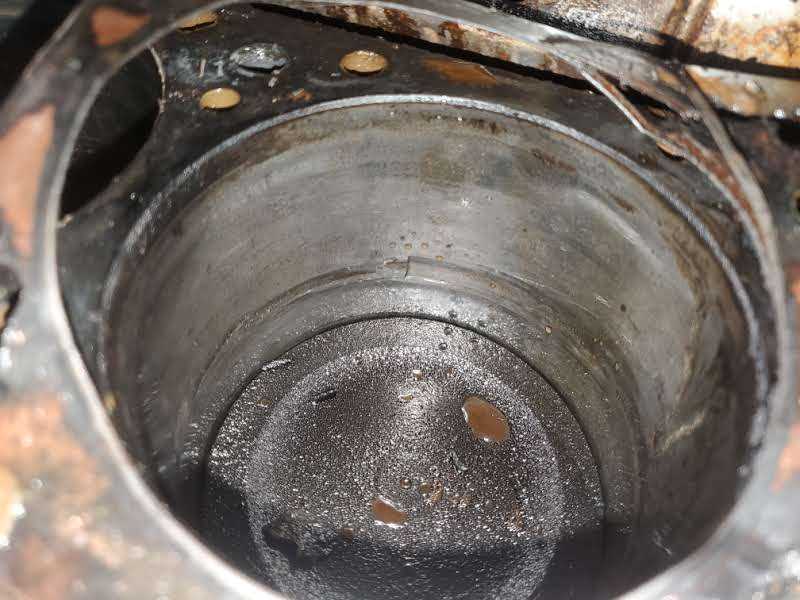
A couple months ago, I decided to rebuild my engine (2.5L). I've had this car since I was a teenager so never really considered that it needed to be rebuilt (I think it really did need it, in hindsight.) I got the head off and found, in one cylinder, there is a really deep gouge. I have never seen anything like this.
Here is a photo of cylinder 3:
Here is a photo of cylinder 2:
I would like some suggestions of what to do. I've almost had enough of this car, and it was never really worth fixing, so I don't want to replace the engine or the block. I want suggestions that I could possibly do with my current situation.
...I don't want to replace the engine or the block. I want suggestions that I could possibly do with my current situation.
IMO, your only option then is too have this block bored out enough to get rid of the "gouge". Every cylinder would need to be done, and oversize pistons would be required. [EDIT] I suppose if the other three cylinders were perfect, this one cylinder could be sleeved, but I honestly don't know how common (or cost effective) that practice would be with a 2.5 duke.
No other way to put it... this looks bad. Was this engine burning oil?
[This message has been edited by Patrick (edited 08-17-2024).]
To be fair, it looks like an engine sat for a number of years and that's where the rings sat. Me? I'd pull the piston and hone it and then see what the bore looks like.
It's a 2.5, it's not a high performance engine, it does not have to be factory perfect.
[This message has been edited by jelly2m8 (edited 08-17-2024).]
To be fair, it looks like an engine sat for a number of years and that's where the rings sat.
...along with water sitting on the piston in the cylinder, judging from the pitting in the cylinder wall. It's difficult to tell in the image how deep that "gouge" is. IMO, cleaning it up completely would require boring it out to at least 0.010" over... but it's pretty difficult for any of us to tell from an online image.
IMO, your only option then is too have this block bored out enough to get rid of the "gouge". Every cylinder would need to be done, and oversize pistons would be required. [EDIT] I suppose if the other three cylinders were perfect, this one cylinder could be sleeved, but I honestly don't know how common (or cost effective) that practice would be with a 2.5 duke.
No other way to put it... this looks bad. Was this engine burning oil?
I was thinking the same.
the other three cylinders are in shockingly good condition, I haven't measured them yet, but I will.
i can't find any info on sleeving a duke online though... definitely is a bad situation.
the engine was burning oil, it was probably about a quart in a month when i was driving it regularly (maybe like 1500 miles in a month). it did also have some leaks. definitely had a good amount of blow-by as well. the air filter was coated in a bit of oil most of the time from the breather.
To be fair, it looks like an engine sat for a number of years and that's where the rings sat. Me? I'd pull the piston and hone it and then see what the bore looks like.
It's a 2.5, it's not a high performance engine, it does not have to be factory perfect.
I was also thinking this. the engine ran well enough for me to put 15,000 miles on it before it constantly had a misfire.
When I bought it, it had been sitting since 2006, I bought it in 2021. The guy who I bought it from had gotten it running, I assume without checking anything beforehand. I'm not even sure he changed the oil before he sold it to me.
i really just want to be able to drive it a little longer before I sell it for parts (it's too rusty to be worth restoring or anything like that.)
...along with water sitting on the piston in the cylinder, judging from the pitting in the cylinder wall. It's difficult to tell in the image how deep that "gouge" is. IMO, cleaning it up completely would require boring it out to at least 0.010" over... but it's pretty difficult for any of us to tell from an online image.
the water in the photo is likely just coolant from when I took the head off. it wasn't a super clean process. it ran on all four cylinders at one point in my ownership.
I'm not really sure how else to describe the defect, it's much deeper than anything I've seen. it's not the kind of thing you could miss running your fingertip along the wall.
When you rebuild a motor, you generally want to have the cyl walls bored to an extent, along with new pistons anyway, so it's not really a huge problem anyway.
I think in this case, you're probably looking at the maximum cyl bore of probably a .060 overbore. You can buy Duke .060 pistons on Rock Auto pretty inexpensively.
Worst case, you have to sleeve it. Machine shop costs would normally run you about $500 for a hone / bore. If you have to resleeve it, that's probably another $300. This is just what machine work costs. You would want to do the rest. You can definitely do this.
When you rebuild a motor, you generally want to have the cyl walls bored to an extent, along with new pistons anyway, so it's not really a huge problem anyway.
I think in this case, you're probably looking at the maximum cyl bore of probably a .060 overbore. You can buy Duke .060 pistons on Rock Auto pretty inexpensively.
Worst case, you have to sleeve it. Machine shop costs would normally run you about $500 for a hone / bore. If you have to resleeve it, that's probably another $300. This is just what machine work costs. You would want to do the rest. You can definitely do this.
I was going to hone the cylinders and make sure they're not out of round. I won't be taking it to a machine shop, since I don't have an engine hoist anymore. I just wanted a cheap band-aid to drive the car a little longer. I don't want to spend a lot of money on fixing it, I've already spent way too much. I might just hone it more than I otherwise would to minimize the damage, and run it like that.
I was going to hone the cylinders and make sure they're not out of round. I won't be taking it to a machine shop, since I don't have an engine hoist anymore. I just wanted a cheap band-aid to drive the car a little longer. I don't want to spend a lot of money on fixing it, I've already spent way too much. I might just hone it more than I otherwise would to minimize the damage, and run it like that.
To be honest, I'm kind of surprised that it even runs like that. What do you plan to do when the engine eventually fails?
Originally posted by 82-T/A [At Work]: To be honest, I'm kind of surprised that it even runs like that. What do you plan to do when the engine eventually fails?
part out or scrap. the frame is rotted, the paint isn't good, the interior isn't good, everything is worn out. this is AFTER all the work I already did. it had a pretty bad misfire towards the end of when I was driving it. it would die at stop lights and had no power. last time I drove it was when I moved house.
this fiero was a bad monetary investment, but a good experience. learned a lot.
the water in the photo is likely just coolant from when I took the head off.
I wasn't referring to the water in the photo. The pitting I mentioned earlier was from rust on the cylinder wall due to water which had been sitting on top of the piston/rings for an extended period of time.
quote
Originally posted by katie80:
the engine was burning oil, it was probably about a quart in a month when i was driving it regularly (maybe like 1500 miles in a month). it did also have some leaks. definitely had a good amount of blow-by as well. the air filter was coated in a bit of oil most of the time from the breather.
quote
Originally posted by katie80:
I might just hone it more than I otherwise would to minimize the damage, and run it like that.
I'm not surprised the engine was going through a lot of oil. Unless the pitting and gouge is completely removed, the engine is liable to be going through the same amount of oil after reassembly.
I'm not surprised the engine was going through a lot of oil. Unless the pitting and gouge is completely removed, the engine is liable to be going through the same amount of oil after reassembly.
sorry, I thought you meant there was still water there that caused the damage. I understood what you meant. I'm not too worried about oil consumption, as long as it is less. maybe it would be good to install an oil catch can so my air filter doesn't get soaked in oil again..
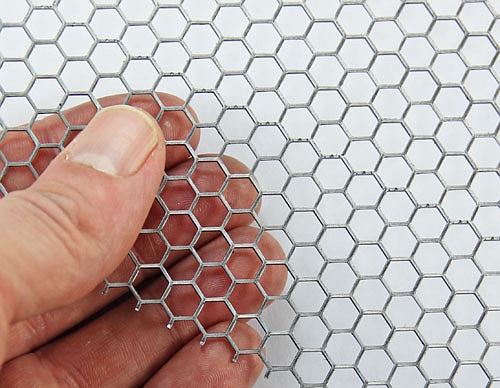
I have a 4-banger Fiero that had a heck of a problem with oil/blow-by entering the air filter canister. Oil would actually pool at the bottom of the canister. It was quite a nuisance. I had the valve cover off while doing something to the engine, and I noticed that the valve cover was baffled where the PCV breather tube plugged into it. However, this hollow chamber was obviously failing in regards to separating oil vapor from the rest of the crankcase gases. So I used a strip of metal hexmesh and folded it back and forth about half a dozen times, and positioned it securely inside this baffled area. The crankcase gases now all had to go through this multi-layered mesh before traveling up the tube and entering the air filter canister. Honestly, the results were simply unbelievable! I now find no oil in the air filter canister when previously it was pooling and needed to be drained.
The hexmesh I used was similar to what is shown in this following online image. The holes are about 1/4" in diameter.
I have a 4-banger Fiero that had a heck of a problem with oil/blow-by entering the air filter canister. Oil would actually pool at the bottom of the canister. It was quite a nuisance. I had the valve cover off while doing something to the engine, and I noticed that the valve cover was baffled where the PCV breather tube plugged into it. However, this hollow chamber was obviously failing in regards to separating oil vapor from the rest of the crankcase gases. So I used a strip of metal hexmesh and folded it back and forth about half a dozen times, and positioned it securely inside this baffled area. The crankcase gases now all had to go through this multi-layered mesh before traveling up the tube and entering the air filter canister. Honestly, the results were simply unbelievable! I now find no oil in the air filter canister when previously it was pooling and needed to be drained.
The hexmesh I used was similar to what is shown in this following online image. The holes are about 1/4" in diameter.














 It was quite a nuisance. I had the valve cover off while doing something to the engine, and I noticed that the valve cover was baffled where the PCV breather tube plugged into it. However, this hollow chamber was obviously failing in regards to separating oil vapor from the rest of the crankcase gases. So I used a strip of metal hexmesh and folded it back and forth about half a dozen times, and positioned it securely inside this baffled area. The crankcase gases now all had to go through this multi-layered mesh before traveling up the tube and entering the air filter canister. Honestly, the results were simply unbelievable! I now find no oil in the air filter canister when previously it was pooling and needed to be drained.