| | | quote | Originally posted by Raydar:
This is something that has confused me for a while. I'm sure someone here knows how this works. If so, I would appreciate it if you could educate me.
We have all of these District-level judges tossing out rulings or injunctions for just about anything that the Democrats don't like, up to and including the actions of the President.
How in the hell...?! Where is their jurisdiction? How can a judge in Bumblefuk New Mexico make a ruling regarding something that is happening in DC? Or Oklahoma? Or aboard an aircraft enroute to El Salvador? Or anywhere else?
Sounds like an over-reach to me.
All it's doing is wasting time and costing the taxpayers money. They just about all get reversed at the Supreme Court level, anyway.
Each judge needs to be subject to a "three strikes" rule. If a higher court reverses three of your rulings, you get to sit on the sidelines for a year - or better yet, forever.
Or maybe be charged with some sort of "judicial malfeasance". |
|
You probably already know this, but I figured I'll say it anyway just in case... but there are both state and Federal judges. Again, pretty sure you already know this, but just stating it for the sake of clarity.
The states have their own court system, and like the Federal system, they have local city, county, and state judges (State Supreme Court). Ultimately, the state generally has no say at all on what the Federal government does, though they can attempt to rule on such issues... but Vertical Federalism prevents them from having any impact. Furthermore, if a state rules on something that violates the Constitution, the Federal court system can overturn the ruling of the state.
At the Federal level, we have 11 districts: (Edit, sorry, I put 9... was recovering from a really bad migraine)
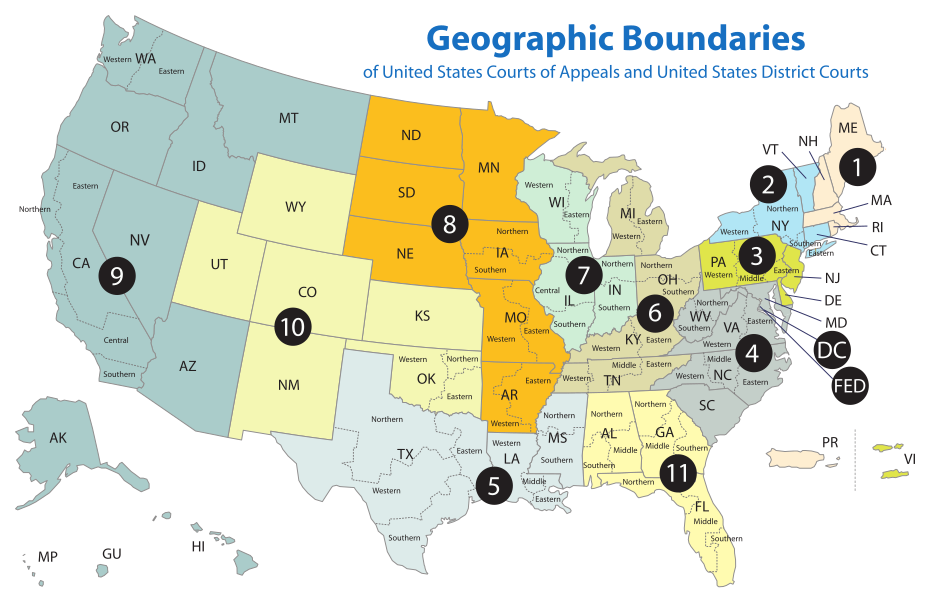
These districts apply to multiple states and are broken out to allow a better distribution of Federal justice throughout the country. There's some debate on whether these should exist at all, but in fact the lower Federal courts were actually created by Congress (not in the Constitution). They're there for a couple of reasons... to reduce the influx of cases to the Supreme Court, and also as a means for supporting Federal charges brought forth by the Department of Justice. Originally, the Federal government didn't really have their own system of laws beyond the Constitution. Some people always ask... why can't murder be charged Federally... and that's because it's a state crime, not a Federal crime. Murder only enters the Federal domain (for example) when it involves a Federal employee or a politician. Lots of laws exist like that.
In any case... the structure exists to better facilitate the Supreme Court... it was never envisioned as something that Democrats could simply try to stall every presidential action. The only thing I'll say though is that the "Executive Order" also doesn't exist in the Constitution, but merely referenced the clause that "
laws be faithfully executed." Known as the Take Care Clause, Article 2, Section 3 of the Constitution:
https://www.law.cornell.edu...care-clause-overviewPersonally, there's a fine line that's been crossed. Most of these injunctions that are filed, it's already known how the Supreme Court will rule on them... so it's intentionally done just to hinder the administration from getting something done. There should be some penalty either to knowingly submitting something to the court, or for the district judge to rule on something he/she knows will likely be overturned. This stuff is extremely obvious... and even years ago, you still had "Westlaw" (the digital form of West American Digest) that allowed a judge and his staff to quickly look things up. There are even AI tools now to properly reference Westlaw (laws and regulations) to identify appropriate laws in conflict. In the vast majority of these cases... the district judges already know how SCOTUS will rule, but they do so regardless based on pure ideology.
The left views the court system as a means of activism... as part of a "change agent." This is absolutely not what the court system is for. The court system is literally meant to validate whether or not a law is constitutional... period. It's for this reason why Obamacare / ACA was ruled "constitutional" much to our frustrations. This is how the court system should operate... not on ideology, but on facts based from written law and text. Emotion should have no bearing on a supreme court decision.
[This message has been edited by 82-T/A [At Work] (edited 01-04-2026).]