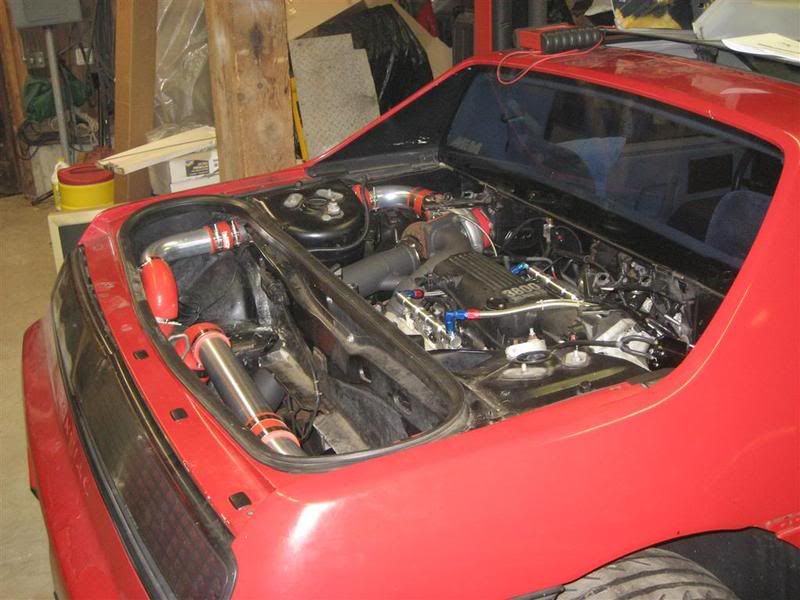
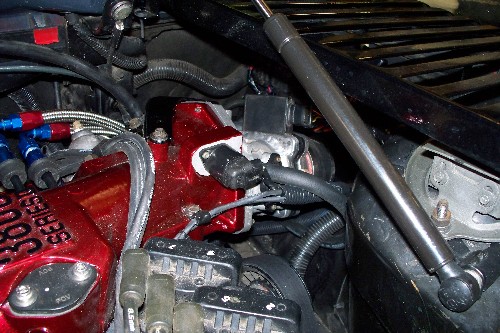
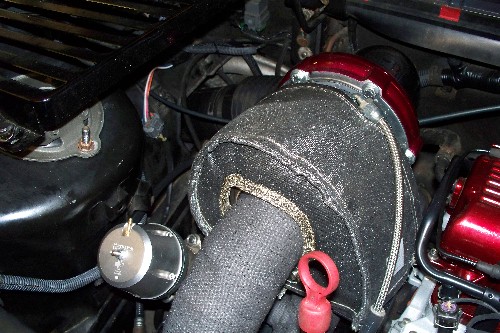
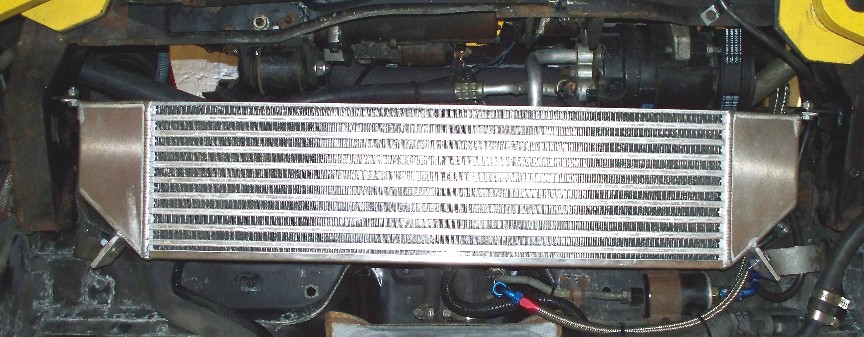
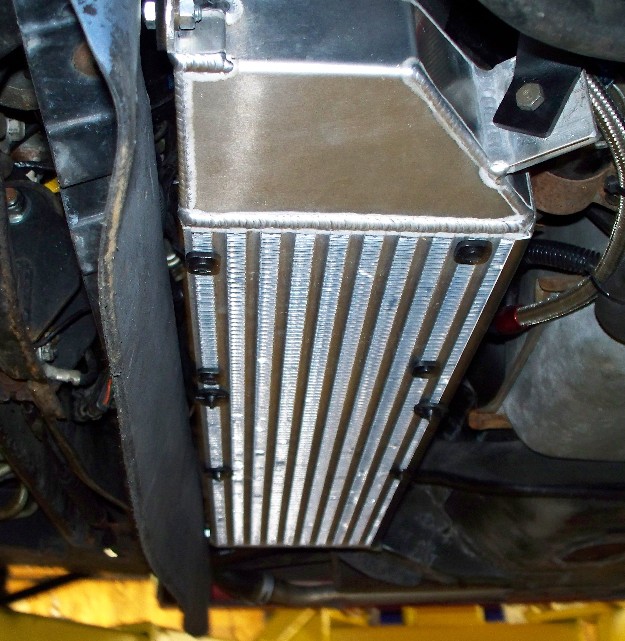
Here are some pics of a 3800 SC -> Turbo conversion I completed earlier this year:
We started with a 3800 Series 2 SC engine (and 4T65-E HD trans) that I had previously swapped into AkursedX's Fiero. We removed the L67 (SC) blower, lower intake, and heads; and installed a set of ported L26 (3800 Series 3 n/a) heads, 95-98 Camaro/Firebird 3800 upper and lower intake, and custom made the exhaust to feed the T-61 turbo. We also found an AIR-TO-AIR intercooler that fit nicely from ETS (their 1G-Street Intercooler) right in front of the engine cradle. We mounted 2 electric puller fans on it and installed an airdam to force air up thru it from under the car. We kept the stock cam in the engine and re-used the 1.84 ratio aftermarket roller rocker arms. Last time I heard this car was running 11.8 sec in the 1/4 mile and trapping as high as 119mph; and this was with some launch issues (not being able to boost on the starting line due to a brake issue which was producing some mediocre 60' times).
------------------ 6+ years on this same swap -- NO engine or transmission failures... Custom GM OBD1 & OBD2 Tuning | Engine Conversions & more | www.gmtuners.com
IP: Logged
01:47 PM
Isolde Member
Posts: 2504 From: North Logan, Utah, USA Registered: May 2008
hey jncomutt, what about that pace car replica with the centrifugally supercharged SBC and a Getrag with a bracing cage custom built around the diff area? That car had a chassis dyno sheet that was something like 600 rwhp.
IP: Logged
01:55 PM
Darth Fiero Member
Posts: 5922 From: Waterloo, Indiana Registered: Oct 2002
Couple of comments/observations I would like to add to this topic...
If you are going to turbocharge a 3800 SC engine; ditch the blower housing and lower intake. Yes, I know block-off plates are sold for the blower housing so you can use it in a turbo conversion. But the problem with this setup is you will be left with a huge open plenum and a lower intake that has virtually no runners. The Camaro/Firebird L36 intake is a two-piece design modeled after a tunnel-ram style intake. There are intake runners, but they are not as long as stock L26/L36 (n/a FWD) intake runners. Having intake runners on a turbo setup improves off-boost performance and engine response. This also translates to less turbo lag vs. the same engine using an intake setup with virtually no runner length. The Camaro/Firebird 3800 intake also consists of an all-aluminum construction.
If you are doing your own porting, concentrate your work on the exhaust. You can clean up the intake ports in the heads, but it is more critical to make sure the exhaust can flow out of the engine and to the turbo; so I wouldn't waste much time on the intake or throttle body. Remember, you will be forcing air thru these components so they will become less critical vs. the exhaust side of the engine.
Properly size the turbo for the expected job it needs to do. There's no reason to slap a 67 or 70-series turbo onto your engine if you only plan on running 10psi of boost. Find a turbo that will operate at or near peak efficiency for the boost you plan on running (this is where tech support offered by the turbo vendor can really come in handy). Also, make sure the weight of your turbo is supported by brackets (attached to the engine or trans) and not by the exhaust system. Turbos are not light; and hot exhaust tubing will not support the weight of a turbo on its own without eventually suffering damage.
Don't go overboard on the cam. You can see (above) what a stock cam with just higher ratio rockers can do in a turbo app. Aftermarket cam profiles have the nasty habit of degrading the quality how the engine runs, off boost. Unless you are running 10's or faster, you can probably accomplish your performance goals using a stock cam by selecting a properly sized turbo and having a nice porting job done to your heads as well as just adding some higher-ratio rocker arms.
Intercooler... There has always been a debate as to which is better, air to air, or water to air. The trouble is in a Fiero, we don't really have a great deal of room for either type of system. I like the air-to-air setup because it is simple, and it simply works. There is more than enough air coming under the car at speed you can tap into for cooling the air-to-air IC. You can mount the IC where I mount them; just make sure you use some kind of an air deflector or dam to direct the air up into the IC core. Electric puller fans certainly don't hurt either. Keep in mind that even if you are using a water-to-air IC system, if you mount the heat exchanger up in front of the radiator, you are still relying on an airdam to kick most of the air up into that exchanger to cool it off. Fiero's don't have big open grills in the front like other cars do. Fiero front ends only have small "port holes" to allow air to come directly at the radiator core area. But the bulk of the cooling air comes in from redirection produced by the airdam when the car is traveling at speed.
hey jncomutt, what about that pace car replica with the centrifugally supercharged SBC and a Getrag with a bracing cage custom built around the diff area? That car had a chassis dyno sheet that was something like 600 rwhp.
That thing has a 5 speed manual trans? Bring it on...
[This message has been edited by Jncomutt (edited 06-11-2009).]
IP: Logged
04:47 PM
darkhorizon Member
Posts: 12279 From: Flint Michigan Registered: Jan 2006
Although I am running a L67 lower and blower casing... It is MUCH MUCH MUCH better to run a N/A upper and lower intake with a HV3 insert... Huge gains in spool and power have been made... in some cases nearly 20 horsepower and 200rpm spool time has been shown....
i like that you use the stock headers but i dont like the placement of taking out the trunk. this has given me some good ideas thanks. now for the second question how much can a stock boosted motor hold , in my other forum post i stated i was trying to achieve 350 to 400 hp, i found a turbo cam and some good rockers but with money being strict right now how far can i stretch this motor without breaking it , with not much internal work done?
so the actual stock part will hold up to alot of preassure, but if you recommend upgrading a part or too what would be a strong point? cam? lifters? springs? injectors obviously
I opened the front up a bit. Made a tunnel to the intercooler. This is a temporary setup while I decided if I liked the results or not. I will be replacing it with one made out of aluminum. I am running dual fans on the back of the intercooler.
If I had it to do over what would I change? I would run a setup like Ryan made above. The A2W setup works really well, but there are a lot of parts to leak, fail, and I hate to think how much additional weight everything added. Ryan's setup is simple, efficient, and does the job.
IP: Logged
08:15 AM
darkhorizon Member
Posts: 12279 From: Flint Michigan Registered: Jan 2006
My air/water system is MAYBE 10-15lbs more than a typical air/air setup. It holds about a gallon of coolant, and i have a 4lb front mount HE. The rear IC core is most likely less weight than a air/air of comparable efficiency.
IP: Logged
02:29 PM
Darth Fiero Member
Posts: 5922 From: Waterloo, Indiana Registered: Oct 2002
The biggest issue you have to worry about concerning the stock internals is the pistons and the piston rings. The stock piston design places the top compression ring really close to the top of the piston (to help with emissions) which exposes it to lots of heat. The factory ring gap is also quite tight for this kind of application (again, to help with emissions). If you try running too much boost or if your tune is off, the likely resulting failure will be a broken top piston ring land and possibly a broken ring which can damage the cylinder bore and trash a block.
Since it is easy to crank up the boost on a turbocharged engine, great care must be taken by closely monitoring the engine's health. You must make sure at all times you are in boost that the engine is getting enough fuel and is not detonating or your engine could suffer an untimely demise. Of course it is also possible to have an engine internal part failure by simply running too much boost, even if you are giving it enough fuel and it is not detonating. My best advice to anyone wanting to do a turbo build on a budget is to keep the boost levels conservative -- if you want it to live. Don't get greedy or it will cost you. The amount of boost you will be able to safely run will depend on a lot of factors: fuel octane, size of turbo, exhaust restrictions, effeciency of the intercooler, weather conditions; etc. One reason why my turbo build has lasted 6+ years with no failures is because I have been careful with it and not gotten crazy with the boost.
-ryan
IP: Logged
02:32 PM
The Mad Scientist Member
Posts: 311 From: bloomington, IN, USA Registered: Feb 2007
keeping in mind that an air to air intercooler, idealy sized, runs at about 80% eff. when up in front of a rad in a front engined car i really dont see how it can get enough air flow through them (something like 10,.000 cfm) when at the back of a fiero. Also the first 12" off a roads surface is scorching hot and in my mind not an ideal place to place the intercooler granted the turbulent air under a car will mix the surface air with cooler air but its still hot.
sizing an intercooler for heat rejection and internal flow is not easy... but with Corky Bells book and A. Graham Bells book and the resources materials available on the internet... its a lot easier these days.
my case for air to water is this:.
1) it transfers heat from the core near the engine to the front for effective heat exchanging.
2) when cruising, the air drawn through the engine also cools the system if the pump is left running or running slower
3) most guys have just fabricated a turbo system ! How hard can a pump, hoses and exchangers be ?
4) as far as efficiency... ever jump into an ambient temperature swimming pool on a 80 degree day ? (talk about shrinkage) and since they way more efficient (14 times more is the general consensus)... they can be smaller... and smaller is good
5) in town driving or sitting still.. the system is still cooling the intake charge so when needed, the benefits are instant.
in the Syclone / Typhoon community something the size of a shoe box is capable of supporting 400 hp from a 4.3 V6 with less than ideal compressors trims
yes there is a place for air to air intercoolers but in a mid engine car I dont believe its in the back. the F40 had them there and it was later determined they were about 60% efficient at speeds over 100mph
------------------
87 Fiero GT 5sp with Vortec L35 4300 Turbocharged V6 Bully Stage 2 clutch Syclone intake manifold and engine management with Moates adapter and chip burner Air/water intercooler and Devil's Own progressive water/alky injection 50lb injectors, 3 bar map sensor, Walboro fuel pump and Jabasco Intercooler pump LM1 wideband on custom manifolds and 3" stainless exhaust system T31/T04B H3 turbo and a S10 caliper conversion. Murphy's Constant Matter will be damaged in direct proportion to its value Murphy's Law of Thermodynamics Things get worse under pressure. Arthur C. Clarke "Any significantly advanced technology is indistinguishable from magic"
[This message has been edited by vortecfiero (edited 06-13-2009).]
IP: Logged
10:19 AM
Jun 14th, 2009
Darth Fiero Member
Posts: 5922 From: Waterloo, Indiana Registered: Oct 2002
keeping in mind that an air to air intercooler, idealy sized, runs at about 80% eff. when up in front of a rad in a front engined car i really dont see how it can get enough air flow through them (something like 10,.000 cfm) when at the back of a fiero. Also the first 12" off a roads surface is scorching hot and in my mind not an ideal place to place the intercooler granted the turbulent air under a car will mix the surface air with cooler air but its still hot.
I understand where you are coming from. But, the Fiero has no sizable grill in comparison to other cars. So even if you were running a front mount Air-to-Air, it will still be getting its cooling flow from close to the road (most coming from UNDER the front nose). Same goes for the heat exchanger on a Water-to-Air IC system. The only way to improve direct airflow to the core of the IC or exhanger is to do to your Fiero's front end like tampalinc did and open it up.
quote
sizing an intercooler for heat rejection and internal flow is not easy... but with Corky Bells book and A. Graham Bells book and the resources materials available on the internet... its a lot easier these days.
my case for air to water is this:.
1) it transfers heat from the core near the engine to the front for effective heat exchanging.
2) when cruising, the air drawn through the engine also cools the system if the pump is left running or running slower
3) most guys have just fabricated a turbo system ! How hard can a pump, hoses and exchangers be ?
4) as far as efficiency... ever jump into an ambient temperature swimming pool on a 80 degree day ? (talk about shrinkage) and since they way more efficient (14 times more is the general consensus)... they can be smaller... and smaller is good
5) in town driving or sitting still.. the system is still cooling the intake charge so when needed, the benefits are instant.
Your statements are based on the assumption your cooling medium will always remain at ambient temp. I have news for you, it won't. Water does not transfer heat at 100% effeciency either. And it will heat soak, depending on what you are doing (racing, hard driving, etc). Once it heats up, it will take a long time to cool back off (to ambient temp). And what is going to cool it off? The same air coming from under the car (at the front) from that scorching road you were talking about?
The simple fact of the matter is the Fiero's body design does not give us an optimal place for any intercooler; air/air or water/air. Unless you have modified the front end of your Fiero, you are still going to be relying on air from under the car (or very close to the road) to cool off the IC/exchanger. The location I mounted my Air/Air IC's at taps into the massive qunatities of air that flows under the car. By putting an air dam under the car just behind the IC core, it serves two functions. 1) It creates a high pressure area ahead of the IC core. This helps to kick air up into the IC. 2) At the same time, it creates a low pressure area behind the air dam, this can help evacuate air that has cooled off the IC core.
The air dam that comes stock on the Fiero under the radiator core does the same thing.
I'm not knocking Water/Air IC's here. I'm just pointing out that we have a limited amount of space to work with in these cars. And IMHO, the rear-mounted Air/Air IC setup makes use of already "available" space without having to modify other parts of the car to make room for more plumbing or a heat exchanger. The rear mounted Air/Air IC isn't perfect by a longshot, but it is proven to work and is simple. And for those wishing to push the capabilities of their Air/Air IC systems, there's always the option of spraying Nitrous or other liquified refrigerant gases onto the cooling core of the IC during a power run to boost IC cooling.
IP: Logged
03:23 AM
PFF
System Bot
darkhorizon Member
Posts: 12279 From: Flint Michigan Registered: Jan 2006
My water to air core stays relatively ICE cold to the touch, and IAT's are never a degree or 2 over ambient. I have a decent temperature rise in boost, about 15C, but I have a tew things I want to change around to try to lower that a bit.
IP: Logged
11:21 AM
The Mad Scientist Member
Posts: 311 From: bloomington, IN, USA Registered: Feb 2007
i was looking around and will this package work on my 3800 series 1
SLP Aluminum Roller Rocker Arms/Pushrod Package Price: $499.99 Quantity in Cart: none View Shopping Cart Continue Shopping Checkout Now APPLICATIONS: - 1997-2008 Grand Prix GTP - 1997-2008 Grand Prix GT - 1997-2004 Regal GS - 1996-2003 Bonneville SSEi - 1996-2004 Bonneville with 3800 Engine - 2000-2005 Monte Carlo SS - 2000-2005 Impala
SLP Performance Parts was among the first companies to develop power-enhancing hardware for 3800 powered vehicles. Now SLP is taking the 3800 bolt-ons to the next level, with the introduction of their exclusive 1.80:1 ratio Aluminum Roller Rocker Arms and Pushrods Package.
SLP's product description: As the workhorse of GM's passenger-car powertrain lineup, the 3800 is equipped with a mild camshaft suitable for use in a variety of vehicle applications. Simply increasing the rocker-arm ratio from 1.6 to 1.8 yields valve lift figures of .464/.459” (stock is .413/.408”), with no adverse effect on drivability.
These rocker arms are manufactured from high-strength T6 aluminum and feature a roller trunnion and tip that significantly reduce valvetrain friction over the stock steel units. Best of all, no valve cover modifications or spacers are required for installation. You can expect 15-20HP increase on a supercharged 3800, and around 8-12 on a normally aspirated 3800 engine.
i was looking around and will this package work on my 3800 series 1
In short, the answer is NO. Series 1 3800 engines require different style/design of rocker arms vs. what the Series 2 uses. There used to be a company called Series1 3800 Performance or something like that who did sell aftermarket upgrades for the Series 1 engines. But I think they went out of business a year or so ago. Who knows, you may be able to find some of those parts floating around for sale out there somewhere.
-ryan
IP: Logged
02:46 PM
Fog Member
Posts: 288 From: Tallinn, Estonia, Europe Registered: Oct 2003
Originally posted by Darth Fiero:Your statements are based on the assumption your cooling medium will always remain at ambient temp. I have news for you, it won't. Water does not transfer heat at 100% effeciency either. And it will heat soak, depending on what you are doing (racing, hard driving, etc). Once it heats up, it will take a long time to cool back off (to ambient temp). And what is going to cool it off? The same air coming from under the car (at the front) from that scorching road you were talking about?
I second to Darth here.
I have same WIC core that DH usses, and on dyno pulls: First pull(5 seconds): 29.75C -> 44.5C 50 seconds rundown: 44.5C -> 31.25C Second pull(11 seconds): 31.25C -> 58.25C 63 seconds rundown: 58.25C -> 36.5C Third pull(11 seconds): 36.5C -> 65C Rundown 80 seconds: 65C -> 41.75C Fourth pull(9 seconds): 41.75C -> 66.5C Rundown 30 seconds: 66.5C -> 47.75C turned off ignition.
Quarter mile run on test day 6 weeks ago(13 seconds): 19.25C -> 53C
IP: Logged
04:17 PM
darkhorizon Member
Posts: 12279 From: Flint Michigan Registered: Jan 2006
Yella Terra 1.80:1 Series 1 3800 Roller Rocker Arms
Yella Terra 1.80:1 Series 1 3800 Roller Rocker Arms Quantity in Basket: None Part Number: 3800-YTRR-6659 Price: $369.99 Shipping Weight: 7.00 pounds
Quantity:
Shipping Rate: Calculated at checkout
APPLICATIONS:
* 1993-1995 Bonneville with 3800 Series I engine 5/16" stud size
These roller rockers are the lightest on the market with each rocker arm weighing only 6 ounces. They will produce more power with less valve float and include pushrods which are 10% lighter than stock.
Why choose Yella Terra Full Roller Rockers?
-- Great Strength The rocker arms used on Yella Terra and Street Terra roller rockers are infinitely stronger than standard pressed steel arms providing the best in resistance to bending and breakage under high spring pressures at high RPM's. Pressed steel rocker arms, in high performance applications, are prone to failure, A high rate of fulcrum wear, flexing, cracking, splitting and breakage are common problems that will result in power loss or possible piston failure due to detonation of the incoming air/fuel charge. Other Yella Terra rocker components such as the trunnions, posi locks and bearings greatly enhance valve train durability in performance applications.
-- Reduced Valve Guide & Seat Wear The traditional metal tip on standard rockers literally drags across the valve tip as the rocker opens and closes causing high side loading on the valve. This inside force leads to irregular and rapid valve, valve guide and valve seat wear in many engines. The roller tip on Yella Terra roller rockers eliminates this side loading action, as a result engines rev quicker and freer with a crisper exhaust note and maintain efficiency longer.
-- More Power Through Less Friction The use of needle roller bearings at the rocker fulrcum combined with roller tip at the valve greatly reduces horsepower robbing friction in the valve train to provide a measurable power increase over standard rocker systems.
-- Reduced Heat The reduction in friction with roller rockers has additional benefits of reducing the operating temperature and foaming effect of engine oil to provide a cooler running engine.
- No special tools are required for installation with the exception of a 1/4" male hex driver and a torque wrench. Simply torque the rocker arm bolts to 25 foot-pounds and the valve cover bolts to 89 inch-pounds.
- We recommend your Yella Terra Full Roller Rocker Arms be installed by a competent professional. These parts can typically be installed with normal hand tools in 2.0 to 6.0 hours, but much care is required and there is opportunity for things to go wrong.
- When you make the best product you can offer a warranty to match and Yella Terra brand rockers are guaranteed to the original purchaser subject to correct fitment and production of the original invoice against breakage of the arm, shaft or trunnion and posilock FOR LIFE.