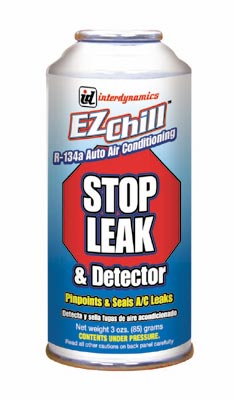
Quite simply, I wouldnt use Any miricle product on anything I own. If you have a leaky compressor, that's a great way to lock it up alltogether. Sure it might plug a hole somewhere, and half the rest of the system in the process. What exactly is your problem? There's likely a much better solution.
IP: Logged
11:51 AM
30+mpg Member
Posts: 4062 From: Russellville, AR Registered: Feb 2002
Absolutely, give it a try! You may want to runsome solvent through the pump if it turns out that it is the pump leaking. If you've tried the other conventional methods (which I see you did), then give it a try!
IP: Logged
12:52 PM
30+mpg Member
Posts: 4062 From: Russellville, AR Registered: Feb 2002
John Boelte:Absolutely, give it a try! You may want to runsome solvent through the pump if it turns out that it is the pump leaking. If you've tried the other conventional methods (which I see you did), then give it a try!
And advice this would be from one who
has had experience with leaks
or
has had no experience with leaks.
IP: Logged
03:06 PM
30+mpg Member
Posts: 4062 From: Russellville, AR Registered: Feb 2002
Instead of charging more $$ into the system only to have it disappear, I'll swap the compressor w/ the spare good one I have and pull a vacuum. That way if it doesn't hold, I'll know it's not the compressor.
IP: Logged
03:32 PM
John Boelte Member
Posts: 1012 From: Indianapolis, IN, USA Registered: Jun 2002
If you've got more time than money, try replacing the compressor. Provided your connections are leak free, that would give you a pretty sound indicator of where your leak is. Of course if the leak is still there, you're back where you started.
BTW, if you want to know if someone is qualified to give advice on your question, maybe you should ask for credentials first.
IP: Logged
07:41 PM
30+mpg Member
Posts: 4062 From: Russellville, AR Registered: Feb 2002
Would leak detector (dye) really void your warranty? If you're concerned about it, clean the dye out of your defective pump. What do you think an ASE mechanic would use? You've tried everything else right?
IP: Logged
07:56 PM
tjm4fun Member
Posts: 3781 From: Long Island, NY USA Registered: Feb 2006
ok, you can't use soapy water with a vacuum to find a leak. to find a leak, you charge the system with nitrogen gas to about 90lbs on your manifold guage set. then you go to the local dollar store and buy a big bottle of kids bubble solution. go over every connection/leak point. if it doesn;t show up there, it could be the compressor seal, if you can get at it, you can slop that with solution, or if you can, dunk the whole front end in a small bucket of water. if it's not there, then the real fun starts. you have to check all the hardlines, then the condensor and evap for leaks. A common leak point is the crimp hose ends, they get a crack and loosen, and it;s usually hard to see. many times putting a regular clamp around it and snugging it up will fix the leak. Also check your pressure switches and the schrader valves. also on the fiero, the block behind the driver's seat wher the rubber goes to the hardlines. nitrogen gas is std for testing systems and flushing common air out of hvac and car systems. afte you;re done, suck it all out with your vacumm pump, and load up the freon. the little you'll leave is far less harmful than normal air.
ooops, forgot your question, see if you can find a std charge can with the dye with no stop leak in it. they should still sell it that way. the dye is actually dyed refirgerent oil, and should be harmless ot the system. There was only one stop leak in a can that actually worked, and you can;t buy it anymore, so that ends that. (worked great on those dmmed pinholes in the condensors)
[This message has been edited by tjm4fun (edited 05-13-2006).]
IP: Logged
08:40 PM
PFF
System Bot
spark1 Member
Posts: 11159 From: Benton County, OR Registered: Dec 2002
The dye isn't the problem, it's the stop leak. A/C shops hate that stuff cause it plugs up their recovery machines. It can also cause major problems if there is any moisture in the system. See http://www.motor.com/MAGAZINE/Pdf/042003_04.pdf
IP: Logged
08:42 PM
30+mpg Member
Posts: 4062 From: Russellville, AR Registered: Feb 2002
Going to obtain a couple of rubber plugs for 1/2" dia holes in the block that bolts to the compressor. Disconnect the compressor & plug the 2 lines that connect to it & pull a vacuum. That way I don't have to swap compressors.
If I still can't get to 27" of vacuum, then unbolt the manifold to body connection and plug those 2 lines. etc. until 27" is obtained.
IP: Logged
11:39 PM
30+mpg Member
Posts: 4062 From: Russellville, AR Registered: Feb 2002
John Boelte:... What do you think an ASE mechanic would use? You've tried everything else right?
Don't know what an ASE mechanic would use. I'm not one and that's why I posted the original question. It looks as though there's a bunch of stuff I haven't tried yet.
Frankly, it is impossible to tell who is ASE certified from just looking at a user name unless it's something like "ASE somebody".
IP: Logged
11:47 PM
May 14th, 2006
tjm4fun Member
Posts: 3781 From: Long Island, NY USA Registered: Feb 2006
fwiw ,I am certified for a/c work. I tried to keep the advice simple, the worst part is pressurizing with the nitrogen gas, most people don;t have access to it. Never EVER pressurize an a/c system with air. if you do, you have to replace the dryer, and flush the system with freon and purge it at the very least.
Finding leaks on car systems is a biatch for anyone, professional or shadetree. you have to hit the obvious points first, connections, hose ends and hardlines. hardlines develop cracks you often can;t even see.
one other hint, if it has leaked a few charges thru, follow the oil. look for "wet connections" the thin oil in the system shows up at all leaks. compressor seal leaks really show that up.
the worst leaks are in the evaporator (the part in the ducting system) and the condenser, both of which are thin aluminum and develope pin hole leaks and cracks, and ar almost impossible to find in the car.
I'd bet that Dye, UV or any other sort, won't do squat for you. It rarely does because you can't get at but a small number of places that leak on many cars.
If you want to use dye, use dye. You can get it at a bunch of parts stores. Autozone and the rest all have it.
Do NOT use leak sealer of any sort until you know where the leak is and how the product works. Some leak sealers are Moisture/Air activated and if the system is leaking fast then you'll likely plug the whole system. Other sealers swell rubber parts like O rings. Some try to do both.
GM cars have several known leak problem. Some of what are unique to GM.
Compressor seal. Can be extremely hard to find but very common. Sniffer often won't get it and Dye definitely won't as the seal is burried behind the clutch. If the leak is fairly slow the gas can be too diffused for a sniffer at times.
High Side test fitting. The valve used by GM in the high side sucks. It is prone to leaks with R12 and even worse with R134. If using R134 you need to use a high side adaptor with its own valve. (Remove the OE valve when you install the new R134 primary seal fitting.) The weak assed adaptors that come with conversion kits won't do crap.
Vacuum leak doesn't always mean anything. The system is not made to retain vacuum. However it obviously doesn't hold pressure either. Since the vacuum pump is connected and you have test hoses on the valves...
V5 systems don't use a clutch cycle switch... make sure the spare port on the ACC/Dryer is covered with a hard cap. Use AC/Gas rated thread sealer on that cap. High vacuum can actualy open the valve there. Assuming the valve is actually good it can open under vacuum. It's not made to seal even a small vacuum.
------------------ Dr. Ian Malcolm: Yeah, but your scientists were so preoccupied with whether or not they could, they didn't stop to think if they should. (Jurasic Park)
theogre:You went over it with a sniffer? Exactly how and where?...
High Side test fitting. The valve used by GM in the high side sucks. It is prone to leaks with R12 and even worse with R134. If using R134 you need to use a high side adaptor with its own valve. (Remove the OE valve when you install the new R134 primary seal fitting.) The weak assed adaptors that come with conversion kits won't do crap.
... make sure the spare port on the ACC/Dryer is covered with a hard cap. Use AC/Gas rated thread sealer on that cap. High vacuum can actualy open the valve there. Assuming the valve is actually good it can open under vacuum. It's not made to seal even a small vacuum.
Slowly, everywhere but the evaporator and inside the insulation jacket on the manifold hoses.
Made a block off plate that has a hose fitting for the compressor. Pressurized the compressor and dunked it in a bucket of water, no leaks.
Using a brass adapter for the high side to connect the gauge line.
Good tip about the dryer valve, thanks.
[This message has been edited by 30+mpg (edited 05-15-2006).]
IP: Logged
09:52 PM
May 23rd, 2006
30+mpg Member
Posts: 4062 From: Russellville, AR Registered: Feb 2002
fwiw ,I am certified for a/c work. I tried to keep the advice simple, the worst part is pressurizing with the nitrogen gas, most people don;t have access to it. Never EVER pressurize an a/c system with air. if you do, you have to replace the dryer, and flush the system with freon and purge it at the very least.
Finding leaks on car systems is a biatch for anyone, professional or shadetree. you have to hit the obvious points first, connections, hose ends and hardlines. hardlines develop cracks you often can;t even see.
one other hint, if it has leaked a few charges thru, follow the oil. look for "wet connections" the thin oil in the system shows up at all leaks. compressor seal leaks really show that up.
the worst leaks are in the evaporator (the part in the ducting system) and the condenser, both of which are thin aluminum and develope pin hole leaks and cracks, and ar almost impossible to find in the car.
Replaced the compressor (still under warranty) and now I can get the system to 27-1/2" vacuum. That's the max the pump will pull. After 3 hours the reading drops to 21-1/2". Is that a slow enough leak to go ahead and dump a charge in?
IP: Logged
02:10 PM
tjm4fun Member
Posts: 3781 From: Long Island, NY USA Registered: Feb 2006
I take it that was a fairly constant drop to that? I know you had the whole system open. in that state, there will be moisture introduced into the system. the purpose of putting a vacumm on the system is to suck out the moisture. the lower pressure vaporizes the water and pulls it out of the system, that will cause pressure drop. it isn;t used for finding leaks, the system is designed for pressure, not vacuum. the compressor shaft seal is one point that is now being reverse loaded. if you haven't replaced the dryer in the system, it likely has a bit of moisture in it. I would first crank the vacumm back up and since you can't flush the system with some nitrogen, put a quick shot of 134 in the system. just enough to get back to 0 pressure. then put the vacumm back on. after that, if it can hold a vacuum for 10 minutes, you should be good. I was very hesitant about using the 134 for a flush, but it is far less harmful than r12 or r22, and you need to get the air/moisture out of the system. (commercial guys used to flush building systems with multiple 20 lb cans of r22 with no recovery, so I wouldn;t worry about the less than 1 oz you'll use.) one important thing that hasn't been mentioned, your compressor has an oil charge. if you bled the system down slowly, it should have most of it;s charge. if you had the comp out, and dumped it, be sure you add the proper amount of the correct oil for your system. since it is now a 134 system (I am guessing that it is) you need a compatible oil. if you don;t know how much you lost,well, you;re guess is as good as mine as to what to add. ( I seem to have misplaced my chilton, so I don;t have the amount handy) too much oil is also a bad thing, so be careful there.
I had a similiar problem with a 93 Grand Am with a V5 Compressor. It would hold vacuum well, but a few days after it was charged, it would all leak out. Turned out to be the high side rubber interconnecting hose had a few pinhole leaks which only showed up when under pressure.
------------------ Tim Red 88 Formula Auto 2.8 100K+ Miles
The problem with political jokes is...they get elected!