
 
     |
| The Lewis Turning Point economics (Page 4/5) |

|
82-T/A [At Work]
|
FEB 11, 09:57 AM
|
|
| quote | Originally posted by maryjane:
I don't think they will either, any more than we did when we (and other developed nations) reached LTP.
It's not just their economy that is different from USSR. Their central govt and central finance system is different, much much different.
So, is the Asian (specifically but not only the Chinese) culture. People believe their #1 asset is their 1 billion population. It isn't. It's their patience. We look a few years down the road. They look decades. We look a decade ahead. They are looking a century. It took the Mongols (Khan dynasties) nearly 2 centuries to unite China. They are used to playing the long game.
They certainly are not hesitant to 'seize the moment' but they are equally at ease waiting for the exact precise decade too.
|
|
I agree... I also think we as a society "used to" think long-term. I can't say when that stopped... but nearly everything we do is reactionary. It doesn't seem like anything we do anymore is long-term... maybe the 80s / 90s?
I keep hearing all these economists say that China will collapse soon, but I almost think they do it so we stop worrying about China.
|
|
|
|
sourmash
|
FEB 11, 10:02 AM
|
|
The propaganda some of you believe in must be a world of wonderment.
No, nobody in the leading edge Western tech world would ever commit industrial espionage or theft. Start with Zuckerberg and work your way down.
|
|
|
|
sourmash
|
FEB 11, 10:27 AM
|
|
| quote | Originally posted by Wichita:
Aging demographics will cause a much more serious issue than the Lewis Turning Point.
China and most of all Asia, especially Japan have much older people than younger people to replace them. They will go in population decline.
Europe is especially bad.
Only a few areas of the world have a decent demography. India being one of them, so look for India to be a big world stage player this century.
North America has it to an extent, because of Mexico. A few South American countries and Africa is in good demography shape.
|
|
The UN says half the planet's population will be Africans in 75 years.
Pretty sure Japan has had negative population growth for several years now.
I don't know that I'd call Africa good in population demographic terms. Speaking in clinical terms, Africa is heading off a cliff and will strain the world with it's population boom. They can't feed what they have now. The West has probably poured trillions into Africa. The medicine and charity we've poured into the continent has resulted in the overpopulation and dependence. Now China is moving in to prospect it.
|
|
|
|
2.5
|
FEB 11, 11:53 AM
|
|
| quote | Originally posted by 82-T/A [At Work]:
I keep hearing all these economists say that China will collapse soon, but I almost think they do it so we stop worrying about China. |
|
Yes.
|
|
|
|
maryjane
|
FEB 11, 12:31 PM
|
|
| quote | Originally posted by Wichita:
Aging demographics will cause a much more serious issue than the Lewis Turning Point.
China and most of all Asia, especially Japan have much older people than younger people to replace them. They will go in population decline.
Europe is especially bad.
Only a few areas of the world have a decent demography. India being one of them, so look for India to be a big world stage player this century.
North America has it to an extent, because of Mexico. A few South American countries and Africa is in good demography shape.
|
|
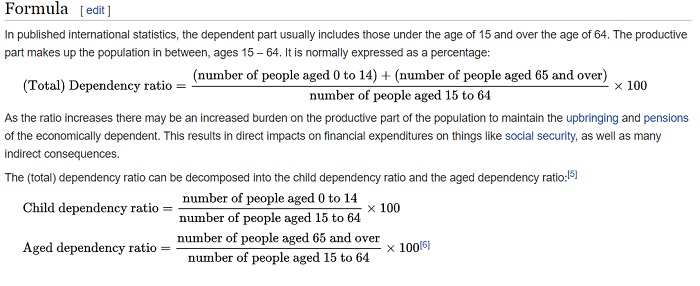
This, if it includes (and should) the very young (that require support but are not old enough to add to productivity) is called the Total Dependency Ratio.
It's made up of the elderly and the young.
I condensed this down from a very large spreadsheet to contain just a few nations. Included a couple of other nations and the US for contrast. ( the whole thing would never fit in a post so I excluded things like country codes, notes, group type region etc and put it in 2 columns instead of one long wide column)
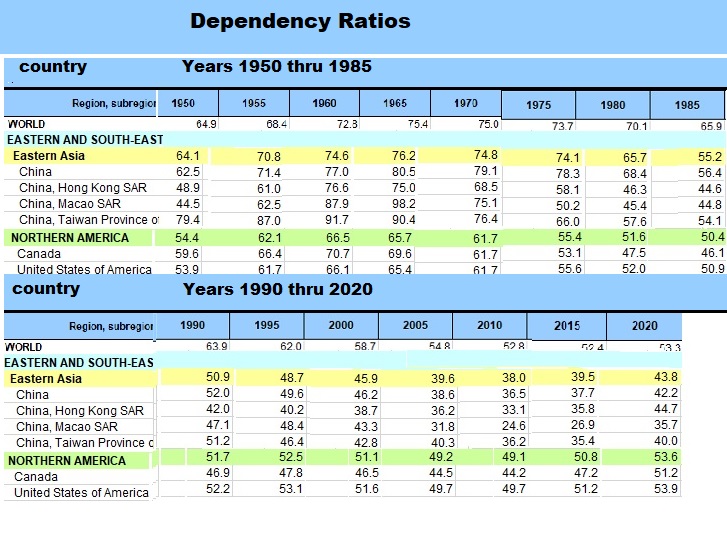
China has in the past, had a much higher TDR than currently and their TDR has been in decline, most likely due to their past 2 child policy on # of children/household which has now (as of May 2021) been changed to 3 children/ couple.
TDR can be negatively affected by both a large number of elderly and a large number of children.
The whole thing can be found at
https://population.un.org/w...Standard/Population/
Scroll down to Total Dependency Ratio1.
|
|

|
cliffw
|
FEB 17, 12:48 PM
|
|
| quote | Originally posted by maryjane:
The Lewis Turning Point is an economic theory involving the point at which a demographic (usually a nation's workforce) reaches the point in which the supply of surplus labor from rural areas, for employment in cities, is exhausted.
|
|
Interesting. I would have to know more about the Lewis Turning Point.
I grew up in big cities till my later 20's. Then I moved to rural America / Texas. Employment in cities was not one of my reasons. I know some in my area who do though.
"Surplus labor" kinda needs a definition. A country boy can survive. Most have work and do work. Yeah, we have those that are not motivated. I wouldn't call them surplus labor. The cities have them in greater numbers.
The ones who can and do, can be bought. The cities don't want to pay the price. Heh, if they did, they might even entice their existing non working population to work.
|
|
|
|
Zeb
|
FEB 17, 10:17 PM
|
|
| quote | Originally posted by maryjane:
When did (or will) the US breach it's own Lewis Turning Point?
|
|
When did mechanization come to farms? I'm not exactly sure, you'd have a better picture than a guy from New Jersey. The "surplus labor from rural areas" dried up within a generation, I'd think.
Exact date? I can't find a good source ( my Google-Fu is weak) but maybe 1950?
|
|
|
|
sourmash
|
FEB 18, 10:44 AM
|
|
|
So by allowing unskilled peasants to invade across our Southern border 'they' are seeking to shift our LTP?
|
|
|
|
maryjane
|
FEB 18, 01:10 PM
|
|
'Mechanization' came to farms with the invention of the mechanical reaper/harvester and increased thru the 1920s.
The real upswing in mechanization tho, was immediately post world war 2, courtesy of 2 models of inexpensive tractors. 1947-1955 they sold an unbelievable # of units each and changed forever the way farming was done in the USA. Over 500,000 of Ford's N seres were sold in the US between 1947 and 1950, with Ferguson not far behind. The Ford 9n, which came out just before the start of the war, sold for $600 new. A good pair of harness plow mules cost $200.

Farmall M right behind with 200,000 built between late 40s and 1950.
The John Deere A & G 'poppin Johnny' tractors sold well over 200,000 units the same time period.
|
|
|
|
pokeyfiero
|
FEB 18, 02:44 PM
|
|
|
|
|