
 
     |
| Why Does Texas Have Its Own Power Grid? (Page 4/17) |

|
Raydar
|
FEB 17, 08:01 PM
|
|
One author's view...
https://www.forbes.com/site...d-the-cold-shoulder/
This is essentially the text from the link. I attempted to edit out the fluff.
Feb 14, 2021,06:29pm
Valentine’s Day Giving The Texas Electric Grid The Cold Shoulder
The energy world is currently transfixed by what is going on in Texas. Usually The Electric Reliability Council of Texas (ERCOT, the electric grid that serves 90% of Texas electricity demand) gets attention in the dog days of summer when temperatures soar above 100 degrees F, air conditioners work round-the-clock to keep us cool, and the grid strains to keep up. But this Valentine’s Day cold snap makes our sweltering summer peaks look like child’s play. Wholesale electricity market prices are at all-time highs and have been in the $1000s of dollars per MWh all weekend. On average, ERCOT prices are much lower, generally in the low $30s.
Volatility and high prices are nothing new for the electricity wholesale market in Texas. (Note that the vast majority of residential customers are not paying these high prices to keep their homes warm as their electricity providers offer higher retail rates in exchange for buffering them from these price spikes, but more on that later.) In fact, very high prices for a small number of hours of the year is a feature of the Texas electricity market, not a bug, as the price spikes are useful incentive for prodding developers to build more generating capacity. However, we generally expect price spikes to happen on hot summer afternoons, driven by air-conditioning. And we expect those price spikes to be brief, lasting minutes or hours, and in isolated locations. This swath of high prices that span the state and have already lasted more than a day and are likely to last several more days is wholly new territory.
What is going on? Demand is crazy high.
On some level, it is a classic case of supply and demand. However, there are two markets involved and both are competing for the same thing. Texas is, as a whole, a summer-peaking state. Our energy use and electricity price spikes are driven by hot summer afternoon air-conditioning use. But, even on a bad day, the temperature difference between the outside air (105F) and a “comfortable” inside temperature (75F) is at most 30F (105F-75F). Temperatures are forecasted to get down to 10F in Austin, so the indoor/outdoor difference between a “comfortable” indoor temperature of 70F is 60F (70F-10F), double what we are trying to control in the summer. Keep in mind our homes are designed with insulation for a 30F differential and a preference for shedding heat, not a 60F differential with a desire to retain heat.
That means our homes are demanding much more energy for heating energy right now than the cooling energy we demand for the same number of hours in the summer. Also, about 60% of homes in Texas are heated by electricity, but not the efficient heat pumps that can operate at these temperatures. Many are the inefficient resistance heating or the older kind of heat pumps that use resistance heating as a back-up when the heat pumps lag behind. To put it in context, a standard electric furnace or heat pump in this auxiliary mode pulls double the power that an air-conditioner pulls in the summer.
All told this means a huge spike in demand for electricity.
But, what about all those 40% of homes that use natural gas for heating? They aren’t immune from the price madness, either.
When Texas electricity prices get this high, it is almost always (forever as I can remember) driven by scarcity pricing. Scarcity pricing happens when reserves (power plants on standby ready to jump in if market conditions get tight) get low. As of this writing, scarcity pricing has not happened with this weather pattern yet. The scarcity pricing mechanisms are traditionally what drive ERCOT prices to their famous $9000/MWh peaks.
Homes and businesses in Texas use electricity and natural gas for heat and at the same time over half of power plants in Texas use natural gas to make electricity. There is competition for natural gas right now between heaters in buildings and power plants that make electricity for heaters. That competition has driven natural gas demand through the roof, driving gas prices into the triple digits from $2.77 in a normal week to over $140 today (Waha Hub). These high gas prices cause electricity prices to go up which invites more gas plants to come online which will drive up the price of gas, and so on and so forth.
Natural gas suppliers are able to claim force majeure and not supply contracted gas if they physically cannot do so. However, if natural gas power plants committed to provide electricity to the market and cannot do so because their gas provider cut off the supply, they might have to procure electricity on the open market (during a time of high price spikes) or face steep penalties to satisfy their contracts and ensure grid reliability, further increasing prices.
All of these factors coming together implies we might yet see scarcity pricing set in as temperatures drop further. In other words, the prices can go even higher.
We are a state defined by our hot summers, but we need to think more about winter
Texas gets this cold, but it is usually just in the north for a few of hours at a time, not a few days across the entire state simultaneously. Homes here can ride through short bouts of cold weather just with thermal lag (that is, it takes a few days for a well-insulated home to lose its heat), but our design specs for heating only account for temperatures down to about 25F in Austin, TX. Our demand response programs to remotely cycle air conditioners on and off are primarily geared towards summer operation.
Demand response behaviors are also likely more designed for typical summer operations than winter conditions. Industrial facilities and large commercial buildings will delay some operations until evening to avoid exacerbating peak demand during the afternoon. But in the winter, shifting more demand to night-time when others are trying to heat their homes makes things worse. There is less certainty and intuitive knowledge about how large consumers will respond to winter peak conditions.
The next few days are going to be tough for the ERCOT market. High and volatile prices are straining electricity market participants. Some retail electricity providers are even paying their customers to leave so they can reduce exposure of their balance sheets to an unforgiving market:
And some market contracts could be very out of the money:
The last time we had a deep freeze in Texas was in 2011 and it triggered the failure of coal and natural gas power plants. This cold snap is deeper and will last longer so risks will be high. At the same time, wind power capacity has more than tripled in the last decade, so we have more diverse resources to bear on the problem. Wind output so far has been good and, in general, exceeded forecasts. Going forward, we will need all hands on deck, and how all resources perform could spell the difference between a near-miss and widespread disaster.
When the dust settles, we will know more, but even though it is cold outside, the market is red-hot right now…
Caitlin Smith, Vice President, AB Power Advisors, contributed ERCOT market knowledge and insight and collaborated on content.
============================================
My take?
Everyone is pointing fingers, and are going to continue to do so. I think it is a case of collossally poor planning, along with a half-baked "green initiative".
Not being able to purchase electricity from "off system" is just stupid, especially when there is enough generating capacity in adjacent states to provide at least some measure of relief.
The "greens" are being soundly disparaged, but I'm not convinced that they are entirely at fault. Certainly to a measure, but...
|
|
|
|
theBDub
|
FEB 17, 08:05 PM
|
|
It’s looking like the worst is almost over. We made it through today and pending tonight should make it out relatively unscathed.
Re: energy sources
I haven’t done any research on this, but I have to think it’s not about going green or not, but more about having a diversity of scalable sources. Rely on one and a bottleneck hurts you. Have oil, gas, wind, solar, nuclear, coal, etc. and if any one goes down you can more easily scale up.
I’m sure TX (and others) have things mostly planned. It’s hard to plan redundancy and excess for a once a century storm.
|
|
|
|
maryjane
|
FEB 17, 08:26 PM
|
|
People with nat gas or even propane central heat still won't have any (heat).
Blower fans need electricity to run unless ya really have a squirrel running around in there.
Heat pump systems don't work well in very cold temps either.
Most recent message from my elec provider (35 minutes ago):
Entergy: We request limited electricity usage due to present extreme cold weather immediately, including turning off electric water heaters and lowering heating thermostats settings. Insufficient reductions may require temporary interruptions of electric service. We apologize for this inconvenience and are working to restore our system to normal grid operations as soon as possible.
I hope to have my plumbing back up to serviceability tomorrow. The whole house filter I have had since building the place in 2009 froze and broke.
We're now flushing the toilet with water I bring up from the pond.
|
|
|
|
Raydar
|
FEB 17, 08:27 PM
|
|
| quote | Originally posted by theBDub:
It’s looking like the worst is almost over. We made it through today and pending tonight should make it out relatively unscathed.
Re: energy sources
I haven’t done any research on this, but I have to think it’s not about going green or not, but more about having a diversity of scalable sources. Rely on one and a bottleneck hurts you. Have oil, gas, wind, solar, nuclear, coal, etc. and if any one goes down you can more easily scale up.
I’m sure TX (and others) have things mostly planned. It’s hard to plan redundancy and excess for a once a century storm. |
|
A diversity of sources seems to be pretty "spot on" to me - at least from my own perspective.
I don't speak from a position of authority, but I have been an observer of the power industry for nearly 30 years, as a support person on the inside. Ya' can't put all your eggs in one basket.
Texas? it might have a plan, but it will either be a long time coming, or absurdly expensive to implement. Either/or.
Regardless, I wish everyone the best. I couldn't imagine...[This message has been edited by Raydar (edited 02-17-2021).]
|
|
|
|
blackrams
|
FEB 17, 08:29 PM
|
|
| quote | Originally posted by theBDub:
I’m sure TX (and others) have things mostly planned. It’s hard to plan redundancy and excess for a once a century storm. |
|
I believe TX had a similar issue within the last 10 years, maybe not as bad as this but, it doesn't take a genius to see standing alone will eventually come to haunt you.
| quote | Originally posted by Raydar:
My take?
Everyone is pointing fingers, and are going to continue to do so. I think it is a case of collossally poor planning, along with a half-baked "green initiative".
Not being able to purchase electricity from "off system" is just stupid, especially when there is enough generating capacity in adjacent states to provide at least some measure of relief.
The "greens" are being soundly disparaged, but I'm not convinced that they are entirely at fault. Certainly to a measure, but... |
|
Steve,
As I said previously in this thread, the SEVEN Ps appear to be very applicable.
This will take lives and will cost a bundlel
| quote | Originally posted by maryjane:
People with nat gas or even propane central heat still won't have any (heat).
Blower fans need electricity to run unless ya really have a squirrel running around in there.
Heat pump systems don't work well in very cold temps either.
|
|
This is precisely why I had my home wired for a back up generator. I can't afford to keep squirrel feed on hand.
Rams[This message has been edited by blackrams (edited 02-17-2021).]
|
|
|
|
Raydar
|
FEB 17, 08:36 PM
|
|
| quote | Originally posted by blackrams:
Steve,
As I said previously in this thread, the SEVEN Ps appear to be very applicable.
This will take lives and will cost a bundlel
|
|
Some things are just stupid beyond comprehension.
I'm all for independence from federal oversight, but this whole thing is just... incomprehensible. Maybe even unforeseeable.
But LOTS of things are unforeseeable, right up until they happen. Ooops.
Edit - I'm guessing you are on Mississippi Power. How are things going in your neck of the woods?
We have heard precious little, over official channels. Thanks.[This message has been edited by Raydar (edited 02-17-2021).]
|
|
|
|
randye
|
FEB 17, 10:04 PM
|
|
| quote | Originally posted by blackrams:
I also had the house wired for my PTO generator as a back up .....
Rams
|
|
We went through 3 hurricanes where we had 1 and 2 week power outages until we finally bought (2) 7.5Kw gasoline generators.
Those eventually were replaced with a Generac whole house unit.
Both of my kids also now have Generac units on their homes.
Magnificent peace of mind.
Proper Prior Planning Prevents Power Paucity Problems[This message has been edited by randye (edited 02-17-2021).]
|
|
|
|
blackrams
|
FEB 17, 10:22 PM
|
|
| quote | Originally posted by Raydar:
I'm guessing you are on Mississippi Power. How are things going in your neck of the woods?
We have heard precious little, over official channels. Thanks.
|
|
Actually, Pearl River Power and we're doing fine (even though the PTO Generator is on the tractor and ready to do it's thing).
As I previously stated, the local news has asked that all Mississippians reduce their consumption so power can be shared with "other" states.
No idea who those other states are but, I'm thinking it probably isn't TX. But, that's just a guess on my part.
Rams[This message has been edited by blackrams (edited 02-17-2021).]
|
|
|
|
maryjane
|
FEB 18, 11:42 AM
|
|
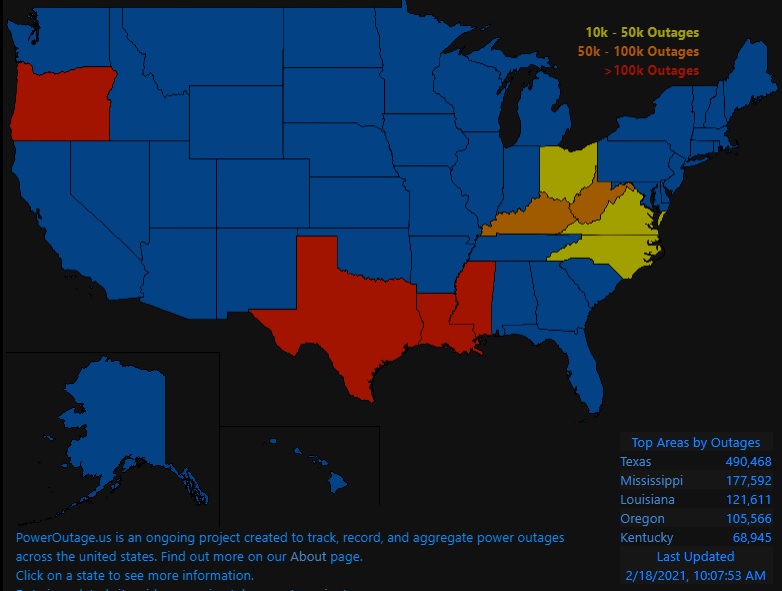
Considering the size of Texas, it's population, # of business and residential customer power requirements, we aren't doing as bad as Ron would have people think.
Our residential customer base power needs exceeds the totals of all other states experiencing outages this morning, as does the miles of power lines, and evidently, the availability of those other states to buy power from other parts of their grid consortium isn't exactly bulletproof either.
And of course, Mississippi is still our (and everyone else's) Mississippi.
https://poweroutage.us/
|
|
|
|
82-T/A [At Work]
|
FEB 18, 12:29 PM
|
|
| quote | Originally posted by blackrams:
Agreed but, such conditions can take a lot of human lives and cause a lot of damage costing huge dollars that didn't need to happen.
You can't be prepared for everything but, common sense can and does prevent a lot of tragedies. That goes on both a personal and state wise level.
Rams |
|
I wasn't framing it in that perspective. The way I see it, there are two sides to this... (and then everyone else who doesn't really care one way or another).
- One side is pushing this failure as an example of green energy not working, and while they are pointing out valid arguments, they're ignoring the positives that otherwise come from wind farms.
- The other side is desperately trying to change the narrative to cover up for the failure of the wind farms, and in most cases actually lying and misrepresenting the failure.
My comment was that this is a freak situation, and we shouldn't really be blaming wind farms for the failure, but that we cannot simply lie and ignore that these wind farms didn't have a weakness in this completely unexpected and once in a quarter century weather occurrence.
|
|
|
|