
 
     |
| Most powerful rocket ever built Superheavy set to attempt launch from Boca Chica Tx (Page 3/4) |

|
82-T/A [At Work]
|
APR 20, 12:34 PM
|
|
Ahaha... well, I think it's important to look at this differently from how NASA test flights go.
Just looking at this rocket from Space-X, you can tell that it's really, really a prototype. To be honest, it didn't even look like it was complete... so I don't know what they expected. But when NASA tests rockets, they generally go over something over and over and over... with the letter of bureaucracy. So when NASA attempts a launch of something... there's generally an expectation that it's going to succeed. With Space-X... this was a very unfinished product, and I think that's OK... because the amount of money this likely cost Elon Musk is peanuts compared to what similar R&D would cost from NASA on a big NASA contract.
Part of me here is playing fan-boy and explaining away the explosion, but in reality... this whole thing was a self-funded side-project. I'm sure he didn't enjoy losing the capsule... but the rest of it probably wasn't totally unexpected. I think they assumed though that the "emergency disconnect" would have worked properly (which it didn't seem that it did).
|
|
|
|
TheDigitalAlchemist
|
APR 20, 04:19 PM
|
|
Elon said pretty loudly a few days ago that it was gonna fail... not like 50/50 that it would take out the launch pad, more like 70/30. I'm paraphrasing, but he seemed fairly confident that it would fail. (and fail earlier on, maybe not make it off the pad)
But I'm surprised no one mentioned that UFO that swooped in and shot the laser beam at the rocket just before the explosion!!!!!! 
|
|
|
|
kslish
|
APR 21, 02:14 PM
|
|
Build fast and iterate...that's their model, all on a budget. This isn't being built on a 4+ billion dollars per launch Artemis budget here. It's SpaceX playing Kerbal Space Program in real life. SpaceX doesn't have (and probably doesn't feel the need to due to the incredible expenditure needed) a full size test facility like NASA does at their Stennis testing center. They prefer to test by actually launching things (because who knows, there "could" be a chance that everything works like it was intended the first time).
I'm rather surprised it made it as far as it did, and even more surprised that it wasn't a catastrophic failure of the actual rocket....it seems to be a failed stage separation mechanism that doomed the flight. In SpaceX's video of the launch, the camera's switch to the internal shot of the interstage section and the commentators are clearly expecting stage separation, and if you look really close you can even see what appears to be explosive bolts firing off around the perimeter of the joint between the stages, but it stays stuck together like someone welded it together solid. Some are hypothesizing the sheer vibrations and tremendous force of the launch bent the interconnecting section mount rings together somehow in a way not anticipated.
The booster had never been tested as a system for a full flight burn....it just had a few short static fire tests. Simulators and computer models only get you so far with the millions of variables in a real world. The booster itself seemed to perform rather well and even tried a boost-back return burn like it was programmed to, it just wasn't expecting the Starship section to still be attached, resulting in several interesting spiraling somersault maneuvers before the flight termination was triggered once it fell back to around 30km in altitude.
I anticipate at least the next 3 or 4 launches to fail spectacularly in some way as well as new "bugs" in the system are found with this kind of design methodology, but they'll iterate and redesign through the issues on the fly, just like they did with the Falcon rockets. Already the next booster being prepped does away with the hydraulic gimble system on the Raptor engines in favor of faster, less complicated ones actuated by electric motors. I'm guessing the next Starship section for the next launch also won't be as complete (maybe no heat shielding and flaps) as well to save on costs until they can guarantee the reliable separation of the sections and then move on to testing the next stage of flight.
I'm more concerned with the crater left under the launch pad than the rocket failure itself. As repairs and modifications to that will most likely take longer than design changes to the booster and Starship.
| quote | Originally posted by rinselberg:
There's a report that a SpaceX spokesperson actually described what happened as a "rapid, unscheduled disassembly" of the launch vehicle.
Ya' think?
|
|
| quote | Originally posted by Notorio:
I saw that quote on NBC and shook my head. It's this kind of Big Tech, Gen Z, doublespeak that really is sad. They don't want anybody to 'feel bad.' I imagine the Safe Spaces, Emotional Coaches, and Petting Zoos at SpaceX are very busy today. What kind of statement would Gene Kranz have released? 
|
|
Gene Kranz would have probably said the same thing. "Rapid Unscheduled Disassembly" is rocket geek speak that has been used for decades. It's found even in McDonnel Douglas documentation describing a Saturn-IVB stage rupturing during a test in the 1960's where the term used was RUDE, as in a Rapid, Unplanned Disassembly Event.
I'm pretty also sure Elon would fire anyone that requires a safe space or an emotional coach. [This message has been edited by kslish (edited 04-21-2023).]
|
|
|
|
maryjane
|
APR 22, 10:22 AM
|
|
I think you are pretty spot on with your assessment Kslish.
and:
| quote | | I'm more concerned with the crater left under the launch pad than the rocket failure itself. As repairs and modifications to that will most likely take longer than design changes to the booster and Starship. |
|
This is one of the reasons SpaceX wants to eventually do both launches and recoveries offshore but has decided to NOT use pre-existing modified oil platforms. SpaceX has sold off the 2 old ENSCO rigs they bought and are going to get a few land launched rockets under their belts before moving out into Gulf waters.
|
|
|
|
cvxjet
|
APR 22, 06:36 PM
|
|
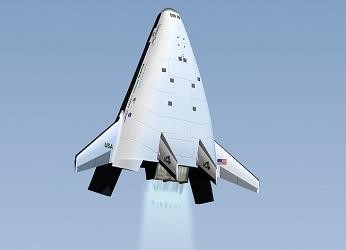
Back around 2000, NASA had Lockheed developing a single-stage-to-orbit vehicle called VentureStar...When the program was originally started, NASA specified Composite fuel tanks- These would obviously be CRYO tanks, meaning fuel- and Oxygen cooled to well below zero to be a concentrated liquid. A number of engineers at Lockheed pointed out that this would be near-impossible.
As testing was conducted, it became clear that the cryo tanks were failing every test- the reason was that a composite structure- for strength/lightness- is honeycomb and that structure exposed to extreme cold would create ice leading to structural failure.
Lockheed actually developed an ALUMINUM tank that worked- and was LIGHTER!
Congress was conducting hearings on progress of the X-33...and an (EXTREMELY stupid) NASA (Planetary) scientist stated "We should do this project with all of the new technology- if we don't have it all, then why bother?"
So Congress cancelled the program....That scientist- Ivan Bekey should win an award for total, complete idiocy!
|
|
|
|
Valkrie9
|
APR 22, 09:40 PM
|
|
|

|
cliffw
|
APR 23, 11:09 AM
|
|
| quote | Originally posted by kslish:
... it seems to be a failed stage separation mechanism that doomed the flight.
|
|
I have no doubt you have more educated insight into the subject.
I think I heard that five of the rockets failed. I did not check if they were launch rockets or subsequent rockets.
|
|
|
|
rinselberg
|
APR 23, 07:18 PM
|
|
The newly expatriated German, Dr. Wernher von Braun, like an astrophysicist Mary Poppins who materialized out of nowhere to teach the people of Huntsville, Alabama, how to make rockets...
This isn't directly related in any way to SpaceX, but I've come here to put a spotlight on this truly inspired and literary remark which I read recently in an article in the New York Times:
"Why Do Stanford, Harvard and NASA Still Honor a Nazi Past?"
Lev Golinkin for the New York Times; December 13, 2022.
https://www.nytimes.com/202...nazi-scientists.html
| quote | “Dr. Wernher von Braun and his team of rocket scientists transformed Huntsville, Ala., known in the 1950s as the ‘Watercress Capital of the World,’ into a technology center that today is home to the second-largest research park in the United States,” proclaims the “About Us” section of the U.S. Space and Rocket Center — a Smithsonian-affiliated museum and the home of the renowned Space Camp program. (A representative of the center said, “We are in a current redevelopment of the rocket center’s website and affiliated Space Camp pages,” and that the center intends to provide additional context.)
In the meantime, von Braun is lauded at practically every turn: on the Space Camp website, on the University of Alabama in Huntsville’s school history page, in the description of the Dr. Wernher von Braun Scholarship, even in a 2019 speech by Robert Altenkirch, who was then the university president — none of which mention Nazis or slave labor. (The school does have a web page about rocketry and slave labor that mentions von Braun.)
As for the von Braun Center performing arts venue, a spokesperson for the city of Huntsville said that there is “an ongoing effort to provide greater historical context and information” on the center’s website. But how long does it take to correct the record?
The impression one gets from these sanitized histories is that this was a man who had materialized out of nowhere, with no discernible past, like an astrophysical Mary Poppins who had come to teach the people of Huntsville how to make rockets.
It seems it is less common to note a Nazi past than to look past it. Such is the case with the NASA Kennedy Space Center’s visitor complex in Florida, which is home to the Dr. Kurt H. Debus Conference Facility. In the official NASA biography of Debus there is but a short, vague paragraph about his life in Germany. On June 24, the Kennedy Space Center’s director, Janet Petro, accepted the National Space Club Florida Committee’s Dr. Kurt H. Debus Award; NASA’s webpage celebrating the event referenced Debus’s astronomical achievements, noting nothing of his SS membership and intimate involvement with building the V-2. |
|
I want to read the Mary Poppins reference in its original context from the article in the New York Times
I'm not trying to seed a discussion about "Operation Paperclip" and the American effort to bring the scientists and engineers who were part of Hitler's Germany to the United States after the war. Not at all. I just think this invocation of "Mary Poppins" is off the charts in this context, as far as literary acumen. A wordsmith's crowning achievement. A literal tour de force of unforgettable erudition. A veritable Fort Knox gold bullion treasury's worth of word coinage.
As far as why I have chosen this forum thread, my thinking is that it's a thread that is of interest to people who have an interest in rockets and space exploration, and that would logically extend to the history of rockets and space exploration, even as far back as the years that came in the immediate aftermath of World War Two. And so I think that no one could fault me in any serious way for glomming onto this thread and using it as a backdrop for this "selfless" act of sharing with the forum.
Am I wrong? (A reference to some recent goings on in the Politics & Religion section that go back to the recent episode involving the Dilbert cartoonist Scott Adams.)

As MSNBC weekday morning anchor José Díaz-Balart (Caballero) always ends his program, "Thank you for the privilege of your time."[This message has been edited by rinselberg (edited 04-23-2023).]
|
|
|
|
kslish
|
APR 23, 09:17 PM
|
|
| quote | Originally posted by cliffw:
I have no doubt you have more educated insight into the subject.
I think I heard that five of the rockets failed. I did not check if they were launch rockets or subsequent rockets. |
|
Just a spaceflight fan....that and both my wife and I have physics related degrees and she's an engineer that tests things to the point of failure for safety certification so she knows the process of continuous improvement through testing to failure....
Five Raptor engines did fail in the primary stage during launch, but the rest of the engines should have been enough to carry out the primary stage's mission to stage separation considering the Starship section wasn't carrying any kind of payload.
The separation issue is an educated guess on my part, but you'd think that they would have at least tried a mission abort sequence (i.e. separate Starship and return for a pad or perhaps a water landing) if it could have separated. Most other rockets would have been ripped apart performing three loops mid flight. Starship ITSELF is supposed to be the launch abort system after all.
|
|

|
cliffw
|
APR 24, 06:29 AM
|
|
| quote | Originally posted by kslish:
Just a spaceflight fan....that and both my wife and I have physics related degrees and she's an engineer that tests things to the point of failure for safety certification so she knows the process of continuous improvement through testing to failure....
|
|
I want to have your Wife's job. I am good at making failure happen,  . .
|
|
|
|

