
 
     |
| Electrical Poohbahs -- Please Pontificate (Page 2/2) |

|
Notorio
|
FEB 19, 07:12 PM
|
|
| quote | Originally posted by cliffw:
Can one just add a short ground lead from the breaker box to a ground rod just out side where the neutral is needed and swap the long reach ground ground wire to a neutral ? |
|
That's what I was thinking. The panel Maryjane posted (thank you!) has the Neutral and Ground tied together inside the box. So what benefit is there to ALSO running the 4/0 (or whatever) neutral wire all the way back to the street?
|
|
|
|
Notorio
|
FEB 19, 07:21 PM
|
|
Hot dog! I found a PDF of the applicable code, a mere 1,056 pages ...

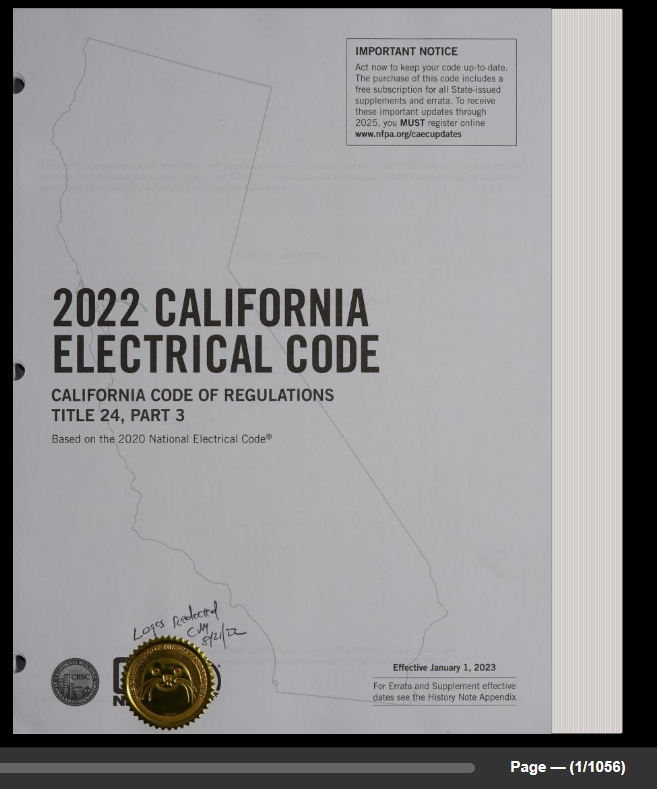
|
|
|
|
maryjane
|
FEB 19, 07:21 PM
|
|
It's difficult to explain, but doing so runs a risk of sending voltage back out the neutral line either inside your home or outside. The ONLY place National Electric Code allows Neutral and Ground to be tied together is inside "First means of disconnect" (their term) which is almost always inside the main distribution panel unless you have a main disconnect in or outside your home before power gets to your main dist panel. (Meter box is not usually considered a means of disconnect)
You should always see zero Voltage on any neutral line.[This message has been edited by maryjane (edited 02-19-2025).]
|
|
|
|
Notorio
|
FEB 19, 08:07 PM
|
|
| quote | Originally posted by maryjane:
It's difficult to explain, but doing so runs a risk of sending voltage back out the neutral line either inside your home or outside. The ONLY place National Electric Code allows Neutral and Ground to be tied together is inside "First means of disconnect" (their term) which is almost always inside the main distribution panel unless you have a main disconnect in or outside your home before power gets to your main dist panel. (Meter box is not usually considered a means of disconnect)
You should always see zero Voltage on any neutral line.
|
|
That makes some sense to me. Thanks.
Unfortunately, having leafed through the Index and several sections of the Electrical Code, it was incomprehensible. I was able to understand the rules for Dumbwaiters and Ice Melting Facilities, but I couldn't really find the section governing Service Entrance Panels. The requirements seem to be spread out over many different sections.
|
|
|
|
maryjane
|
FEB 19, 10:07 PM
|
|
It will be in Section 250.2?, meaning 250.2 thru a bunch more subsections.
Keep in mind that NEC doesn't MANDATE that neutral/ground be bonded, it just states that NEC 'allows' it. Note what I posted:
"Yes, ground and neutral can be (and probably are) bonded together at the "first means of disconnect) "
and
"The ONLY place National Electric Code allows Neutral and Ground to be tied together is inside "First means of disconnect"
Watch this for a simpler explanation regarding why almost every application ground and neutral ARE bonded together (at first means of disconnect).
https://www.youtube.com/watch?v=6QEYg4wX70E&t
People think neutral is dead, and it is, on a deactivated circuit, but it is very much a current carrying conductor if the circuit is live. Add just a small measure of Voltage to neutral, (relative to ground) and you have a very dangerous situation. So, bonding the neutral to ground at the main panel, gives stray or unintended voltage on your neutral, a place/way to go to ground rod.
One of the first explanations of household current I got many many years ago was, "Electricity comes in to your house, all volts and no amps but Electricity leaves, all amps and zero volts. (accurately, 'almost' zero volts) (the amps are created when 'work' is done which causes current flow and vice versa...no 'work'-no amps)
We have all heard "Electricity wants to go to Earth ground and will take the shortest available fastest path to get there"
NO NO NO!
Water and any liquid does that.
Electricity, takes ALL available paths and it only travels one speed..which is very close to light speed.
It does not 'want' to go to ground either. Electrical current flow is simply trying to achieve balance. Where current 'wants' to go is back to source. For residential apps, that is the transformer out on the pole or in the pedestal in your yard. That's where your utility company's single hot line is transformed (stepped) down and split to two separate 120 volt lines to go to your meter loop.
(Lightening and sometimes, electricity from a home generator, act differently)
Anyway, good luck with it.
I rewired my shop last year, and it's a very small shop. I too, was floored when I saw what 12/2 with ground cost.[This message has been edited by maryjane (edited 02-19-2025).]
|
|

|
cliffw
|
FEB 20, 02:42 PM
|
|
| quote | Originally posted by maryjane:
You should always see zero Voltage on any neutral line.
|
|
How much voltage should show on the ground line ?
My outside circuit breaker box at the meter has a ground rod connected to it at the ??? neutral bar, I think.
|
|
|
|
maryjane
|
FEB 20, 05:26 PM
|
|
| quote | Originally posted by cliffw:
How much voltage should show on the ground line ?
My outside circuit breaker box at the meter has a ground rod connected to it at the ??? neutral bar, I think. |
|
It varies. Theoretically, there should be zero/no voltage on the ground line but unless it's a brand new build, with all new appliances with each having no voltage leakage and every single outlet was wired 100% correct there may occasionally be a small amount of voltage present. Millivolts.
Yes, neutral will pass thru a set of lugs in the meter box and go on to the main dist panel. There will be a lug somewhere in the meter can for ground. Equipment ground to carry away any voltage from moisture that provides a path between the hot wire lugs and the metal parts of the meter box. Sometimes the ground from the meter box goes straight to the ground rod, sometimes that wire goes on thru to the main dist panel and then down to the ground rod.
|
|
|
|