
 
     |
| Today Is Texas Independence Day (Page 2/2) |

|
williegoat
|
MAR 27, 10:47 AM
|
|
| quote | Originally posted by maryjane:
big concrete goldfish pond
|
|
I imagine concrete goldfish just sink to the bottom pretty quick, anyways.
[This message has been edited by williegoat (edited 03-27-2024).]
|
|

|
cliffw
|
APR 21, 09:57 AM
|
|
Today, in 1836, the Texians (correct spelling) attacked Santa Anna, the Napoleon of the west, at San Jacinto.
Houston after luring Santa Anna so far from Mexico and his resupply source, troop replentishment source, after keeping his troops from revolting due to their lust for vengeance for the Alamo and Goliad, he unleashed that vengeance.
The Mexican army had became complacent about the threat which they created. They encamped with their backs to the San Jacinto river, thus eliminating an escape route they ended up needing. They had been partying hard the night before.
Houston ordered the attack in the early sun light hours, charging in from the East. Surprising the Mexicans while many were still asleep. The attack roused them awake and they had to defend them selves looking into the early morning Sun, blinding them.
The Texians charged in, pissed off yelling "Remember the Alamo, remember Goliad". The battle was over in just 18 minutes. Santa Anna ran off in fear of his life, as did many of the Mexican army. Santa Anna ordered a Private to change uniforms to disguise his identity after all being cornered. It did not work. The Texians noticed most in his army saluted him.
When brought before the wounded General Houston, Houston again had to quell his troops from executing him, Santa Anna had done to the Alamo and Goliad defenders. Houston made a deal with the devil and allowed him to live if he signed over the whole territory of Texas north of the Rio Grand river and reaching into modern day Colorado.
Don't mess with Texas.
|
|
|
|
maryjane
|
APR 21, 02:50 PM
|
|
| quote | The Mexican army had became complacent about the threat which they created. They encamped with their backs to the San Jacinto river, thus eliminating an escape route they ended up needing. They had been partying hard the night before.
Houston ordered the attack in the early sun light hours, charging in from the East. Surprising the Mexicans while many were still asleep. The attack roused them awake and they had to defend them selves looking into the early morning Sun, blinding them |
|
Almost none of that is true. As I have said in the past, I grew up about 5 miles from that battleground, have spent hundreds of hours walking it, and studying it.
We tend to look at that battleground thru 20th century eyes, but where the San Jacinto River is today (as part of the Houston Ship channel) it didn't exist as such in 1836. The River actually ended at the confluence of itself and Buffalo Bayou tho part of the river does turn SE and down to San Jacinto Bay. (also now part of Houston Ship channel)
The Mexican force had it's backs to a very wide marsh that bordered what is now Burnet Bay. The San Jacinto River left leg,(as viewed from the North) was farther across a wide marsh would have been on the Mexican army's right flank during the battle but on their left during encampment.
The Texan force had their backs to Buffalo Bayou. Buffalo Bayou today, is the wide deep body of water that runs in front of where the Battleship Texas was moored. But, Houston's army, if need be, could have fallen back along their own right flank
The 18 minute battle took place in the afternoon, around 4:30pm, not in the early morning. There were really very few Mexicans killed at the battlefield location we all know today and in that little time span, but the carnage, continued throughout the late afternoon and into the night as Texians (against Houston's wishes) pursued the melee of retreating (mostly unarmed) Mexicans as far down as Peggy Lake. It is here at Peggy Lake that the great killing took place into the night of the 21st and continued in the morning of the 22nd April.
“Gentlemen, I applaud your bravery, but damn your manners. Gen Sam Houston.
And, there was no 'partying hard the night before'. Santa Anna and his force of 700 men arrived at Lynchburg the same day (April 20) with Houston's army arriving in the early morning and Santa Anna later in the morning and into the afternoon . At this point, Houston outnumbered Santa Anna 950 to 700. Santa Anna had forced marched his troops thru swolen rivers, creeks and knee deep mud roads to try to catch Houston but fearing Houston would attack while Houston had the numerical advantage, he immediately ordered his troops to work building defenses out of whatever they could find. The attack did not take place and Gen Cos arrived very late the night of the 20th thru early morning of the 21st but his men too were put to work on defensive positions. Santa Ana now had the numerical advantage as well as more artillery. (Houston had only the twin sisters. By Early afternoon, with a numerical advantage, Santa Ana allowed his and Cos' men to get some sleep, figuring Houston would not attack as he knew Houston was aware that Cos had arrived. Known both to Houston and Santa Ana was, that there were another 800 to 1000 Mexican troops under Mexican Gen Filisola 32 miles away (as the crow flies) at Thompson's Ferry Brazos river crossing.
The entire battle grounds and surrounding area around it was owned by a rancher named Margaret (Peggy) McCormick. 2 days after the battle she found her property strewn with the bodies of 100s of dead stinkiin Mexican soldiers and made her way to Houston's camp to get him to have his men bury the carcasses. He refused and Santa Ana refused to order his imprisoned men to do it. She and 1 or 2 of her slaves or employees buried quite a few several years later after there was nothing left but skulls and skeletons but to this day, no one knows what happened to the nearly 700 dead Mexican's bodies regarding the location..[This message has been edited by maryjane (edited 04-21-2024).]
|
|

|
cliffw
|
APR 22, 09:03 AM
|
|
|
|
|
maryjane
|
APR 22, 10:55 AM
|
|
| quote | Originally posted by cliffw:
Thank you Don. |
|
It will be really strange for me to go to cross on that ferry and not see those tripod mast from the Texas that have been visible at the end of the Lynchburg ferry road my whole life...
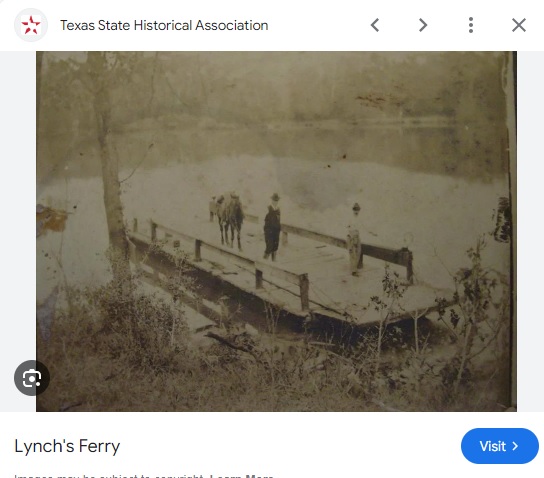
To illustrate what San Jacinto looked like then as compared to now, this was Lynch's ferry not too many years after the battle. The river was not the wide deep waterway it is today.
About the same location, a newer ferry , a few years after the previous ferry and, looking across the on the ferry river now:
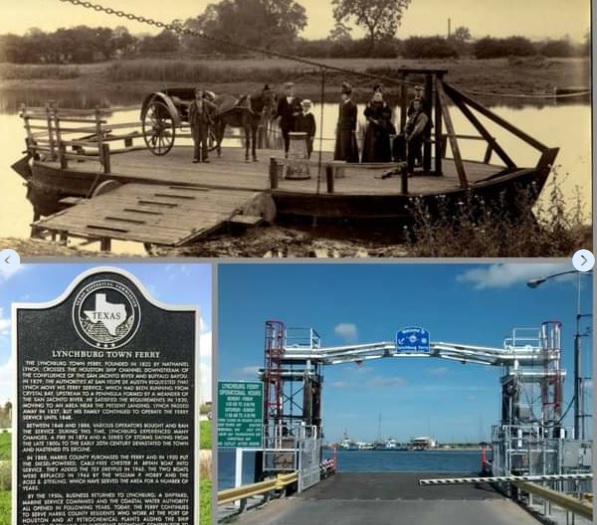
Buffalo Bayou back then, was even smaller, way before it was widened and dredged for ocean going ships to go up and down for the Houston ship channel..
|
|
|
|