
 
     |
| anyone familiar with lawn irrigation system controllers? (Page 2/2) |

|
82-T/A [At Work]
|
JUL 11, 07:37 PM
|
|
| quote | Originally posted by maryjane:
That would be fine, except I can only find the solenoid valves for zones 4, and 6. The ones I have found are Hunter brand.
The rest are buried under years of grass thatch and maybe inches of dirt.
No chart, no documentation, no company logo except 'Rainbird'.
There is, in the extreme SE corner of the yard (right by the city water meter, the code required flowback valve assy. Just 1 foot from there, indicated by the white star below, is a solendoind valve I assumed was station 1 but I now believe to be master valve for the system as it only has power if the controller in the garage is on 'auto'. (there is also a manual valve between that and the flowback assy)
I left the unit on auto last light and around 7AM, all stations watered as they should in sequence except zone 1.
I have come to hate Orbit popup nozzles tho. What a pita to adjust.
One of the good things (for me anyway) is that I live within sight (barely) of one of the most famous roads in central Texas.
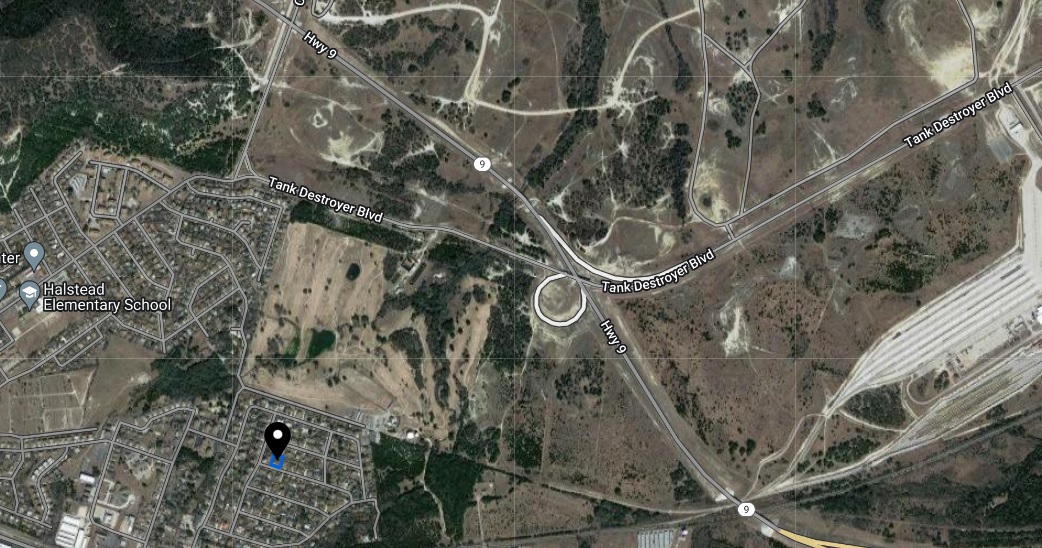
Not far from Hell on Wheels Ave and Ivy Division (4th Inf Division) Rd , which is 7 long miles of tracked armor and rubber tired motor pool.
https://www.google.com/maps...,1160m/data=!3m1!1e3
(Of course, if the SHTF, and things go nuke, I'm toast in the blink of an eye.
|
|
Hah, that's pretty cool!
The only thing I can claim is that I own a piece of property that used to be part of a WW2 bombing range, before it was used as a dairy farm. They'd had a couple of incidents of cows exploding over the decades since WW2, and they found a few things, so the DoD sent letters to all the property owners stating they were going to fly a helicopter with some kind of magnetic sonar (or something) to look for unexploded ordinances. They found nothing, so my lot in Okeechobee County is good... haha...
As for the sprinkler, yeah, that really sucks. I don't really know what else to tell you. Are there things like metal detectors that can detect electrical current? Either that, or if you find zone 1, you'll just have to trace it back.
It brings up another question. In San Antonio, my sprinkler system had solenoid / valves installed randomly throughout the yard. BUT... here in Florida, all the valves are installed under a big bulkhead right next to the water line.
I have to assume it has to do with how hard the surface is under the grass, and how easy it is (or not) to dig.
In Florida, it's all sand, even here in Tampa. No matter how far down I dig... just sand.
In San Antonio, I couldn't even get a nail / spike in the ground more than a few inches before I hit solid rock and that was that. I just opened one of the last boxes from my last PCS and I had a bunch of galvenized staking nails that I found. They were useless to me because no matter how hard I tried, I couldn't drive them into the ground.
So, I assume that they would run a water line out somewhere in the yard, and then install a solenoid there where it would branch-off to two zones (when it's disabled, zone 1, when it's enabled, zone 2)... something like that, because they couldn't dig. Otherwise, I have no idea. It just seems to make sense to have the solenoids all located in one place, especially if they leak.
|
|
|
|
maryjane
|
JUL 12, 12:16 AM
|
|
The gang manifolds are a relatively new thing (and kinda costly too). Since they have to run the plumbing to each zone anyway, they usually run the wiring in the same trench but someplaces, the low voltage wire doesn't have to be in the same trench or the same depth as the pipe. (pipe depth is usually less) .
There are several off the shelf wire detectors (Harbor Freight sells one less than $50)
1. You disconnect hot wire of the questionable zone from the timer inside. You connect a lttle battery powered transmitting device to that wire.
2. The transmitter sends a signal down the wire to the solenoid.
3. A sensor you carry around will follow the wire from where the wiring bundle exits the house down to the solenoid. Beeping as you go, with beeps eighter getting louder and closer together as you stry from or get closer to the wire pathway.
BUT, I saw an ingenious way to do the same thing, using a gas powered engine (lawnmower for instance) and a portable battery powered AM radio.
1. Using an alligator clip, you connect one end of a wire to the disconnected questionable zone wire just as in the above instructions.
2. The other end of the wire is wrapped around the plug wire of the lawn mowerthat sits a ways from where you want to track. Several turns around it. This induces a signal in the attached wire that will run down the zone wire to the solenoid.
3. Using the am radio, tune the radio to an unused station or weak station. 540 was used in the example. Start the lawnmower. The premise is, that the radio picks up the induced signal from the underground wire as static. (earphones would be a plus) The static gets worse the closer you are to the buried line. If it fades, you went past the solenoid or veered off the path.
IF you want to trace out all zones, you disconnect the common from the timer and connect the lawnmower's wire to that, but there are so many commons that may crisscross underground it might prove difficult.
Automobile ignition systems usually won't work. The wires are shielded too well against radio interference.
My problem? I don't own a gas powered lawnmower. My big brush cutting Stihl weedeater might work but it's not good practice to hold the throttle down for an extended period of time if there is no load on it. I'm sure not going to risk burning up my old but good Stihl chainsaw. (My neighbors were amazed that I even have a 'real chainsaw' that big, much less can drop start it and know how to use it at my age.)
I routinely hear the heavy gun fire from Ft Hood and about once a month, see C17s fly low over the house, one after another as they either bring in or take out troops (probably weekend reservists) They fly low enough I can see every detail on the airplane. Maybe it's just 2-3 making practice approaches tho.
A BNSF rail line runs East & West about 500 yards due south from my house. Doesn't bother me, I like trains, but if you look in the google earth image, you can see a big multi line rail yard just East of where I live, as that 1 line splits off into sidings in 2 different locations.. Those are Ft hood's rail sidings. I have more than once, driven down a few blocks and watched 80-100 flat cars go by loaded with US Army equipment. Mostly trucks, trailers and humvees and Strykers but some Abrahms too.
Look closely at that yard. The upper yard is empty but the lower yard sidings are full of empty US Army rail flatcars. (I gave up counting after 200)

Closer:
On the first southmost siding, sits loaded flatcars. About 1000 yards farhter East sits another long line of loaded flatcars.
(I combined them for easy viewing but they are in reality, one behind the other on different East West sidings.

These stay loaded 365/24/7 with components swapped out for maintenance and running to keep everything lubed up and tires from getting flat spots.
This, is US Army's III Corps 1st Army Div Heavy ready force. Loaded,cocked, locked and ready to roll.
What's on the flatcars?
The shadows know.........

(This is just a small part of what is at Ft Hood. The US Army 3rd Inf Div at Ft Carson has a similar ready force loaded as well and 1st Armored Div at Ft Bliss does the same at theirlarge rail yard.)[This message has been edited by maryjane (edited 07-12-2022).]
|
|
|
|
maryjane
|
JUL 12, 12:53 AM
|
|
I have a retaining wall that needs some attention and like 90% of the retaining walls here, it's made from rail cross ties. I am NOT looking forward to driving dozens and dozens of these 3/8x 12"nails thru cross ties but it has to be done. Not tomention all the 5/8 rebar to stabalize it, driven thru the first 2 layers and into the ground.
(an old nail I pulled out last week. New nails are about $1 ea)

And here I thought movin to town was going to mean an easy life... so far, been nothing but work in 103-107 deg temps.[This message has been edited by maryjane (edited 07-12-2022).]
|
|
|
|
82-T/A [At Work]
|
JUL 12, 09:18 AM
|
|
| quote | Originally posted by maryjane:
These stay loaded 365/24/7 with components swapped out for maintenance and running to keep everything lubed up and tires from getting flat spots.
This, is US Army's III Corps 1st Army Div Heavy ready force. Loaded,cocked, locked and ready to roll.
What's on the flatcars?
The shadows know.........
(This is just a small part of what is at Ft Hood. The US Army 3rd Inf Div at Ft Carson has a similar ready force loaded as well and 1st Armored Div at Ft Bliss does the same at theirlarge rail yard.)
|
|
I was just going to say... that makes a lot of sense now. The cars are there to be able to transport hardware anywhere in the country from a central location. Makes perfect sense if you need to defend the homeland.
I wonder, during the height of the Afghan and Iraq war... how many more tanks did we have overseas, than we had at home... ready to defend an invasion?
I played a lot of "Civilization" on my computer when I was a kid, and it unless you were using Sun Tzu's Art of War strategy (a good defense through offense), you always left yourself open to a sneak attack. And then you'd have to quickly bring home as many troops and other hardware as quickly as possible to defend the homeland... assuming you had a means to do so (cargo ships, and cargo planes). Otherwise you were screwed.
| quote | Originally posted by maryjane:
I have a retaining wall that needs some attention and like 90% of the retaining walls here, it's made from rail cross ties. I am NOT looking forward to driving dozens and dozens of these 3/8x 12"nails thru cross ties but it has to be done. Not tomention all the 5/8 rebar to stabalize it, driven thru the first 2 layers and into the ground.
(an old nail I pulled out last week. New nails are about $1 ea)
And here I thought movin to town was going to mean an easy life... so far, been nothing but work in 103-107 deg temps.
|
|
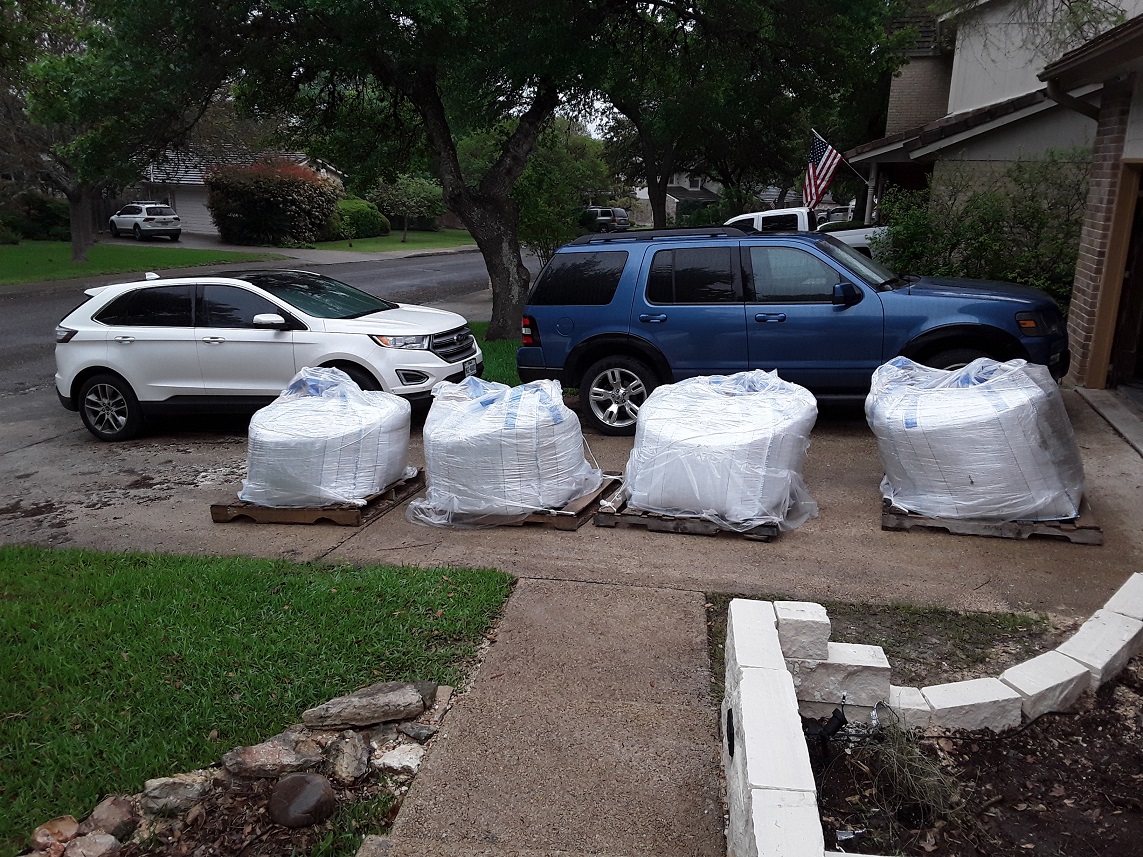
Yeah, in SA... I had originally intended to use stakes on top of railroad ties to edge-off parts of my grass from the rock beds. I got like 2-3"s into the ground, and then nothing. I tried everything... then I brought out the sledge hammer, and tried to use that... only for huge thick nails (like the one in your picture) to literally bend. I suppose I could have gotten an impact drill... but then I found a shop off 281 called "Soil & Stone." They literally sold cut limestone blocks which I used to build a retaining wall. They sent me two pallets for something like $150 bucks. I then got four huge bags (pallet bags) of pea-gravel for another $150 bucks... enough to do the entire front surround, and in the back... it was amazing.
When I was first looking at the pre-cut paver stones from Home Depot, it was going to cost me thousands of dollars... which was total BS. I bought a chisel and a stone cutting saw from Harbor Freight for like $50 bucks total. All in all... a couple of weekends, and I had a pretty awesome looking front yard for $700 bucks.
|
|
|
|