
 
     |
| Like big engines? Here's one for ya. (Page 2/2) |

|
blackrams
|
NOV 08, 01:00 PM
|
|
| quote | Originally posted by maryjane:
Nomenclature--nomenclature--nomenclature!
1st of all, when speaking of 1 propeller on the same engine, on a multi engine aircraft, with direction of rotation being opposite to offset torque and wing load, 'counter rotating props' is correct nomenclature.
BUT, when speaking of 2 propellers on the same engine or gearbox, with each propeller rotating opposite of each other, the correct terminology is Contra-rotating.
"On most twin or multi-engine propeller driven aircraft, the propellers all turn in the same direction, usually clockwise when viewed from the rear of the aircraft. In a counter-rotating installation, the propellers on the right wing turn counter-clockwise while those on the left wing turn clockwise. The principle advantage of counter-rotation is to balance propeller torque effects thus eliminating any problems associated with a Critical Engine.
Counter-rotating should not be confused with contra-rotating which refers to two propellers on the same engine which spin in opposite directions."
In vertical flight capable aircraft, two sets of rotors on the same gearbox is correctly referred to as a Coaxial arrangement
https://www.sciencedirect.c...a-rotating-propeller
|
|
I appreciate the response but, that doesn't answer my question in reference to the airflow and compressibility between the two sets of props.
Everything I'm finding discusses the torque issue and how the second props cancel out the torque induced by the first prop.
In that the first prop will induce a spiraled compressed airflow, the second must overcome that compressed airflow and reverse it, thereby increasing it's speed even more. That makes sense to me. So, I'm curious if the first and second props have the same pitch. This assumes both props are turning at the same speed.
As I said, I've got absolutely no experience with such a set up.
From the website you provided:
| quote | | In marine applications of contra-rotating propulsion it is normal for the aftermost propeller to have a smaller diameter than the forward propeller and, in this way, accommodate the slipstream contraction effects. Similarly, the blade numbers of the forward and aft propellers are usually different; typically, four and five for the forward and aft propellers, respectively. Furthermore, because of the two propeller configuration, contra-rotating propellers possess a capability for balancing the torque reaction from the propulsor which is an important matter for torpedo and other similar propulsion problems, |
|
Assuming water and air have similar flow characteristics, that explains some of my questions. Thanks
Edited: Asking such a question on a car forum is kind of silly but, there's a vast amount of different experiences here so, I thought, why not. 
Rams[This message has been edited by blackrams (edited 11-08-2020).]
|
|

|
maryjane
|
NOV 08, 01:21 PM
|
|
| quote | I appreciate the response but, that doesn't answer my question in reference to the airflow and compressibility between the two sets of props.
Everything I'm finding discusses the torque issue and how the second props cancel out the torque induced by the first prop. |
|
Probably because you are using the incorrect search term(s).
There is no (or very little) "compression" between the 2 props. On aircraft, the 2nd prop has either a sharper pitch angle and/or is geared faster to prevent compressed air buildup and make the propulsion system be . Very little air is 'lost' to the outside of the prop circle. This arrangment also disrupts the 'corkscrew' effect the airstream inherently has and the corkscrew affect is a major contributor to torque cause by the spiraling air hitting the vertical and horizontal control surfaces farther back on the fuselage.[This message has been edited by maryjane (edited 11-08-2020).]
|
|
|
|
blackrams
|
NOV 08, 01:31 PM
|
|
| quote | Originally posted by maryjane:
Probably because you are using the incorrect search term(s).
There is no (or very little) "compression" between the 2 props. The 2nd prop has either a sharper pitch angle and/or is geared faster to prevent compressed air buildup and make the propulsion system be quieter. Very little air is 'lost' to the outside of the prop circle. |
|
You are probably correct on the terms issue. Thanks for the responses. I'll continue to be curious about such things.
Radar (Steve)
If it can hover, I'll fly it but, that one is a bit shaky in my opinion.
My daughter (just yesterday) sent me a video of her taking a ride in a Chinook. Brought back many memories. BTW, those rotors rotate in different directions.
Rams
|
|
|
|
maryjane
|
NOV 08, 01:52 PM
|
|
|
The Sikorsky/Boeing Defiant will be a game changer once they replace the T55 engines with next generation GE engines.
|
|
|
|
cvxjet
|
NOV 08, 02:25 PM
|
|
Always loved the Corn-cobb engine (4360).....Four rows of 7 cylinders each....Never heard of that engine- which is amazing since I am a big airplane geek. (Just goes to show, "The more you know the more you can learn")
Contra-rotating props; They (Basically) eliminate the swirling the air does after leaving the (one prop).....which is wasted energy.
My favorite plane of all time; The RB-51, which was a WW2 P-51 that was raced for years in the Cleveland Air Races and later at Reno, etc....A guy bought it and modified it (Clipped wings and tail, taller vertical tail, cut down canopy)...Then, a Griffon 57 V-12 bomber engine with contra-rotating props.
It won numerous races and set the recip-engine speed record at 499- with bad weather! They believed it could do 530 mph in good conditions...
At Reno in 1979, it was racing and something went wrong with the propeller control- they went to FLAT-pitch! The engine was over-revving while the plane decelerated...Steve Hinton, the pilot, was trying to make an emergency runway, but couldn't keep her in the air...His last words were "Tell Karen I love her" (His Fiancee)
The plane disappeared behind the end of the runway in a BALL of fire.....
His pit crew raced the length of the runway and cleared the 6 foot chain-link fence by just driving off the end of the runway jumping it (Destroyed the car) They found that Steve had SURVIVED the crash.....The wings had broke off (With the fuel tanks) and exploded but the engine had dragged the cockpit clear of the flames. They had strengthened the cockpit the year before which helped but when they found him the cockpit had finally disintegrated.
A few years later, Steve won the Reno race with a Super Corsair (F4U with a Corn-cob installed) (And was married to Karen)
They should make a movie about this!

Here is a painting I did in High school of it....
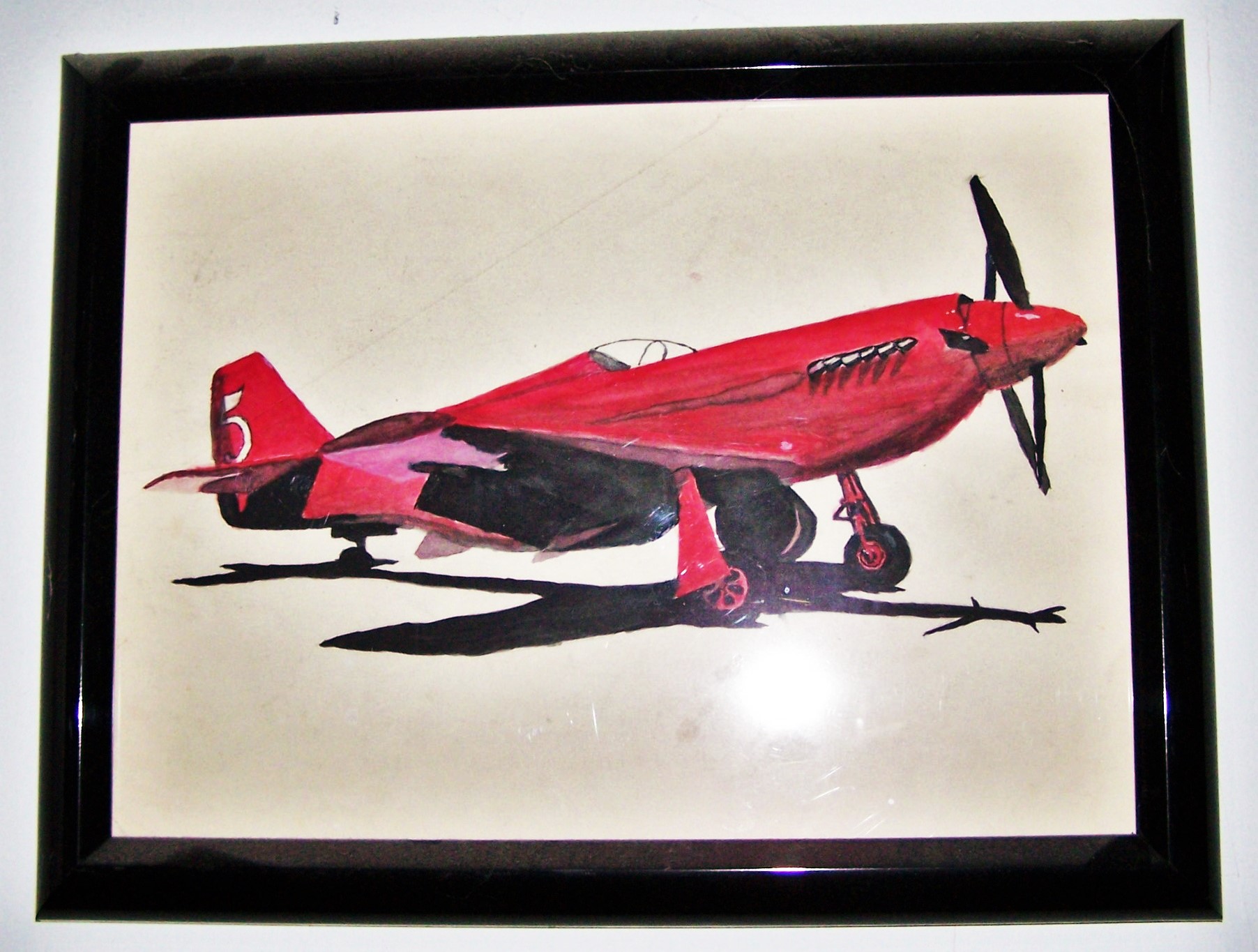 [This message has been edited by cvxjet (edited 11-08-2020).]
|
|
|
|
82-T/A [At Work]
|
NOV 09, 01:26 PM
|
|
| quote | Originally posted by cvxjet:
At Reno in 1979, it was racing and something went wrong with the propeller control- they went to FLAT-pitch! The engine was over-revving while the plane decelerated...Steve Hinton, the pilot, was trying to make an emergency runway, but couldn't keep her in the air...His last words were "Tell Karen I love her" (His Fiancee)
The plane disappeared behind the end of the runway in a BALL of fire.....
His pit crew raced the length of the runway and cleared the 6 foot chain-link fence by just driving off the end of the runway jumping it (Destroyed the car) They found that Steve had SURVIVED the crash.....The wings had broke off (With the fuel tanks) and exploded but the engine had dragged the cockpit clear of the flames. They had strengthened the cockpit the year before which helped but when they found him the cockpit had finally disintegrated.
A few years later, Steve won the Reno race with a Super Corsair (F4U with a Corn-cob installed) (And was married to Karen)
They should make a movie about this!
|
|
Hahah... I'm such a dork. The entire time I was reading this, I was thinking about this scene:
|
|
|
|
cvxjet
|
NOV 09, 04:00 PM
|
|
I don't remember seeing that video.....
here is a vid of Steve Hinton and RB-51's crash....(The problems start at 4:50)
https://www.youtube.com/watch?v=Cc6bhjys0g4[This message has been edited by cvxjet (edited 11-09-2020).]
|
|

|
blackrams
|
NOV 10, 01:07 AM
|
|
Have always been told any landing you can walk away from was a good one.
Having experienced eight engine failures in a single engine helicopter resulting in auto-rotation to the ground over my test flying career, I can say that being able to put that AC back in the air after such an experience is truly a joyful event. Never bent a skid but, did screw up a lot of rotor blades flying NOE. Coulda, Woulda, Shoulda are big deals when you only have one pull of the collective left prior to touch down.
Rams  [This message has been edited by blackrams (edited 11-10-2020).]
|
|
|
|
williegoat
|
NOV 10, 01:28 AM
|
|
| quote | Originally posted by blackrams:
Have always been told any landing you can walk away from was a good one.
Having experienced eight engine failures in a single engine helicopter resulting in auto-rotation to the ground over my test flying career, I can say that being able to put that AC back in the back after such an experience is truly a joyful event. Never bent a skid but, did screw up a lot of rotor blades flying NOE. Coulda, Woulda, Shoulda are big deals when you only have one pull of the collective left prior to touch down.
Rams |
|
So its kind of like flaring your parachute just before you gently touch your toes on terra firma?
|
|
|
|
blackrams
|
NOV 10, 07:17 AM
|
|
| quote | Originally posted by williegoat:
So its kind of like flaring your parachute just before you gently touch your toes on terra firma? |
|
There are similarities to a point. As I understand the square chutes, never jumped with one. IIRC, I have either 89 or 98 jumps (can't remember now) but they were always with a military T 10 round chute. Ours always had the back two panels cut out which did provide some forward speed but not nearly what the new chutes provide.
Rams
|
|
|
|