
 
     |
| The evidence against anthropogenic global warming (Page 19/600) |

|
4-mulaGT
|
AUG 16, 08:18 PM
|
|
| quote | Originally posted by Phranc:
Just yesterday I was telling a warmist that the IPCC study was flawed. He said prove it so I flooded him with links proving it. All he did was attack the sources and claim it was neo-con BS and pointed out one guy who was obviously a liar because he worked for coal at some point. I then countered with the links about funding and how the warmists for folds more funding and how the skeptics don't get much at all. Then he stated attacking me. Not once did he attack of even acknowledge the substance against the warmist claims. |
|
whats funny is that I had an *actual* debate with someone about global warming just yesterday, and HE used to work for a coal company!!
|
|
|
|
fierobear
|
SEP 01, 11:34 PM
|
|
Sun Makes History: First Spotless Month in a Century
"Drop in solar activity has potential effect for climate on earth.

The sun has reached a milestone not seen for nearly 100 years: an entire month has passed without a single visible sunspot being noted.
The event is significant as many climatologists now believe solar magnetic activity – which determines the number of sunspots -- is an influencing factor for climate on earth.
According to data from Mount Wilson Observatory, UCLA, more than an entire month has passed without a spot. The last time such an event occurred was June of 1913. Sunspot data has been collected since 1749.
When the sun is active, it's not uncommon to see sunspot numbers of 100 or more in a single month. Every 11 years, activity slows, and numbers briefly drop to near-zero. Normally sunspots return very quickly, as a new cycle begins.
But this year -- which corresponds to the start of Solar Cycle 24 -- has been extraordinarily long and quiet, with the first seven months averaging a sunspot number of only 3. August followed with none at all. The astonishing rapid drop of the past year has defied predictions, and caught nearly all astronomers by surprise.
In 2005, a pair of astronomers from the National Solar Observatory (NSO) in Tucson attempted to publish a paper in the journal Science. The pair looked at minute spectroscopic and magnetic changes in the sun. By extrapolating forward, they reached the startling result that, within 10 years, sunspots would vanish entirely. At the time, the sun was very active. Most of their peers laughed at what they considered an unsubstantiated conclusion.
The journal ultimately rejected the paper as being too controversial.
The paper's lead author, William Livingston, tells DailyTech that, while the refusal may have been justified at the time, recent data fits his theory well. He says he will be "secretly pleased" if his predictions come to pass.

But will the rest of us? In the past 1000 years, three previous such events -- the Dalton, Maunder, and Spörer Minimums, have all led to rapid cooling. One was large enough to be called a "mini ice age". For a society dependent on agriculture, cold is more damaging than heat. The growing season shortens, yields drop, and the occurrence of crop-destroying frosts increases.
Meteorologist Anthony Watts, who runs a climate data auditing site, tells DailyTech the sunspot numbers are another indication the "sun's dynamo" is idling. According to Watts, the effect of sunspots on TSI (total solar irradiance) is negligible, but the reduction in the solar magnetosphere affects cloud formation here on Earth, which in turn modulates climate.
This theory was originally proposed by physicist Henrik Svensmark, who has published a number of scientific papers on the subject. Last year Svensmark's "SKY" experiment claimed to have proven that galactic cosmic rays -- which the sun's magnetic field partially shields the Earth from -- increase the formation of molecular clusters that promote cloud growth. Svensmark, who recently published a book on the theory, says the relationship is a larger factor in climate change than greenhouse gases.
Solar physicist Ilya Usoskin of the University of Oulu, Finland, tells DailyTech the correlation between cosmic rays and terrestrial cloud cover is more complex than "more rays equals more clouds". Usoskin, who notes the sun has been more active since 1940 than at any point in the past 11 centuries, says the effects are most important at certain latitudes and altitudes which control climate. He says the relationship needs more study before we can understand it fully.
Other researchers have proposed solar effects on other terrestrial processes besides cloud formation. The sunspot cycle has strong effects on irradiance in certain wavelengths such as the far ultraviolet, which affects ozone production. Natural production of isotopes such as C-14 is also tied to solar activity. The overall effects on climate are still poorly understood.
What is incontrovertible, though, is that ice ages have occurred before. And no scientist, even the most skeptical, is prepared to say it won't happen again.
Article Update, Sep 1 2008. After this story was published, the NOAA reversed their previous decision on a tiny speck seen Aug 21, which gives their version of the August data a half-point. Other observation centers such as Mount Wilson Observatory are still reporting a spotless month. So depending on which center you believe, August was a record for either a full century, or only 50 years.
|
|
|
|
Phranc
|
SEP 01, 11:58 PM
|
|
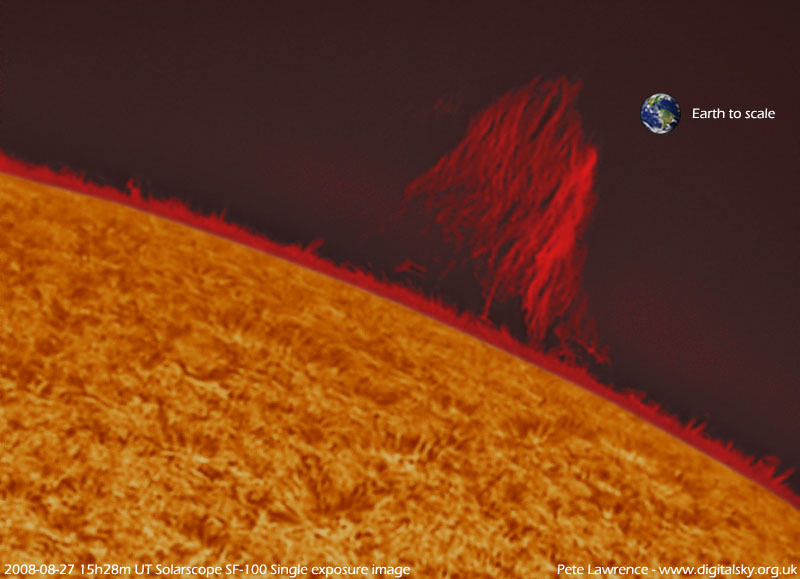
For the last month I've been watching this http://www.spaceweather.com/ place and wondered why I never saw a sun spot.

They also have other stuff.
 [This message has been edited by Phranc (edited 09-02-2008).]
|
|
|
|
rogergarrison
|
SEP 02, 04:33 PM
|
|
|
Like I said when Gore started spouting his BS, Its the NATURAL chain of events now as it has been for 5 billion years. Temps are controlled by (bugles) the SUN. As it does whatever it does, so the earth reacts. It will always do that until the sun dies or explodes. Nothing we do here has any but a miniscule effect on the planet. I doubt if we could even pump out enough ammonia into the atmospere to affect anything if we even tried.
|
|
|
|
fierobear
|
SEP 02, 05:56 PM
|
|
Shifting of the Pacific Decadal Oscillation from its warm mode to cool mode assures global cooling for the next three decades.
20 07 2008
Foreword: Don J. Easterbrook sent me this essay on Friday for publication here, but with the dustup over Monckton’s paper and the APS, I decided to hold off publishing it for a bit. For background, see Easterbrook’s web page here. - Anthony
Shifting of the Pacific Decadal Oscillation from its warm mode to cool mode assures global cooling for the next three decades.
Don J. Easterbrook, Dept. of Geology, Western Washington University, Bellingham, WA
Addressing the Washington Policymakers in Seattle, WA, Dr. Don Easterbrook said that shifting of the Pacific Decadal Oscillation (PDO) from its warm mode to its cool mode virtually assures global cooling for the next 25-30 years and means that the global warming of the past 30 years is over. The announcement by NASA that the (PDO) had shifted from its warm mode to its cool mode (Fig. 1) is right on schedule as predicted by past climate and PDO changes (Easterbrook, 2001, 2006, 2007) and is not an oddity superimposed upon and masking the predicted severe warming by the IPCC. This has significant implications for the future and indicates that the IPCC climate models were wrong in their prediction of global temperatures soaring 1°F per decade for the rest of the century.

Figure 1. Cooling of the Pacific Ocean and setting up of the cool-mode PDO. Sea surface temperature anomaly in the Pacific Ocean from April 14-21, 2008. The anomaly compares the recent temperatures measured by the Advanced Microwave Scanning Radiometer for EOS (AMSR-E) on NASA’s Aqua satellite with an average of data collected by the NOAA Pathfinder satellites from 1985-1997. Places where the Pacific was cooler than normal are blue, places where temperatures were average are white, and places where the ocean was warmer than normal are red. The cool water anomaly in the center of the image shows the lingering effect of the year-old La Niña. However, the much broader area of cooler-than-average water off the coast of North America from Alaska (top center) to the equator is a classic feature of the cool phase of the Pacific Decadal Oscillation (PDO). The cool waters wrap in a horseshoe shape around a core of warmer-than-average water. (In the warm phase, the pattern is reversed). Unlike El Niño and La Niña, which may occur every 3 to 7 years and last from 6 to 18 months, the PDO can remain in the same phase for 20 to 30 years. (NASA image by Jesse Allen, AMSR-E data processed and provided by Chelle Gentemann and Frank Wentz, Remote Sensing Systems. Caption by Rebecca Lindsey, adapted from a press release from NASA JPL).
Instead of a rise of 1°F during the first decade of this century as predicted by IPCC climate models (Fig 2), global temperatures cooled slightly for the past nine years and cooled more than 1°F this year (Fig 3). Global cooling over the past decade appears to be due to a global cooling trend set up by the PDO cool mode and a similar shift in the Atlantic. The IPCC’s prediction of a 1° F warming by 2011, will require warming of about 1° F in the next three years and unless that happens, the IPCC models will be proven invalid.

Figure 2. IPCC predicted warming.

Figure 3. Measured cooling.
As shown by the historic pattern of PDOs over the past century (Fig. 4) and by corresponding global warming and cooling, the pattern is part of ongoing warm/cool cycles that last 25-30 years. Each time the PDO mode has shifted from warm to cool or cool to warm, the global climate has changed accordingly. In 1977, the PDO shifted from cool mode to warm mode (Fig. 4) and set off the global warming from 1977 to 1998, often referred to as the “Great Climate Shift.” The recent shift from PDO warm mode to cool mode is similar to the shift that occurred in the mid-1940’s and resulted in 30 years of global cooling (Fig. 4). The global warming from ~1915 to ~1945 was also brought on by a mode shift in the PDO (Fig. 4). Every indication points continuation of the PDO patterns of the past century and global cooling for the next 30 years (Fig. 4). Thus, the global warming the Earth has experienced since 1977 appears to be over!
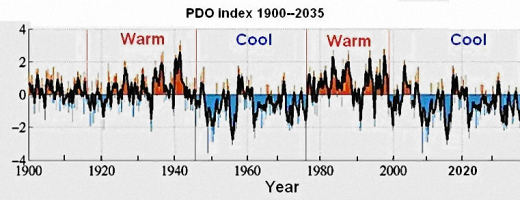
Figure 4. PDO indices, 1900-2008 with predictions to 2040.
===================================
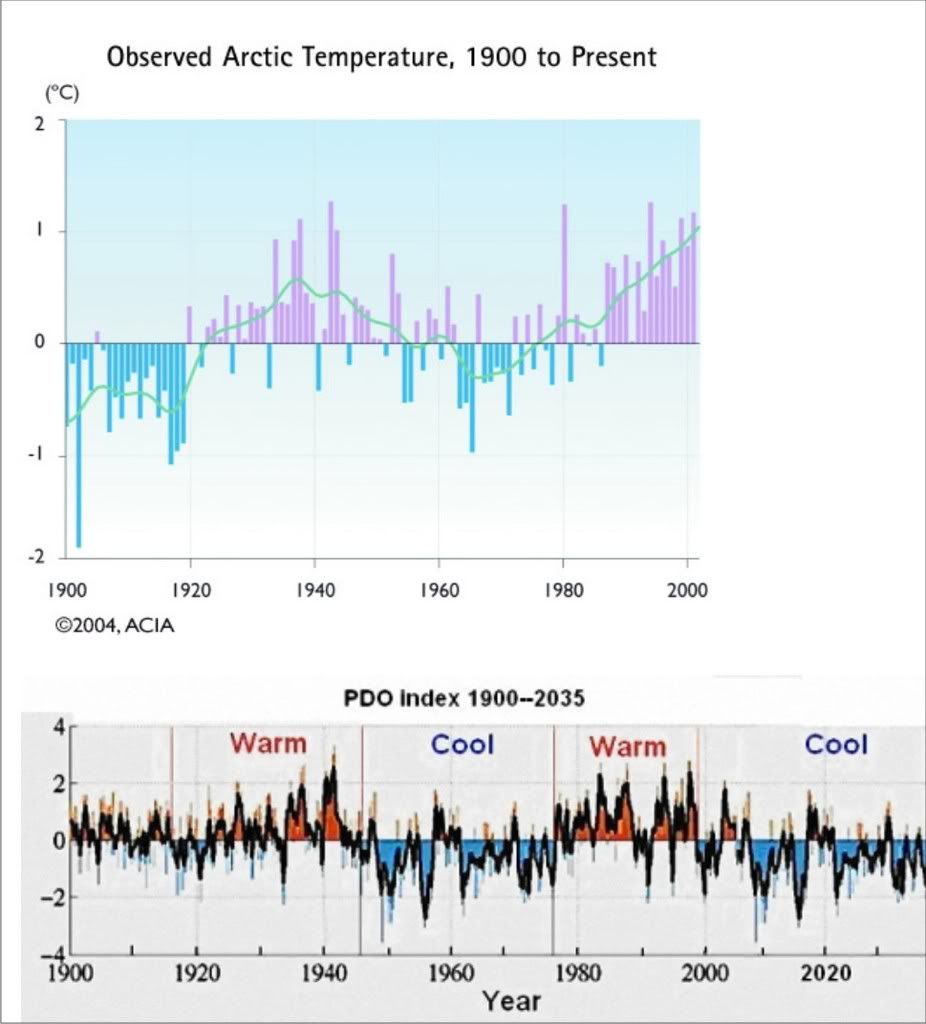
Compare the above graphic to the temperature history...
I put two graphs next to each other. Those peaks and troughs have some interesting similarity.
|
|
|
|
fierobear
|
SEP 02, 08:02 PM
|
|
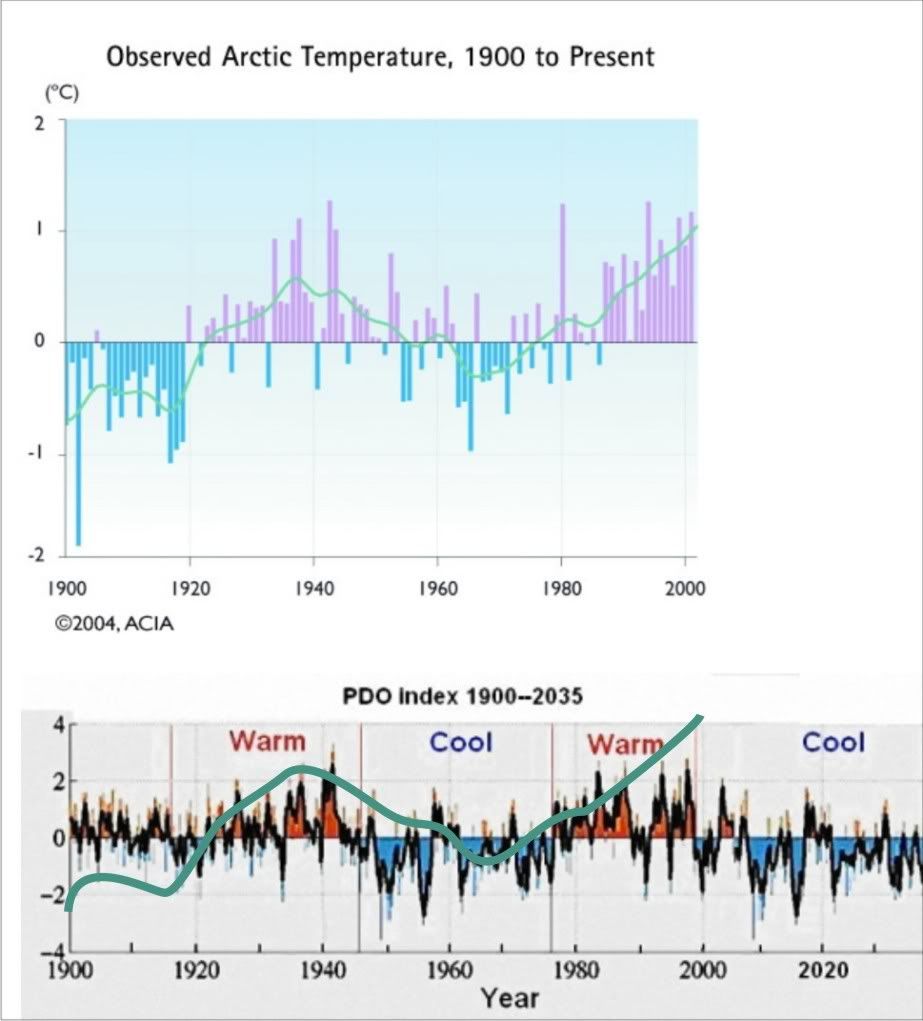
I traced the temperature line from the upper graph, and placed it over the lower graph. Interesting, huh?
.
.
So, what if the PDO was driving both temperature AND extra CO2 release from oceans, and the true correlation is PDO to temperature, and CO2 was a coincidence, like CO2 is everywhere else in history?[This message has been edited by fierobear (edited 09-02-2008).]
|
|
|
|
fierobear
|
SEP 03, 04:56 PM
|
|
We must take "extreme and risky action" to...solve a problem that might not exist!!!
Extreme and risky action the only way to tackle global warming, say scientists
· Geo-engineering 'better than doing nothing'
· Fake clouds among ideas in Royal Society papers
Political inaction on global warming has become so dire that nations must now consider extreme technical solutions - such as blocking out the sun - to address catastrophic temperature rises, scientists from around the world warn today.
The experts say a reluctance "at virtually all levels" to address soaring greenhouse gas emissions means carbon dioxide levels in the atmosphere are on track to pass 650 parts-per-million (ppm), which could bring an average global temperature rise of 4C. They call for more research on geo-engineering options to cool the Earth, such as dumping massive quantities of iron into oceans to boost plankton growth, and seeding artificial clouds over oceans to reflect sunlight back into space.
Writing the introduction to a special collection of scientific papers on the subject, published today by the Royal Society, Brian Launder of the University of Manchester and Michael Thompson of the University of Cambridge say: "While such geoscale interventions may be risky, the time may well come when they are accepted as less risky than doing nothing."
They add: "There is increasingly the sense that governments are failing to come to grips with the urgency of setting in place measures that will assuredly lead to our planet reaching a safe equilibrium."
Professor Launder, a mechanical engineer, told the Guardian: "The carbon numbers just don't add up and we need to be looking at other options, namely geo-engineering, to give us time to let the world come to its senses." He said it was important to research and develop the technologies so that they could be deployed if necessary. "At the moment it's almost like talking about how we could stop world war two with an atomic bomb, but we haven't done the research to develop nuclear fission."
Such geo-engineering options have been talked about for years as a possible last-ditch attempt to control global temperatures, if efforts to constrain emissions fail. Critics argue they are a dangerous distraction from attempts to limit carbon pollution, and that they could have disastrous side-effects. They would also do nothing to prevent ecological damage caused by the growing acidification of the oceans, caused when carbon dioxide dissolves in seawater. Last year, the Intergovernmental Panel on Climate Change dismissed geo-engineering as "largely speculative and unproven and with the risk of unknown side-effects".
Dr Alice Bows of the Tyndall Centre for Climate Change Research at the University of Manchester said: "I'm not a huge fan of messing with the atmosphere in an geo-engineering sense because there could be unpredictable consequences. But there are also a lot of unpredictable consequences of temperature increase. It does appear that we're failing to act [on emissions]. And if we are failing to act, then we have to consider some of the other options."
In a strongly worded paper with colleague Kevin Anderson in today's special edition of the society's Philosophical Transactions journal, Bows says politicians have significantly underestimated the scale of the climate challenge. They say this year's G8 pledge to cut global emissions 50% by 2050, in an effort to limit global warming to 2C, has no scientific basis and could lead to "dangerously misguided" policies.
The scientists say global carbon emissions are rising so fast that they would need to peak by 2015 and then decrease by up to 6.5% each year for atmospheric CO2 levels to stabilise at 450ppm, which might limit temperature rise to 2C. Even a goal of 650ppm - way above most government projections - would need world emissions to peak in 2020 and then reduce 3% each year.
Globally, a 4C temperature rise would have a catastrophic impact. According to the government's Stern review on the economics of climate change in 2006, between 7 million and 300 million more people would be affected by coastal flooding each year, there would be a 30-50% reduction in water availability in southern Africa and the Mediterranean, agricultural yields would decline 15-35% in Africa and 20-50% of animal and plant species would face extinction.
Martin Rees, president of the Royal Society, said: "It's not clear which of these geo-engineering technologies might work, still less what environmental and social impacts they might have, or whether it could ever be prudent or politically acceptable to adopt any of them. But it is worth devoting effort to clarifying both the feasibility and any potential downsides of the various options. None of these technologies will provide a 'get out of jail free card' and they must not divert attention away from efforts to reduce emissions of greenhouse gases."
Mike Childs of Friends of the Earth said: "We can't afford to wait for magical geo-engineering solutions to get us out of the hole we have dug ourselves into. The solutions that exist now, such as a large-scale energy efficiency programme and investment in wind, wave and solar power, can do the job if we deploy them at the scale and urgency that is needed."
|
|
|
|
Phranc
|
SEP 03, 05:52 PM
|
|
|
They do know that its been cooling for the last few years and warming right?Do these people even pay attention to the science anymore? Did they ever?
|
|
|
|
fierobear
|
SEP 03, 06:15 PM
|
|
| quote | Originally posted by Phranc:
They do know that its been cooling for the last few years and warming right?Do these people even pay attention to the science anymore? Did they ever? |
|
Why bother paying attention to the science, when the science seems to have it WRONG, and they are pushing for action NOW NOW NOW, regardless of any facts? This is no longer science. It's religion.
|
|
|
|
ryan.hess
|
SEP 03, 06:18 PM
|
|
"Cooling in the pacific is going to cool the globe" - Some retired Geology professor
Well there you have it. Case closed!
It's strange how one side rails against using limited satellite measurements, "one point measurements" (e.g. arctic temp), and skewed graphs (hockey stick).......... and yet here we are again!
Oh no! We're gonna die!
|
|
|
|