|
| Anyone try DOT 4 Synthetic Brake Fluid? (Page 2/4) |

|
theogre
|
OCT 14, 06:24 PM
|
|
|
|
|
Zac88GT
|
OCT 14, 07:35 PM
|
|
|
You might want to check out Castrol SRF. It's compatible with DOT3 and DOT4 systems and has very high boiling points. 590*F dry and 518*F wet, so it's wet boiling point is still higher than most other fluids dry boiling points. It's pretty expensive though, and hard to find locally so I ended up going with Motul RBF660 (617*F dry and 400*F wet).
|
|
|
|
pmbrunelle
|
OCT 14, 07:36 PM
|
|
| quote | Originally posted by theogre:
Topping up the MC tank w/ 4 is no point.. |
|
You don't add a bit of DOT 4 to an otherwise DOT 3 system in the hopes of raising the boiling point...
A typical scenario is my friend with a BMW who comes over to work on his car.
When he's done, he leaves behind half a quart of DOT 4 in the bottle.
Next time I work on my car, I'm not going to go out an buy a bottle of DOT 3; I'm going to use my BMW buddy's DOT 4 leftovers first.
|
|
|
|
Dennis LaGrua
|
OCT 16, 11:07 AM
|
|
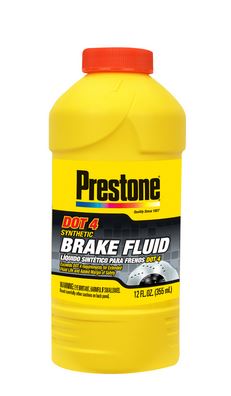
Here is the confusing part about "synthetic"
|
|
|
|
pmbrunelle
|
OCT 16, 12:08 PM
|
|
Well of course brake fluid is synthetic; brake fluid is man-made.
Brake fluid is not like gasoline; extracted from oil that came from the ground.
Advertising synthetic brake fluid is like talking about "fat-free ketchup".
|
|
|
|
Blacktree
|
OCT 16, 12:28 PM
|
|
... or gluten free meat 
|
|
|
|
theogre
|
OCT 17, 01:01 AM
|
|
or "Gluten free" labels on Swedish Fish and many other candies that never had it.
Many "Synthetic" oils and other things used that term that means little or nothing thanks to Mobil 1 losing a lawsuit to Castrol.
| quote | Originally posted by pmbrunelle:
Next time I work on my car, I'm not going to go out an buy a bottle of DOT 3; I'm going to use my BMW buddy's DOT 4 leftovers first. |
|
Any left over brake fluid will suck water right from air and "go bad" just sitting on a self. Often that doesn't take long too.
This "bad" fluid may not as low as wet boil but can't absorb wet fluid in a car during brake work and likely will reach wet boil or even boil lower then the spec sim to above testing.
Always Buy "fresh" fluid in factory seal bottle(s).[This message has been edited by theogre (edited 10-17-2020).]
|
|
|
|
Shho13
|
OCT 17, 11:12 AM
|
|
I flushed and did a complete DOT 4 conversion when I replaced all my brake hoses and calipers on my car a few years ago back I overhauled the brakes... Works perfectly fine. Been about 6 years now.
DOT 4 is compatible with DOT 3 and can be mixed.
DO. NOT. ADD. DOT. 5. DOT 5 is completely different and *will* break things. ------------------
"Discord"
Red 1988 GT under restoration!
Let's Go Mets!
( ͡° ͜ʖ ͡°)
|
|
|
|
pmbrunelle
|
OCT 17, 01:37 PM
|
|
| quote | Originally posted by theogre:
Any left over brake fluid will suck water right from air and "go bad" just sitting on a self. Often that doesn't take long too.
This "bad" fluid may not as low as wet boil but can't absorb wet fluid in a car during brake work and likely will reach wet boil or even boil lower then the spec sim to above testing.
Always Buy "fresh" fluid in factory seal bottle(s).
|
|
I will usually go through a bottle of brake fluid within about half a year of opening it.
What's the difference between half a year stored on a shelf with the cap closed, vs. half a year extra on the vehicle?
I didn't think that my habit of keeping opened brake fluid bottles on the shelf for half a year was so bad, given that you have people driving around on 10+ year old brake fluid.
I guess the real answer to this question is that I have to buy a brake fluid tester like yours. I already have too many auto parts/tools, and not enough places to store this stuff...
|
|
|
|
theogre
|
OCT 18, 12:55 AM
|
|
| quote | Originally posted by pmbrunelle:
I will usually go through a bottle of brake fluid within about half a year of opening it.
What's the difference between half a year stored on a shelf with the cap closed, vs. half a year extra on the vehicle?
I didn't think that my habit of keeping opened brake fluid bottles on the shelf for half a year was so bad, given that you have people driving around on 10+ year old brake fluid.
I guess the real answer to this question is that I have to buy a brake fluid tester like yours. I already have too many auto parts/tools, and not enough places to store this stuff... |
|
Most bottle caps won't seal even if have "gaskets" in them.
Threads etc wet w/ fluid have a easy path for water to get at the rest of bottle. Remember B-fluid attract water then move it so everywhere = out that water... like water will seek level everwhere.
Depended on where stored open bottles can reach wet boil spec in a few days because Many keep in basements, garages, and other places w/o AC allowing local weather to get at the open bottle.
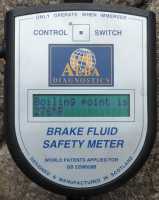
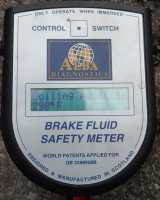
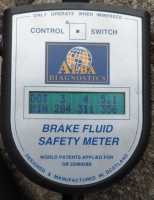
Fluid in cars w/ good caps etc will take a lot longer to see wet boil. Above test is DOT 4 after ~ 20 of only Dot 4 in the system and "flushed" nearly 10 years ago.
But Leave Bottle and/or MC cap open, more so w/ these GM Brake MC and its huge cap, and can be at Wet Boil or lower Very fast. Depending on weather can be super fast meaning Hours to 1 day to see wet boil or worse.
I got tool above from shop went bankrupt.
Boil tool above and related are way out price rage for most DIY. OTC, Mactools, and more makes/sells several types including "rebrand" of tool shown above (Like OTC 3890) often at ~ $350 or more.
Seem some "knockoffs" of tool above available for ~ $100.
Are "Cheap" test methods but many are specific to fluid used. IOW Many only work in 1 DOT X fluid or results mean nothing.
Some "cheap" testers are unreliable and break easy. Example: Ones that are "pen size" make sure only the probe tips are in fluid. Otherwise fluid can get into it and ruin the guts.
Side Note: OTC 3890 Brake Fluid Tester is used by Porsche and likely other car brands... https://static.nhtsa.gov/od...MC-10166922-0001.pdf
SPX/OTC likely bought original maker of above tester also now owns Kent-moore that made nearly all GM specialty tools in all FSM
|
|
|