
 
     |
| Is it something in the air ? (Page 18/20) |

|
Wichita
|
JAN 16, 04:44 AM
|
|
According to the World Economic Forum, the conference where the ultra wealthy fly into Davos to party with Hollywood celebrities. A casual dressed Burning Man of sorts where they all get drunk and do blow and hookers to discuss the world's problems.
This is what they came up with while spewing more C02 than 99.9% of the population does.
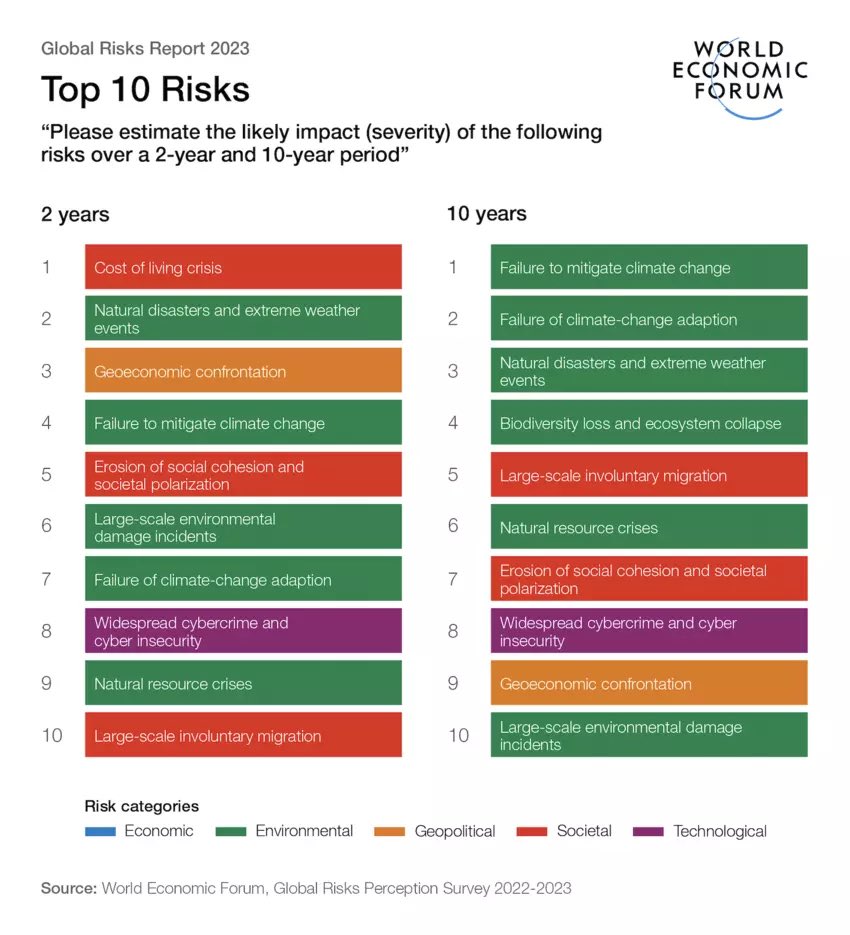 [This message has been edited by Wichita (edited 01-16-2023).]
|
|
|
|
rinselberg
|
JAN 16, 08:19 AM
|
|
Some people are concerned about "different other" risks.
|
|
|
|
82-T/A [At Work]
|
JAN 16, 09:20 AM
|
|
| quote | Originally posted by rinselberg:

These eminently edible gummy bears were made from a "bioplastic" resin that has been tested by researchers at Michigan State University.
The researchers say that their new resin could be used to manufacture the very largest wind turbine blades, and that such future wind energy "behemoths" would be more readily recyclable than the glass fiber composite wind turbine blades that are currently representative of the industry. Wind turbine blades made from this resin could be recycled into many in-demand products—including newly manufactured wind turbine blades.
Let me be proactive and consider the (likely) question "Why would it be useful to recycle wind turbine blades into newly manufactured wind turbine blades?"
Wind turbine blades have a fixed service lifetime. And there could be advantage in preemptively replacing even serviceable blades with larger blades, or blades of a different and improved design. Replacing wind turbine blades before the end of their originally projected service life. That's upping the wind energy game from checkers to chess (metaphorically speaking).
|
|
This is dangerous territory. I really like gummy bears...
I still think they should / could be using those old blades for something... like making roofing materials, etc. It kills me that they just felt it necessary to dump them all in the desert.
|
|
|
|
rinselberg
|
JAN 16, 10:25 AM
|
|
| quote | Originally posted by 82-T/A [At Work]:
I still think they should / could be using those old blades for something... like making roofing materials, etc. It kills me that they just felt it necessary to dump them all in the desert. |
|
Carbon Rivers is building a facility to process discarded wind turbine blades.
https://www.carbonrivers.com/
|
|

|
cliffw
|
JAN 19, 05:28 PM
|
|
| quote | Originally posted by rinselberg:
... Evidence-Based Decarbonization Methodologies.
|
|
That BS,  , may sound warm and fuzzy to the Green Nuts but it is bunk. Go ahead, tell us how it decarbonizes even a little bit. , may sound warm and fuzzy to the Green Nuts but it is bunk. Go ahead, tell us how it decarbonizes even a little bit.
| quote | Originally posted by rinselberg:
Think of a truck that shuttles freight between a container ship port and a close by rail yard, in an intermodal freight transport context. It creates a relatively short stretch of roadway where overhead electrification for trucks, or fast battery recharging infrastructure gets a lot of decarbonizing "bang for the buck." It also lends itself to an efficient deployment of "green" hydrogen infrastructure, for trucks that are electrified with hydrogen-powered fuel cells instead of (or as an optional mode, along with) batteries.
The exact situation I describe. For trucks shuttling freight between a container ship port and a close by rail yard.
I have some posts about it in some other threads.
|
|
I heard you spout this nonsense before. You mentioned a six mile electric zone. What are you trying to do ? Save the planet six miles at a time ? Now you are pipe dreaming about hydrogen fuel cells and green hydrogen infrastructure. With all the planet ingredients in batteries, Why didn't we start with hydrogen fuel cells,  ? ?
|
|
|
|
rinselberg
|
JAN 19, 09:09 PM
|
|
| quote | Originally posted by cliffw:
You mentioned a six mile electric zone. What are you trying to do? Save the planet six miles at a time? |
|
That's a reference to one of the trucking routes that the California Air Resources Board or CARB has their (beady) eyes on, as one of the first trucking routes or corridors that they want to have decarbonized with electric and/or hydrogen fuel cell-powered trucks.
It's a route where trucks are shuttling freight from a container ship port, along a six-mile stretch of roadway to railroad terminals and distribution warehouses where the goods are loaded onto freight trains or other trucks for long distance and nation-wide distribution. And vice-versa. The same trucks move freight along the six-mile corridor in the opposite direction, from railroad terminals and distribution warehouses to the container ship port, for export.
It's decarbonization, and it also addresses the disproportionate exposure of the people in these neighborhoods to the harmful emissions from the currently diesel-powered truck traffic on this six-mile corridor and others like it. As I (tried to) summarize in the second post or first reply, way back on page 1:
https://www.fiero.nl/forum/.../HTML/000377.html#p1[This message has been edited by rinselberg (edited 01-19-2023).]
|
|

|
cliffw
|
JAN 23, 08:25 AM
|
|
| quote | Originally posted by rinselberg:
... California Air Resources Board ...
... decarbonized |
|
Your a funny guy.
What should I or anyone else give a damn damn about CARB, ? Have you read their mission statement? The California Air Resources Board is one of six boards, departments, and offices under the umbrella of the California Environmental Protection Agency. Why only six ? How many OverLords do you want, ?
CARB is a self grandiose organization.
Again with "decarbonization", ! You never did define that word. Why is it that progressives make up words or re-define existing words ? I don't understand it. Now we are told "equity" means equality. It does not. What the Progressives mean is that everyone gets a trophy. When actually equity means an increase in outcome due to an increase in effort.
I could go on about Progressive word hijacks, but, that is not about this particular discussion.
| quote | Originally posted by rinselberg:
It's a route where trucks are shuttling freight from a container ship port, along a six-mile stretch of roadway to railroad terminals and distribution warehouses where the goods are loaded onto freight trains or other trucks for long distance and nation-wide distribution. And vice-versa. The same trucks move freight along the six-mile corridor in the opposite direction, from railroad terminals and distribution warehouses to the container ship port, for export. |
|
BRILLIANT !
What you think will save the planet, does NOTHING ! Moving the trucks six miles away solves NOTHING. Tell me how you think it will.
| quote | Originally posted by rinselberg:
It's decarbonization, and it also addresses the disproportionate exposure of the people in these neighborhoods to the harmful emissions from the currently diesel-powered truck traffic on this six-mile corridor and others like it. As I (tried to) summarize in the second post or first reply, way back on page 1:
https://www.fiero.nl/forum/.../HTML/000377.html#p1
|
|
"Disproportionate" . That's rich. Not as rich as "comprehension" blah, blah, blah. But it is rich. What makes those people in these neighborhoods "slaves" to those those neighborhoods, .
|
|
|
|
rinselberg
|
JAN 23, 09:02 AM
|
|
| quote | Originally posted by cliffw:
What you think will save the planet, does NOTHING ! Moving the trucks six miles away solves NOTHING. Tell me how you think it will. |
|
I'm talking about short stretches of roadway where currently, diesel-powered trucks load freight that's been offloaded from container ships and move it farther inland, where there are railroad and long distance trucking facilities to ship the freight to destinations nationwide. Imported goods.
The same diesel-powered trucks also move freight in the opposite direction, from the railroad and long distance trucking warehouses, to the container ship port where the freight is containerized and loaded onto container ships for export.
These diesel-powered trucks are shuttling back and forth over relatively short stretches of roadway. One such stretch is about six miles, but that's just the example that stuck in my mind. Six miles. Ten miles. Three miles. There's nothing "magic" about six miles.
So you have short stretches of roadway with a lot of traffic from the same diesel trucks all the time, shuttling freight in both directions.
These are the roadways that the California Air Resources Board or CARB wants to prioritize in terms of replacing the currently operating diesel-powered "shuttle trucks" with electric-powered shuttle trucks, or hydrogen-powered shuttle trucks.
You might want to go back to the very beginning of this thread and look at the brief article that was posted by MidEngineManiac when he started this thread.
|
|
|
|
Wichita
|
JAN 24, 06:13 PM
|
|
Don't eat meat, don't eat plants. What's left?

|
|
|
|
randye
|
JAN 24, 06:41 PM
|
|
| quote | Originally posted by Wichita:
Don't eat meat, don't eat plants. What's left?
|
|
$cientology founder, and drug crazed lunatic, L. Ron Hubbard was convinced that plants can communicate and that they are also infested with the spirits of dead space aliens.

Crazy people abound.
It must be something in the air.[This message has been edited by randye (edited 01-24-2023).]
|
|
|
|