
 
     |
| Your opinions on how to lower Hydrocarbons? (Page 1/2) |

|
Kitskaboodle
|
NOV 28, 06:28 PM
|
|
I took my truck to the smog shop today and it passed. However, I noticed that one of the emission parameters is getting toward the Max limit. (HC / Hydrocarbons) The other two numbers, CO and Nox look very good for an engine that has an estimated 530K miles. (give or take since my Speedo has been dead a long time)
All that said, what specific areas I should look at to lower HC / hydrocarbons?
See attached report on the emission numbers.
Kit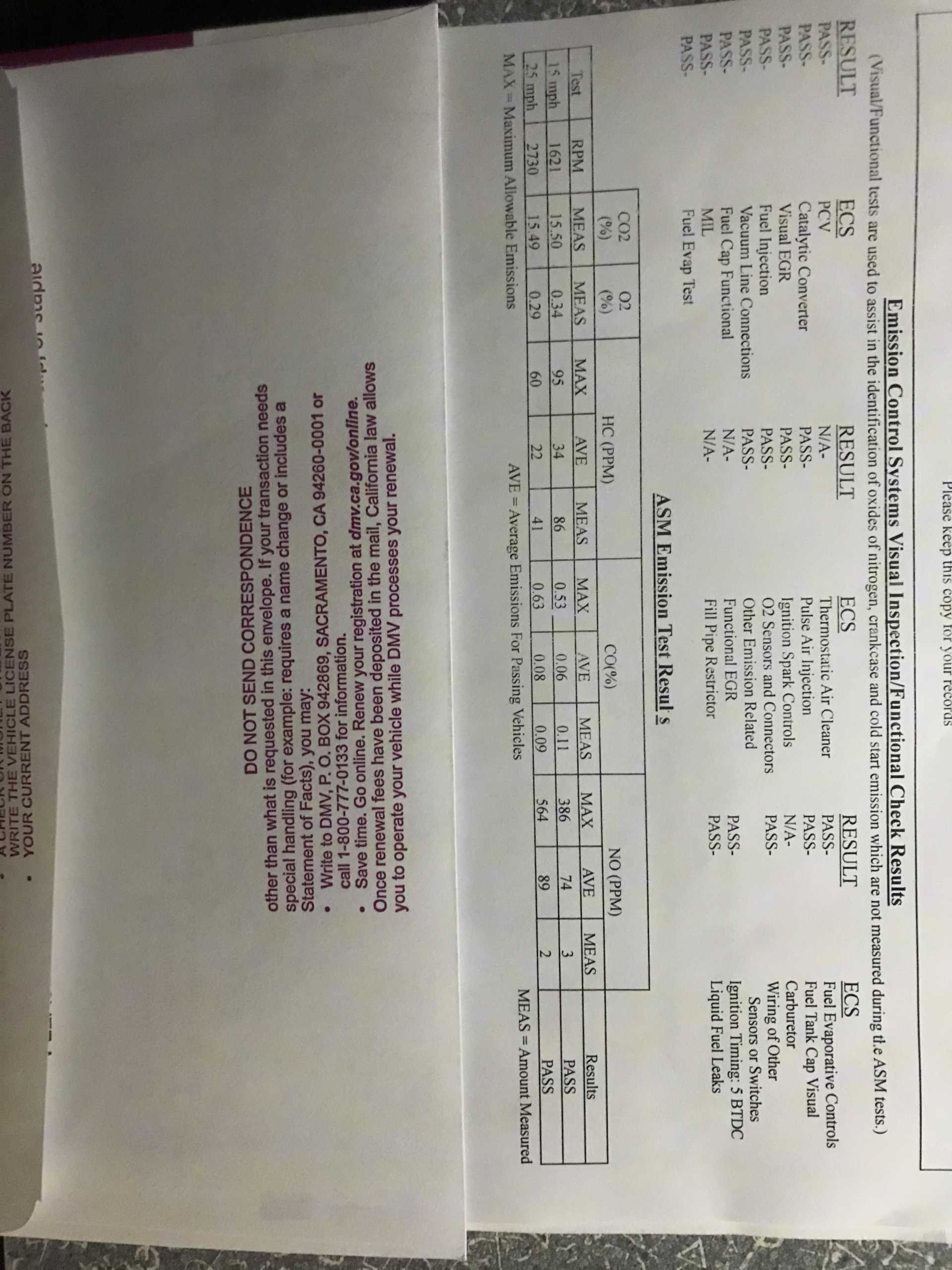
|
|
|
|
Raydar
|
NOV 29, 08:51 AM
|
|
What year/make is your truck? OBD2? Or earlier?
It has been my understanding that CO and HC are mostly controlled by the catalyst, and NOx is mostly controlled by EGR.
But I haven't had to smog anything for almost six years now, so... my memory could be incorrect.
It might be possible that your truck is running rich at lower RPM. Might have a leaky injector. Could be an Oxygen sensor that is aging.
I had an O2 sensor to fail, indicating "full lean" which caused my engine to dump gas in. Was so rich that it made my eyes water when I stood behind the car, and killed my catalyst.
If you have a scanner, look at Fuel Trim, to see if it's adding or removing fuel from "baseline". If it's removing, it thinks you're running too rich. But it will only be able to remove so much.[This message has been edited by Raydar (edited 11-29-2025).]
|
|
|
|
Kitskaboodle
|
NOV 29, 12:55 PM
|
|
Thanks for the input Raydar. Truck is a 94 Toyota pickup/ 22re 4 cylinder/ OBD1
Injectors are original. I do run Seafoam, Regane through the intake and gas tank every so often. How do you check injector performance without pulling them out?
On another note, I wanted to mention one more area of concern that I have about my engine. Believe it or not, I’m on the original timing chain. Yes, 530K on the original chain. About two years ago I finally got around to replacing my oil pan gasket as it had been leaking for years. Not an easy job to get to it so I waited for years to get it done. Anyways, when I pulled the pan off, the timing chain guides were sitting at the bottom of the pan in pieces. Not a shock since the guides are plastic and after 530K the chain will slap after this many years and miles of stretching. That being said, I don’t if it has stretched enough to make the valve timing so off that it is affecting some emission numbers. The engine seems to run fine, is relatively smooth with no surging, hiccups or anything else. I have already bought (a year ago) all that is needed to do the timing chain but it’s a big job and I don’t feel like tackling that job just yet.
Your thoughts? Kit
|
|
|
|
Raydar
|
NOV 29, 04:00 PM
|
|
If you're running Seafoam, it's probably gone a long way towards keeping the injectors clean.
The only way I can think of to test, without taking a lot of stuff apart, is to hook up a pressure gauge (assuming you've got a shrader valve on the fuel rail somewhere), and allow the system to prime. It should maintain pressure - at least for a little while. A slow bleed-off, after a few seconds, might not be ideal, but it's better than the pressure dropping off immediately.
Also, I'm not sure how your regulator and return line are set up. I could be sending you down a rabbit hole.
Is your truck a Tacoma? I know a guy who had a 95. It was damn near un-killable.
Gotta be some 'Yota experts here. Maybe they'll jump in.
|
|
|
|
Kitskaboodle
|
NOV 29, 08:02 PM
|
|
Good idea about the leak/down test. I know I’ve done that on my Fiero, although the V6 has the fuel pressure regulator right on the rail. Not sure about the 22re.
The rule is this:
89-95 is my generation and is called the “pickup”.
In 96 they went to a new generation with a more aero front end called the “Tacoma”. Or as some 4x4 guys call them, “Taco’s”.
Did you have any input on my previous post about valve timing affecting hydrocarbons? There is a possibility my valve timing is off due to 530K on a stretched chain. Kit
|
|
|
|
Kitskaboodle
|
NOV 29, 08:12 PM
|
|
Here is a pic of my engine for reference.
Kit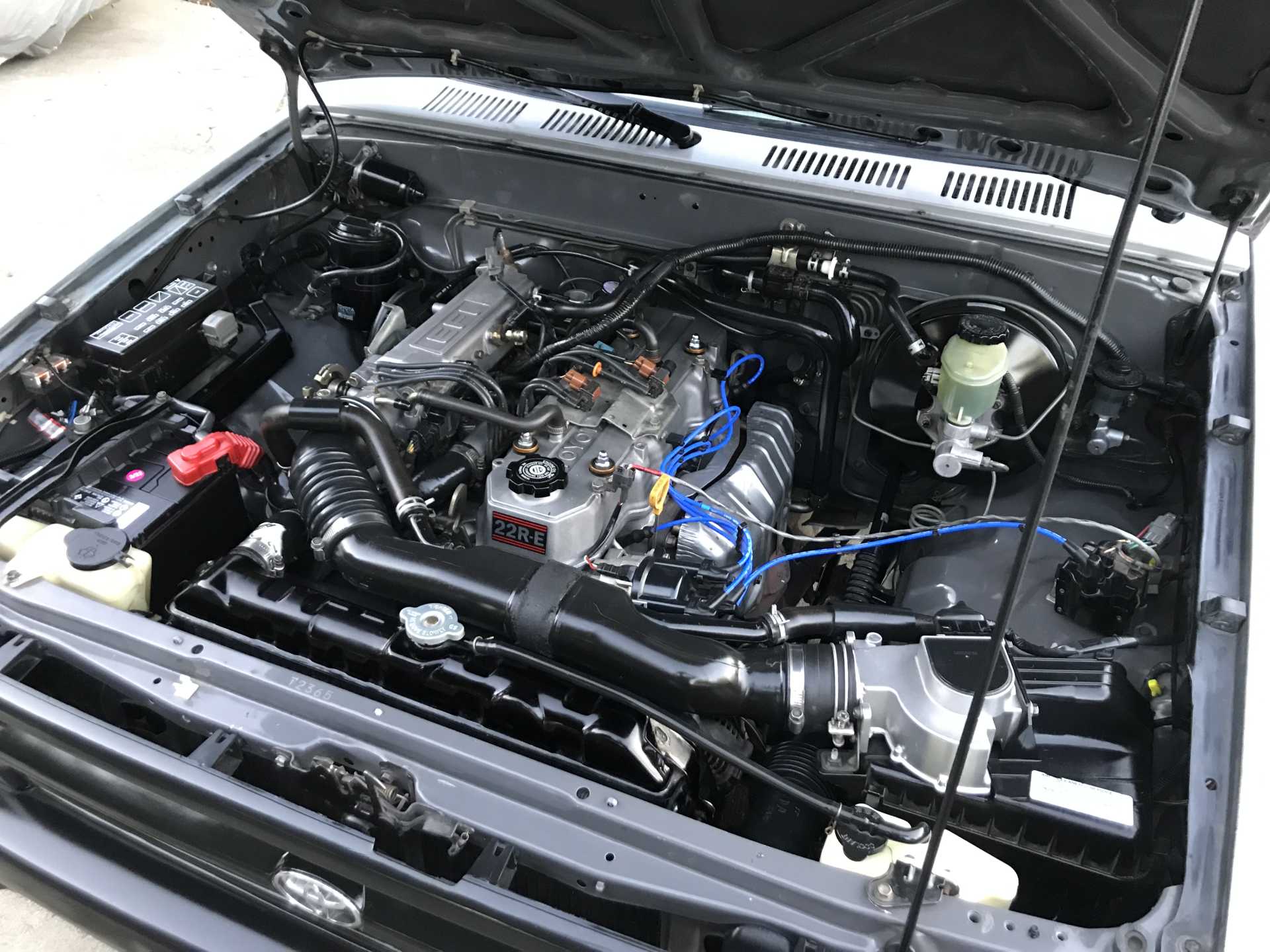
|
|
|
|
cartercarbaficionado
|
NOV 30, 12:01 AM
|
|
| quote | Originally posted by Kitskaboodle:
Thanks for the input Raydar. Truck is a 94 Toyota pickup/ 22re 4 cylinder/ OBD1
Injectors are original. I do run Seafoam, Regane through the intake and gas tank every so often. How do you check injector performance without pulling them out?
On another note, I wanted to mention one more area of concern that I have about my engine. Believe it or not, I’m on the original timing chain. Yes, 530K on the original chain. About two years ago I finally got around to replacing my oil pan gasket as it had been leaking for years. Not an easy job to get to it so I waited for years to get it done. Anyways, when I pulled the pan off, the timing chain guides were sitting at the bottom of the pan in pieces. Not a shock since the guides are plastic and after 530K the chain will slap after this many years and miles of stretching. That being said, I don’t if it has stretched enough to make the valve timing so off that it is affecting some emission numbers. The engine seems to run fine, is relatively smooth with no surging, hiccups or anything else. I have already bought (a year ago) all that is needed to do the timing chain but it’s a big job and I don’t feel like tackling that job just yet.
Your thoughts? Kit |
|
you need to do that.... like 6 months ago... the last time i had a 22re that did that to the guides we had a real fun time rebuilding the engine since it litterally dropped the chain and made everything a little.....too friendly..
and the cat is trashed. ours let us know it wasnt gonna pass emissions and was pretty swiss cheesed inside right before the engine let go
|
|
|
|
Kitskaboodle
|
NOV 30, 03:16 PM
|
|
Understood that I should have changed the chain long ago. In fact, many 22re owners change their timing chain at 250-300K. Yes, it’s a risk to keep on driving it. I am pretty careful about how I drive it though. I keep my speeds below 67-68 max on the freeway and I don’t beat on my truck like some Yota owners. All my oil changes are done at 3500 miles or less and I keep the rpm’s way down below 3000 rpm.
On a different note, they say that if and when you start hearing grinding going on inside the front of the engine, you will know that your chain is starting to “eat” into the side of block and/or timing cover. Mine is not doing this……yet. 😀
At the slightest hint of grinding, the truck will immediately get parked until I can get to the job
Kit
|
|
|
|
cartercarbaficionado
|
NOV 30, 04:06 PM
|
|
| quote | Originally posted by Kitskaboodle:
Understood that I should have changed the chain long ago. In fact, many 22re owners change their timing chain at 250-300K. Yes, it’s a risk to keep on driving it. I am pretty careful about how I drive it though. I keep my speeds below 67-68 max on the freeway and I don’t beat on my truck like some Yota owners. All my oil changes are done at 3500 miles or less and I keep the rpm’s way down below 3000 rpm.
On a different note, they say that if and when you start hearing grinding going on inside the front of the engine, you will know that your chain is starting to “eat” into the side of block and/or timing cover. Mine is not doing this……yet. 😀
At the slightest hint of grinding, the truck will immediately get parked until I can get to the job
Kit |
|
i was not lucky enough to get to the warning. and almost 70 mph aint exactly slow in these considering its turning almost 3700 rpm in ours doing that
|
|
|
|
Raydar
|
DEC 01, 10:27 AM
|
|
If it's an interference engine, I would go ahead and do the timing set and guides. Sooner than later.
Don't know if that would effect HC readings, though. I know that some manufacturers (like GM) use VVT to reduce NOx.
We had a J35 (V6) Honda to prematurely frag a timing belt. Bent three intake valves. Of course it was spread across both heads. But you've only got one head to tear up. 
|
|
|
|