|
| LS4 V8 DoD 4T65-E TAPShift swap underway (pics inside) (Page 2/39) |

|
Joseph Upson
|
SEP 13, 01:10 PM
|
|
| quote | Originally posted by FIEROPHREK:
Hey Joe you always want your coolant to flow out of the T-stat. If cool coolant flowed past it, it would stay closed all the time. If Darth doesn't want to rip that water pump off and post pics i can disassemble mine and post some pics. Keep the pic coming 
|
|
That's why I've been so concerned about my situation, I haven't received confirmatory information for my engine in which case my hoses would be connected backwards. It just didn't seem right for it to have traditional flow pattern with the thermostat at what is normally the inlet on previous engines so I'll swap the hoses around especially given you are absolutely right about the premature closing of the thermostat that would result. In my case it might not manifest very easily since I drilled some safety holes in the face of the stat in the event of a failure to allow some coolant flow.
|
|
|
|
AkursedX
|
SEP 13, 01:35 PM
|
|
|
I would assume by the porting job that the owner of this car is looking for some more power. I know there isn't much out there for the ls4 yet, but Harland Sharp apparently makes 1.8 rockers for this engine. That might be something the owner would be interested in.
|
|
|
|
Darth Fiero
|
SEP 13, 04:19 PM
|
|
| quote | Originally posted by Joseph Upson:
Where did you get your information on the coolant flow? It looks like the coolant would flow in the opposite direction since the thermostat housing appears to be located centrally at the back of the pump. I was confused for a moment with the 3900 coolant flow since the thermostat is located in the same area as shown in your picture however, the filler neck and crossover mounted at the end of the heads up high suggested that despite the thermostat location it is the inlet point for coolant. |
|
I was looking thru the service manual for the LS4 and found some pictures in the section titled "Radiator Hose Replacement - Outlet LS4". Here is a picture from that section showing the outlet hose and where it connects to the engine...
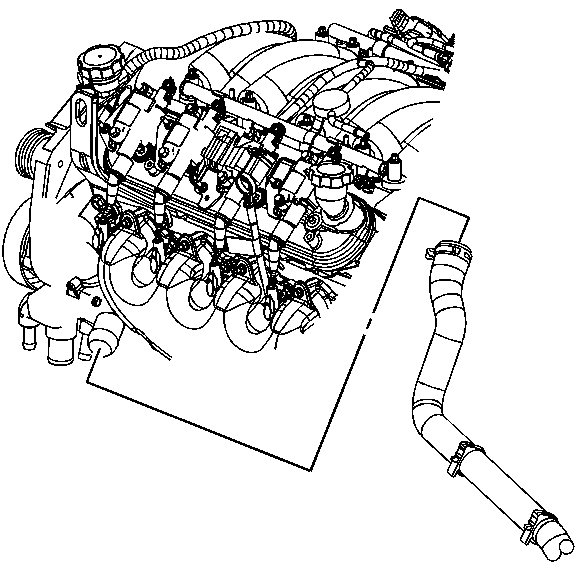
EDIT: My initial statement about coolant inlets and outlets turned out to be incorrect/backwards. The coolant inlet to the engine is in-fact the t-stat housing. The smaller coolant port just below this housing is the heater core return to the engine which routes returning coolant across the t-stat. There is a bypass hole that connects the inlet/outlet portions of the system that gets closed off once the t-stat opens. Before that (with t-stat closed) coolant is allowed to circulate between the two sections of the system so the t-stat will always see a constant flow of coolant.
I apologize for this mistake and will update the coolant flow pics as soon as possible.
-ryan[This message has been edited by Darth Fiero (edited 11-21-2007).]
|
|
|
|
Joseph Upson
|
SEP 13, 04:40 PM
|
|
| quote | Originally posted by Darth Fiero:
I was looking thru the service manual for the LS4 and found some pictures in the section titled "Radiator Hose Replacement - Outlet LS4". Here is a picture from that section showing the outlet hose and where it connects to the engine...
As you can see in the picture, the indication is the outlet hose connects to the t-stat housing. The heater hose connection that comes in closest to the t-stat housing I assume is the hot water outlet to the heater core. Therefore the two other ports must be returns. |
|
Thanks, my problem is that I'm apparently not paying as close attention to detail as I should. My picture of the hose connection is titled rad outlet and I was so focused on the picture which has no writing indicating the direction that I missed the title description. So my hoses are connected backwards which explains why things didn't make since to me when looking at the fitting arrangement.
What I don't like about this configuration on my engine is the height of the inlet, and the pump configuration which sucks water out of the block as opposed to pushing it through the heads then out the bottom of the block. It can also be a problem in the event of a low coolant level in my case if there is not enough water to push into the inlet which sits kind of high.[This message has been edited by Joseph Upson (edited 09-13-2007).]
|
|
|
|
FIEROPHREK
|
SEP 13, 05:00 PM
|
|
Hey Joe don't forget that the LS series of motors untilizes reverse flow cooling. The round holes on the waterpump housing are for coolant into the engine. The square holes are for the coolant out of the engine.
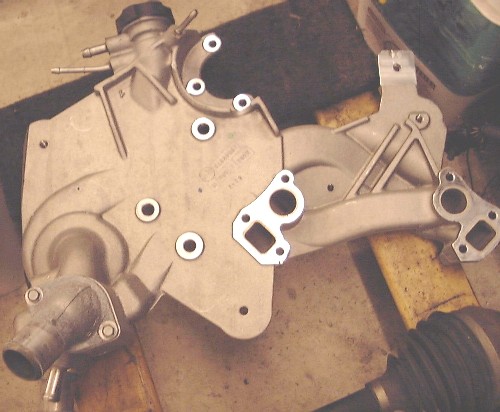
There are actually 4 passagways in the housing. If your hoses where hooked up backwards the only thing i think it would do is change the direction of coolant flow through your radiator. That might create some issues with your coolant overflow since it is now on the hot side of the rad.------------------
ARCHIES JUNK IS FASTER THAN SHAUNNA'S JUNK

|
|
|
|
blkcofy
|
SEP 14, 12:50 AM
|
|
This is why I fell in love with the LS4. For the last 2 years I've been eyeing the 3.8 Series II/III S/C until I started to learn more and more about this engine. With all of the porting Ryan's done and with the planned tuning, I'm hoping to deliver at least 340hp. And I'm guessing the all aluminum engine block is lighter than the 2.8L that's coming out!
[From ]www.modernracer.com]
The heart of the Grand Prix GXP is the new 5300 V-8 – the first time in almost 20 years that a V-8 engine has been offered in a Grand Prix. It also is the first application ever for the small-block V-8 in a front-wheel-drive configuration.

Engineered specifically for front-drive layouts, the 5300 V-8 produces a peak of 303 horsepower and 323 lb.-ft. of torque – with 90 percent of torque available from 1500 rpm to 5200 rpm. It also incorporates Displacement on Demand (DOD) technology, which debuted in 2005 GM extended midsize SUVs equipped with the Vortec 5.3L V-8 (LH6) engine.
With the 5300 V-8, DOD technology enables fuel economy gains of up to 12 percent in certain driving conditions by reducing the number of cylinders engaged in the combustion process. A sophisticated engine controller determines when to deactivate cylinders, allowing the engine to maintain vehicle speed in lighter load conditions such as highway cruising. When the cylinders are deactivated, the engine effectively operates as a V-4, with alternate cylinders on each cylinder bank disabled. The engine returns to V-8 mode the instant the controller determines the vehicle speed or load requires additional power. The process is seamless and virtually imperceptible.
The all-aluminum 5300 V-8 is based on the Gen IV small-block architecture, but is modified to accommodate the “east-west” mounting position of the Grand Prix’s front-wheel-drive chassis. To fit the “sideways” positioning in the Grand Prix, several changes were made to reduce the engine’s overall length, including the use of a shorter crankshaft and a single-belt accessory drive system.[This message has been edited by blkcofy (edited 09-14-2007).]
|
|
|
|
Madess
|
SEP 14, 08:06 AM
|
|
|
Ok question - I want to do an LS4 swap as well - but I want to go with a manual tranny. Computer wise is this possible and if so, what is required?
|
|
|
|
Will
|
SEP 14, 01:36 PM
|
|
|
The Gen III and IV engines are NOT, to my knowledge, reverse flow cooling. That was a trick that GM used with the Gen II's to get a little more from the outdated design before the Gen III came out.
|
|
|
|
FIEROPHREK
|
SEP 14, 05:01 PM
|
|
| quote | Originally posted by Will:
The Gen III and IV engines are NOT, to my knowledge, reverse flow cooling. That was a trick that GM used with the Gen II's to get a little more from the outdated design before the Gen III came out. |
|
I'm not sure if GM considers it "reverse flow" anymore but i just went outside and ran some water through the pump ports. I ran water into the round ports and water came out of the inlet tube on the housing. That round port on the block goes right to the heads. The heads get the coolant first.
------------------
ARCHIES JUNK IS FASTER THAN SHAUNNA'S JUNK
|
|
|
|
blkcofy
|
SEP 15, 03:47 PM
|
|
| quote | Originally posted by Madess:
Ok question - I want to do an LS4 swap as well - but I want to go with a manual tranny. Computer wise is this possible and if so, what is required? |
|
To try to answer your specific question, I was strongly advised against keeping my 5sp manual getrag. Despite the fact that it is a newly rebuilt tranny w/ less than 300 miles on it the logic thought of 135hp engine match w/ now a 340hp engine match probably doesnt make alot of sense. While many folks have reported that the Getrag should have been able to handle the power, I've weighed that advice vs logic, as well as hearing many of these same Getrag loyals looking for new tranny's after a few years. I've had my car for 14 years and would like to have it another 14, so I opted with using the tranny that came with the engine (4T65e). Now, I actually ended up having Ryan practically rebuild compenents on it to handle future power upgrades as well as more aggressive shifting since I'm also keeping the TAPShift functionality. Would I have loved to keep a manual in the car? H-E-double toothpick yeah! So I did look into it further and found that the 6sp tranny in the G6 would be a possible option. I think you'd still have to do some mods to it to firm it up, as the G6 GTP is only 252hp.
Keep asking and looking if you want to go manual...look into the G6 even. And if you think you actually can use a 5sp Getrag....do I have a deal for you!! 
|
|
|