
 
     |
| Blooze Own: An F355 Six Speed N* Build Thread (Page 112/126) |

|
cptsnoopy
|
SEP 17, 12:55 PM
|
|
Beeeautiful! 
Charlie

|
|
|
|
fierogt28
|
SEP 17, 11:32 PM
|
|
Blooze, that's nice clean work. It too, suprises me why there is more spot welds
on the 88, than the 85. Very good to know as reference.
I'm happy to see how clean you lower rails are going to be. In the past I thought
that the cradle rear nut inside the rail was tack welded. Now we see clearly that its in
an cage spot welded instead. Your like me...I like a car just as clean underneath as on
top. Only good weather, and no "in the rain" driving.
Plus, that reinforcement plate is good news...I guess for the folks who actually never
get to see the inside of their fiero frame.  ------------------
fierogt28
88 GT, Loaded, 5-speed.
88 GT, 5-speed. Beechwood interior, All original.
|
|
|
|
Yarmouth Fiero
|
SEP 18, 07:09 AM
|
|
I am glad you were able to put those frame rails to good use. Its a sin to throw good metal away.
As always, your workmanship is impeccable Blooz and certainly an inspiration for the rest of us in the midst of our own projects.
edit: for early morning poor grammar[This message has been edited by Yarmouth Fiero (edited 09-18-2014).]
|
|
|
|
Bloozberry
|
SEP 24, 09:29 PM
|
|
Thanks cptsnoopy, fierogt28, and Yarmouth Fiero.
Last weekend I popped by Yarmouth Fiero's place to check in on his progress and was stunned by how robust his new rear lower frame rails look compared to the stock Fiero parts that I'm working on. He's lopped off the stock lower rails and strut towers and is setting up with 2" x 4" rectangular tubing running straight back instead of angling inwards. His engine bay looks truly cavernous now making mine look like a toy!
What little time I got to work on my car over the last week was mostly spent aligning and welding the RH lower rail back together. That meant pulling the engine and transmission off the cradle and using the bare cradle as an alignment jig. It's always a good thing to double check these sorts of things before final welding! Everything checked out so I zip-zapped the RH rail in place:

I ground the welds flush, re-primed them, and was finally back to where I started a couple weeks ago before discovering the rusty lower rails: recessing the rear bumper. I mentioned earlier that I had decided to cut back the lower frame rails by 2" to allow the bumper bar to fit the inside of the fiberglass fascia. Recall that the previous owner simply removed the bar altogether and hadn't planned on using anything.  The rail halves that I got from Yarmouth Fiero were already shortened but I still needed to lop off 2" from the portion of the rails that were mine. The left-most black line shows where it needed to be cut back: The rail halves that I got from Yarmouth Fiero were already shortened but I still needed to lop off 2" from the portion of the rails that were mine. The left-most black line shows where it needed to be cut back:

It was quick work with the cut-off wheel in the angle grinder:

The plan is to re-weld the bumper bar mounting flanges onto the rail ends like this:

|
|
|
|
355Fiero
|
SEP 25, 02:28 AM
|
|
Hey Blooz;
Nice work on the rails and the bumper idea. I had planned on putting a 2x2" or 2x3" (if it fit) 1/8" thick square tube across the lower rails to act as my rear bumper. I just wasn't sure how big of a bumper I was going to be able to fit in there and there was still a lot of body mods to go before I was going to work on that.
I like your idea a lot more than what I was going to do behind the rear bumper. Nice work Yours will be much safer than what I was thinking.
Cheers
Don
|
|
|
|
Bloozberry
|
OCT 03, 10:17 PM
|
|
Thanks Don! I have 3" x 1" bumper bars on my 308 kit, similar to what you've suggested. They work just fine too. I know first hand because a car piled into the back of my Stinger 5 or 6 years ago while I was stopped at a light. He was doing 60 km/h. The bar folded, absorbing much of the energy. I shake my head though at some kits and modified Fieros that I've seen without any bumpers at all. That's just insane.
Speaking of bumpers, I finally booked some time at a friend's place who happens to have an 8' metal brake and a 40 ton hydraulic stamping machine among many other high powered metal shaping tools. It's good to have friends like Stan. I arrived after having cut and marked up a 17.5" x 58" rectangular piece of 16 gauge steel at home. We loaded the sheet metal into the metal brake and made a five of the 8 necessary bends before literally boxing ourselves into a corner. No matter how we tried, the last three bends couldn't be made in the brake because of interference between the sheet metal and the tool. Here's what it looked like with three remaining bends to do:

So, on to Plan B. Stan plugged in his metal stamping press, installed the dies for folding sheet metal, and told me to keep my fingers clear. Here's the press:

And here's a close up of the 90 degree stamping die:

The die is only 36" long so we had to stamp each bumper crease twice to get the whole 58" width of my rear bumper. At first I thought that we'd be able to fold the first 36 inches of each crease progressively to say, 20 degrees, then slide the bumper along and do 20 degrees on the last 22" before going to successively greater angles to minimize any distortion. NOT! When you press the foot pedal, that anvil comes screaming down and does a complete down/up cycle bending your metal 90 degrees in one fell swoop. Here it is in action:

Luckily, after bending the first 36", the last 22" of each crease were able to be done with virtually no deformation after it was punched. Before the second half of each crease was pressed it looked like a disaster though! Having lines on both sides of the sheet metal helped tremendously in keeping the part aligned before hitting the "GO" pedal. Here's the end result compared to the rusted old bumper bar from my '85 parts car:

The next step was fabricating the mounting plates that get welded to the bumper bar. I used 16 gauge sheet steel for these as well and held them in place temporarily with some special Cleco fasteners, which are like temporary rivets. They're great because they allow you to hold pieces together in a very compact way.

Once I was happy with the mounting plates, I mocked up the bumper bar onto the lower frame rail flanges that I had also only temporarily pinned in place. Here's a view from the front looking back at the flanges and bumper:

And here's a view of the mocked up, 2" recessed bumper bar. Next step is to take it apart again, finish priming all the parts, and begin welding the various parts together. The bumper itself will still be a bolt-on deal just like stock.

|
|
|
|
2MidV8
|
OCT 04, 01:47 AM
|
|
The way it should have been built!!!

------------------
85 MadArch Widebody Notchback 4.9 4T60E
88GT 3800SC ZZP NIC F23

|
|
|
|
2MidV8
|
OCT 04, 01:57 AM
|
|
Sorry one more....notchies rule!!!!
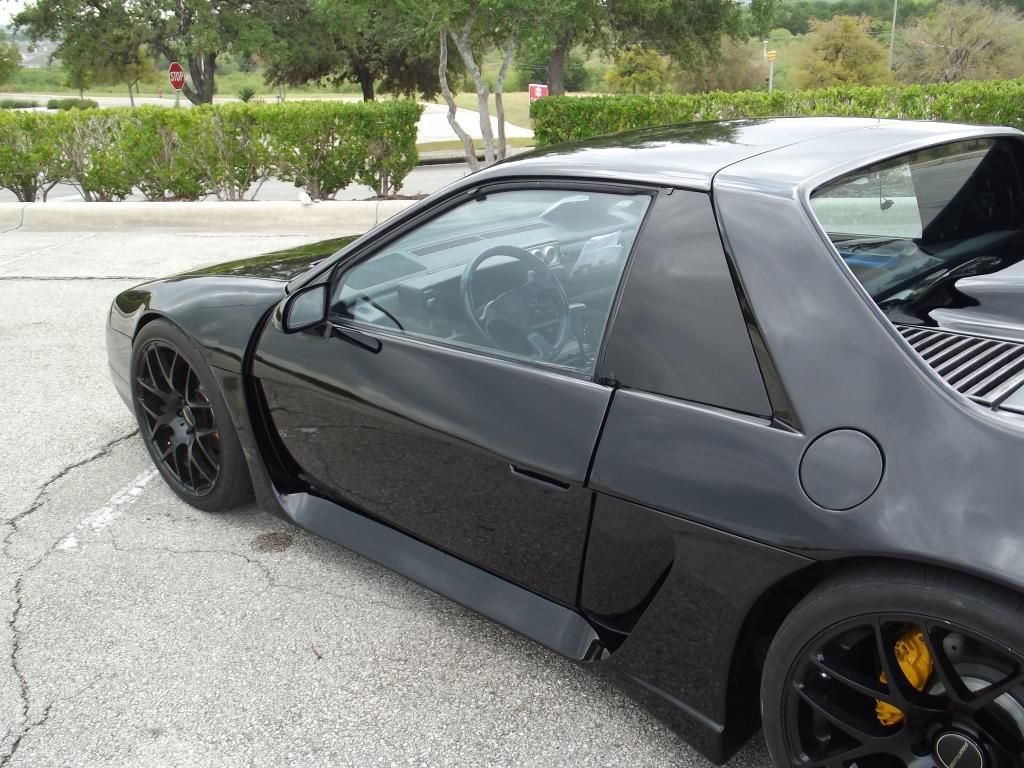
------------------
85 MadArch Widebody Notchback 4.9 4T60E
88GT 3800SC ZZP NIC F23
|
|
|
|
2MidV8
|
OCT 04, 02:21 AM
|
|
|
Blooze has an awesome project going!!! I'm just saying in a general sense that Pontiac should have taken this car into the next level. God damn GM execs. to hell!! ------------------
85 MadArch Widebody Notchback 4.9 4T60E
88GT 3800SC ZZP NIC F23
|
|
|
|
Will
|
OCT 04, 12:21 PM
|
|
| quote | Originally posted by Bloozberry:
The next step was fabricating the mounting plates that get welded to the bumper bar. I used 16 gauge sheet steel for these as well and held them in place temporarily with some special Cleco fasteners, which are like temporary rivets. They're great because they allow you to hold pieces together in a very compact way.
|
|
What kind of clecos are those?
|
|
|
|

