
 
     |
| Blooze Own: An F355 Six Speed N* Build Thread (Page 106/126) |

|
Zac88GT
|
MAY 08, 12:54 PM
|
|
| quote | Originally posted by Bloozberry:
As for the boot clamps Reallybig... I was thinking the same thing... these clamps don't seem to be able to be tightened enough to work properly. Have you found a source for the good ones?
|
|
I used Mevotech B1000 (large) and B1001 (small) I believe for my CV boots. They're the factory style with the little square that gets crimped to tighten them. You should use a proper crimping tool but I've seen people get away with using a pair of side cutters and a hammer.
|
|
|
|
Bloozberry
|
MAY 08, 09:47 PM
|
|
| quote | Originally posted by Zac88GT:
I used Mevotech B1000 (large) and B1001 (small) I believe for my CV boots. |
|
Thanks for the part numbers... although I nearly gagged when I saw the prices... $16 for a large clamp and $14 for each small clamp? Hopefully there's something else out there.
Due to popular demand  I'm posting a few more shots of the flywheel being machined. Once the transmission face of the flywheel was finished being turned, it got flipped around, the contour of the engine side was programmed, and the machinist let 'er rip again. I could stand for hours watching the progress (in fact I did). There's just something really cool about watching a raw piece of material being turned into a thing of beauty. Anyways, with both sides shaped, the flywheel got transferred to the CNC milling machine for the holes. I'm posting a few more shots of the flywheel being machined. Once the transmission face of the flywheel was finished being turned, it got flipped around, the contour of the engine side was programmed, and the machinist let 'er rip again. I could stand for hours watching the progress (in fact I did). There's just something really cool about watching a raw piece of material being turned into a thing of beauty. Anyways, with both sides shaped, the flywheel got transferred to the CNC milling machine for the holes.

Unlike the lathe, in the mill the piece is clamped solidly to the bed and only the machine head does all the moving. Interestingly, the programming for the holes was based on the number of degrees each hole was apart from each other, the radial distance from the center of the piece, and the depth of each hole. It uses fewer programming steps than if it were done using XYZ coordinates. And there were lots of holes... 57 to be exact. Here's a photo of the counter-bores being drilled for the wear plate fasteners:

By this point the ring gear had been installed and all the holes were milled. The ring gear gets heated up in an oven and slipped onto the OD of the flywheel while it's still hot. It cools down rapidly, contracting and cinching itself with an interference fit. For faster spinning engines (12,000+ RPM), the ring gear should to be bolted to the flywheel to prevent it from expanding and coming off due to centrifugal forces... at least that's what the machinist said.

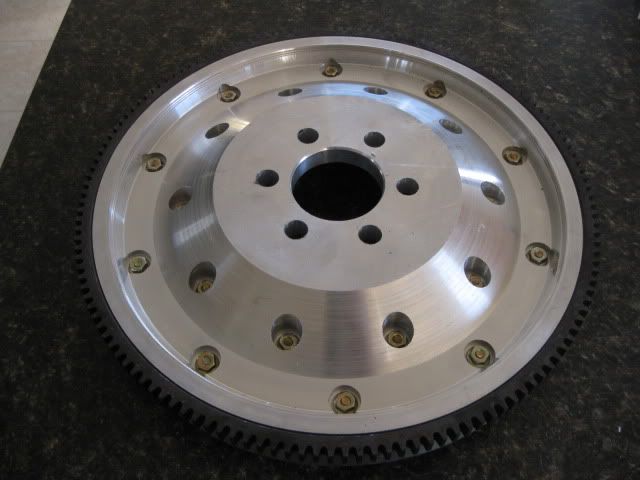
Here's the flip side of the completed bare flywheel. Notice the countersunk groove for the wear plate:

The wear plate is a steel insert made by Fidanza for '91 - '96 Dodge Stealths, part number 221021. It has a 10.25" OD, a 6" ID, and comes with 22 self locking nuts and machine bolts with countersunk heads, although you only need 20 of them. As usual, we Canadians pay about twice what Americans pay for the same part... it was $78 delivered through Amazon. All in all not terribly expensive:

The wear plate gets bolted onto the flywheel using 60 in-lbs of torque. I discovered I hadn't correctly sized the countersunk holes on the backside of the flywheel to the diameter of the socket wrench I needed to torque the nuts with.  THe simple solution was to turn down my socket to fit. Here's the flywheel with the wear plate installed: THe simple solution was to turn down my socket to fit. Here's the flywheel with the wear plate installed:

I started out with an aluminum billet weighing exactly 22 lbs. After all was said and done, the completed flywheel including the ring gear, wear plate, and fasteners, tipped the scales at 12.70 lbs. That's a lot of aluminum left on the machine shop floor! By comparison, the Fiero steel flywheel weighs in at 15 lbs, and according to Fieroguru, the bare LS1 flywheel comes in at a whopping 24 lbs!

Total cost for the flywheel at this stage: $124 for the aluminum, $300 for machining, $78 for a wear plate, and $47 for a ring gear = $550. Not bad for a one-off, custom designed, precision machined, high-tech thing of beauty.
|
|
|
|
Zac88GT
|
MAY 09, 12:35 AM
|
|
| quote | Originally posted by Bloozberry:
Thanks for the part numbers... although I nearly gagged when I saw the prices... $16 for a large clamp and $14 for each small clamp? Hopefully there's something else out there.
|
|
No need to worry, the price looks outrageous because they come in a box of 10, but the parts stores sell them individually.
|
|
|
|
Bloozberry
|
MAY 09, 07:56 AM
|
|
Oh... well that makes more sense. 
|
|
|
|
Will
|
MAY 09, 08:13 AM
|
|
| quote | Originally posted by Bloozberry:
I started out with an aluminum billet weighing exactly 22 lbs. After all was said and done, the completed flywheel including the ring gear, wear plate, and fasteners, tipped the scales at 12.70 lbs. That's a lot of aluminum left on the machine shop floor! By comparison, the Fiero steel flywheel weighs in at 15 lbs, and according to Fieroguru, the bare LS1 flywheel comes in at a whopping 24 lbs!
|
|
Not bad... better than I expected. I didn't think the back of it was so deeply contoured.
|
|

|
ccfiero350
|
MAY 09, 08:40 AM
|
|
Great Job! Too bad such a nice piece will not see the light of say again once assembled to the car. 
BTW I have a small collection of custom made nut drivers, sockets and screw drivers for a bunch of parts I've made over the years too.
Edit: forgot pliers, snap ring and needle nose and many pry bars.
------------------
yellow 88 GT, not stock
white 88 notchie, 4 banger[This message has been edited by ccfiero350 (edited 05-09-2014).]
|
|
|
|
cptsnoopy
|
MAY 09, 10:32 AM
|
|
I want one! 
Charlie

|
|
|
|
aeffertz
|
MAY 10, 01:08 AM
|
|
|
Are you going to rivet that gear ring to the aluminum or something?
|
|
|
|
Bloozberry
|
MAY 10, 08:21 AM
|
|
|
No, in fact it's very common for ring gears on street cars to be retained on their flywheels by an interference fit only. The shop that machined the flywheel has some very knowledgeable staff (they routinely rebuild NASCAR engines from the States), so they were the ones who suggested the diameter of the ring gear seat on the flywheel to ensure proper retention.
|
|
|
|
fieroguru
|
MAY 10, 08:22 AM
|
|
| quote | Originally posted by Bloozberry:
I discovered I hadn't correctly sized the countersunk holes on the backside of the flywheel to the diameter of the socket wrench I needed to torque the nuts with. THe simple solution was to turn down my socket to fit. |
|
What size socket did you use to torque the nuts (been so long I can't remember)? The drawing shows the counter bore to be 1/2" and I know I had issues taking the LT1 Fidanza flywheel apart because the counter bore holes were too narrow. So I upsized the holes on mine and had a socket that fit the new larger hole, so there were no installation issues. I just want to confirm I didn't make the hole larger than 1/2" and forgot to change the drawing... just another reason I want to pull the LS4/F40 back out to check/verify some things before starting to offer these flywheels for sale. If I compare the picture of the backside of mine to yours, it looks like I might have gone up to 9/16 or 5/8" for the counter bore. Here is the backside of mine:
When I designed this flywheel/clutch combo, I wasn't trying to make it as light as possible, just lighter than the SBC/Fiero pressure plate combo I was used to running. My goal was to keep the overall weight of the flywheel/clutch/pressure plate close to the stock fiero V6 setup. I didn't take the time to calculate the MOI change between the two, but I know this new flywheel/pressure plate does have a higher MOI than the stock 2.8 setup due to the larger diameter pressure plate accounting for more of the total weight of the package. However, it does have a much lower MOI than the Archie SBC setup I was used to and the RWD LS(x) setup.
The LS4/F40 prototype flywheel tipped the scales at 11.2 lbs. Larger crankshaft pilot, larger (but fewer) crankshaft bolt holes, larger counter bores for the wear strip bolts, spring dowels vs. solid, scale calibration differences, etc. all would help account for the lighter weight.
Using my wife's 30 lb postal scale here are the overall flywheel/clutch/pressure plate weights
LS4/F40 flywheel with a used factory ford clutch/pressure plate: 11.2 + 18.4 = 29.6 lbs
LS4/F40 flywheel with new SF964F clutch: 11.2 + 16.52 = 27.72 lbs
For comparisons,
Archie SBC flywheel/Spec clutch is about 42 lbs total and flywheel is about 1" larger in diameter.
Stock 2.8 fiero setup is about 15 lbs for the flywheel and 15.6 lbs for the clutch/pressure plate = 30.65 lbs.
Stock 2000 LS1 is 24 lbs for the flywheel and 32 lbs for the clutch/pressure plate = 56 lbs and this weight is spread over a 2" larger diameter.[This message has been edited by fieroguru (edited 05-10-2014).]
|
|
|
|