
 
     |
| Engine temps all over the place (Page 7/9) |

|
Patrick
|
DEC 27, 05:57 AM
|
|
That was an informative video.
|
|

|
David Hambleton
|
DEC 27, 10:18 AM
|
|
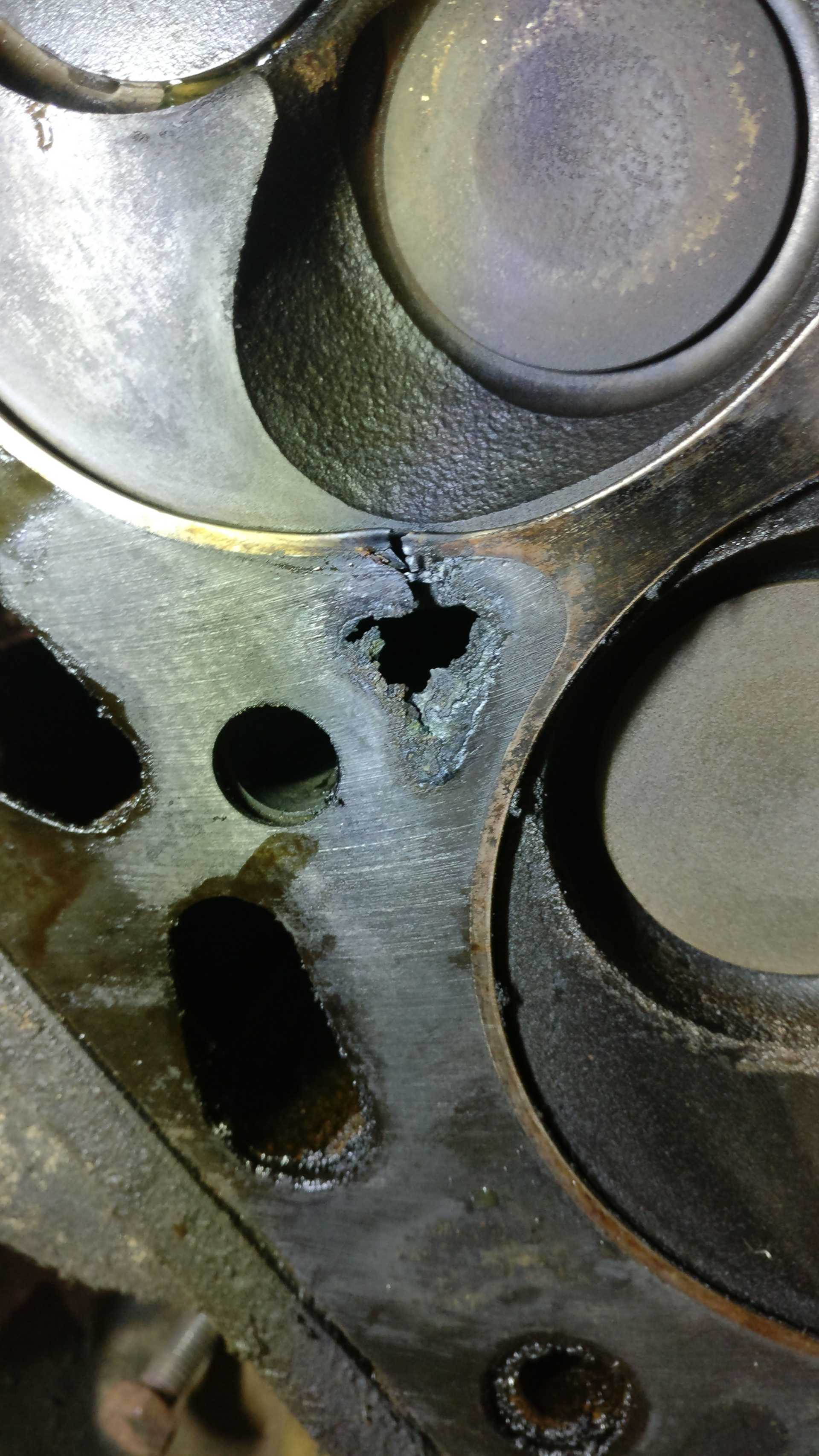
In this thread: https://www.fiero.nl/forum/Forum2/HTML/146435.html the head gasket break shown below resulted in coolant loss that manifested itself in fluctuating gauge temperatures.
I think the gauge was reacting to intermittent splashes of overheated coolant and no coolant contact.
Bubbles would flow in the coolant reservoir that I think were from combustion chamber pressure.
The final evidentiary gasket issue symptom was coolant squirting through the broken exhaust manifold joints, lol!
Replacing the head gasket solved the issue; no sensors or gauges were changed. (Also replaced the broken-joint exhaust manifold...)
|
|
|
|
phonedawgz
|
DEC 27, 11:54 AM
|
|
| quote | | I start the car in the morning and within a few miles (2-3) temperature goes up to 230F. It then continues to rise to about 250F, stays there for a few minutes, then drops in seconds to 140. Again it stays there for a few minutes, then temp rises to 230F-250F again. This cycle repeats itself for about a half hour, after which the temperature drops to 175F-195F at which it stays for the remainder of the trip. |
|
Sounds to me that there is air in the block that is keeping the thermostat from opening, and when the air finally warms up the thermostat enough it opens, lets cool coolant in and closes again. I drilled an 1/8th inch hole (3mm) in my thermostat quite a while ago to solve this kind of problem. While it won't solve the problem of where the coolant is going, it will solve the problem of the highly fluctuating temperature.
|
|
|
|
theogre
|
DEC 27, 12:04 PM
|
|
Head gasket can end up like above but Often leaks exhaust coolant or both before complete failure.
Because Often isn't the gasket failed but side effect of iffy head(s) block or head bolts.
Example: Many Dukes had iffy Head Bolts when new and any could fail more so bolt between #2 #3 cyl on exhaust side stretch or break and first sign was head gasket leaked. Why? That "#2" bolt (order in tightening head bolts) gets hotter then rest because in between #2 #3 exhaust ports and weak bolts fail. If caught early, is/was a way to remove the broke bolt and replace that w/o lifting the whole head. Not a good plan for many but even GM push this fix to save Warranty Cost and payout to the Dealers.
Poof?
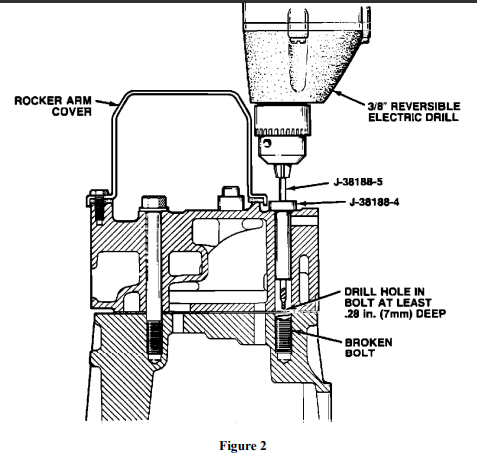
Kit also came w/ long normal drill bit and easy out to get broke section out.
From TSB Number: 87-6 (GAS)-94 Date: 7/89
BROKEN CYLINDER HEAD BOLT/COOLANT LOSS
Subject: (NEW BOLT/GASKET)
1985-87 6000, FIREBIRD 85-86, GRAND AM AND FIERO MODELS WITH 2.5L ENGINES[This message has been edited by theogre (edited 12-27-2022).]
|
|
|
|
ArthurPeale
|
DEC 27, 03:01 PM
|
|
| quote | | Originally posted by Cliff Pennock: Haven't checked the plugs (they haven't been removed for over 20 years, I'm afraid they will break off). |
|
It can happen, but it's also really important to have top-notch plugs. I'd at least check the ones facing the trunk. If those break access is much easier.
I thought I was going to have to pull the head for my #5 plug because it wouldn't move and I thought the plug was loose in the hex. Turned out to be that there WAS NO HEX. It had completely rusted away. Gap was double what it should be. I used a deep bolt extractor and gently worked it back and forth.
------------------
Arthur Peale
|
|
|
|
Cliff Pennock
|
DEC 28, 07:11 PM
|
|
Crap. If it's a head gasket that needs replaced, then I'm SOL. There's no way I can do that myself (because of a lack of space to work on the car) so I would need to bring the car to a garage. And that's probably going to cost me more than the car is worth...
I will see if I can find a kit to test for exhaust gases in the coolant.
|
|
|
|
sdgdf
|
DEC 29, 03:50 AM
|
|
| quote | Originally posted by Cliff Pennock:
Crap. If it's a head gasket that needs replaced, then I'm SOL. There's no way I can do that myself (because of a lack of space to work on the car) so I would need to bring the car to a garage. And that's probably going to cost me more than the car is worth...
I will see if I can find a kit to test for exhaust gases in the coolant. |
|
Usually exhaust gases from a bad head gasket will cause the reservoir to spew. At the very least you can do a compression test.
It all sounds like you’ve got complicated issues with slow coolant leaks combining with air pockets in the Fieros gigantic cooling system and the way the thermostat is designed. In my experience with it and other cars air pockets can linger for days/weeks after purging the system. I just replaced a heater core on mine and it took over a week to get decent heat from it. No flow, the hoses going to it just cold with the rest of the system fluctuating.
Usually you can look at the gauge and tell when it’s hitting the thermostat temp and it opening, even that AND the fan cycling on/off. If it’s hitting that thermostat temp and not dropping it’s an air pocket, bad thermostat or some other reason for no flow. My Sonic likes to eat waterpumps every 30k or so.
On my 3800SC swap I got it with the fan programmed obnoxiously low and no thermostat, heater core bad and bypassed. It fluctuates a lot, up to about 210 where my thermostat opens and back down to about 120 with all the cold coolant circulating into the engine and the fan running. The cycles of it fluctuating get less and less extreme the longer you run it as it takes a while for the huge amount of coolant to stabilize between the thermostat opening several times and the fan running etc.
Should NEVER let the reservoir run dry. ALWAYS guarantees an air pocket which on a Fiero is difficult to deal with. I know from owning a turbo Chevy Sonic, which is designed to leak coolant at any given opportunity. On mine you can fix every hose, every possible leak and it’ll still vent a little coolant from the cap/reservoir so there’s always some loss. Never on the ground, on it it’s just enough to see and smell some slight coolant vapor from time to time. In any case on your engine you should find every hose, every connection, know where it all is every know and then feel the connections for wetness. Check the coolant level at the res every time you drive. Don’t necessarily question the level or why it needs more but top it off if it needs it. On my Sonic, they designed it to overheat and warp the aluminum head, so many end up in junkyards. It’s designed to run hot for fuel economy, like 220-240 constantly, has bunch of plastic pieces in the system, hoses that go out frequently and bulge, waterpumps that go out regularly. Reservoir that cracks and leaks every 20-30k. I’ve only kept it on the road by being diligent with it, up to 150k now. It’s not like my Fieros Ive had or my S10, can overheat a few times and keep going. Even once on it and it’s done.
If I were in your shoes, I’d remove the thermostat and drive it for a couple weeks, checking all the connections for leaks, keeping the fluid topped before/after every drive. It appears stable after that then put it back in. Topping off coolant shouldn’t necessarily be a big deal. If it’s a head gasket problem so bad it’d cause these kind of problems you’d likely see it in your exhaust, spark plugs, compression test, etc. If you’ve got lingering air pockets the level will go down all the time until you get them resolved, and you could just get stuck in a cycle of letting the reservoir run dry and creating more.[This message has been edited by sdgdf (edited 12-29-2022).]
|
|
|
|
sdgdf
|
DEC 29, 04:03 AM
|
|
Also to add, pressure test the cooling system with the plugs out, if it drops pressure use a bore scope to see if you’ve got any coolant on top of the pistons….
Btw if it’s a 4cyl doing the hg shouldn’t be completely horrible.
|
|
|
|
sanderson231
|
DEC 29, 11:25 AM
|
|
Here's is what I do to get the air out of the system when filling:
1) Remove the fill cap and thermostat
2) Remove the radiator cap
3) Slowly fill the system at the thermostat neck until coolant comes out the radiator
4) Fill reservioir with about 3" coolant
5) Replace the radiator cap
6) Slowly fill the system pausing to let air gurgle out
7) When the system appears full rerplace the fill cap
8) Run the car for about 30 seconds to circulate some coolant
9) Remove fill cap and top off
10) Repeat steps 7 and 8 two more times
11) Take the car on a drive without the thermostat allowing the system to get up to normal temperature
12) Fill reservior to normal level
11) Let car cool. Top off level at fill neck and replace the thermostat
If the car is normal, the coolant temps will vary as the fan cycles on and off but that is a slow process. The coolant temperature should not spike at all.
I also use this method on my 3800 and 4.9 where the fill is a Moroso in-line tee in coolant outlet hose (no Fiero type fill neck). On these cars I have to leave the thermostat in place but there is a small whole drilled in the thermstat so that the engine can vent while filling with the thermostat closed.
------------------
formerly known as sanderson
1984 Quad 4
1886 SE 2.8L
1988 4.9L Cadillac
1988 3800 Supercharged
|
|
|
|
Cleveland4444
|
DEC 30, 11:31 PM
|
|
|
If you suspect a head gasket failure, you can do a leak down test before you end up taking it into a shop and paying for it. If you are losing that much coolant, I would suspect you would be getting white smoke or milky oil. Leak down test is easy enough to do. It won't be definitive, just a tool to help you out. Compression test wouldn't be a bad idea either.
|
|
|
|