
 
     |
| GM 3.6 experts... Why the disparity between different LFX engines? (Page 7/7) |

|
Will
|
NOV 28, 12:15 PM
|
|
| quote | Originally posted by dobey:
They are both "GM" in the sense that they were produced for GM cars. The trans is a Getrag.
The Saab is the only car with a High Feature V6 that came with a manual in transverse configuration. The G6 F40 is the wrong bell pattern. The Ecotec F40 is also yet another different bell pattern. The G6 also has some other differences from the HF/Ecotec versions. The gearing in the earlier Saab 2.8t F40 trans (at least, the FWD version, not sure about AWD) should be the same as the 2006 G6 F40. |
|
The Saab actually got the shorter MU9 gearing while the '06 G6 has the MT2 gearing.
|
|
|
|
Raydar
|
NOV 28, 07:38 PM
|
|
| quote | Originally posted by stickpony:
why the saab F40, and not a GM F40? different gearing or something?> |
|
The Saab was apparently the only High Feature V6 available with the F40.
The 3.6 in the G6 was only available with an automatic. The F40 in the G6 was only bolted to the LZ9 (3900). Maybe the Ecotec. Definitely not the HF 3600 V6.
I've been a G6 fan/owner for several years. I don't think I'm mistaken. (It would be cool if I was wrong, however.  ) )[This message has been edited by Raydar (edited 11-28-2016).]
|
|
|
|
Joseph Upson
|
NOV 28, 07:54 PM
|
|
Unless GM fixed it and I doubt it, all 3.6L motors can benefit from an oil catch can. I've read several complaints about it and observed it once again recently following maintenance I performed on my mom's 07 3.6L. I dumped about 2 oz of oil out of the intake tube. It was puddling oil well below 100k miles and many are not aware of this tendency because they don't perform their own maintenance in order to see it. There's not much of a baffle under the valve cover and as much as I've seen in the tube I'm sure the engine is ingesting a good bit given the proximity of the vent tube to the throttle body.
The car is also on its third front catalytic converter with just over 135k miles. The applications with extended oil change capability are risky as some owners have complained of finding no oil registering on the dipstick short of the oil change interval. The initial impression would be that oil is getting past the rings but it's actually being sucked into the motor from the valve cover as many of the complaints are on relatively low mileage cars. I mention this issue after inquiring about a nice 08 Caddi CTS with a bad DI 3.6L at 130k miles. A used replacement motor would run about $2k, which is the best option since it appears to be a timing chain failure with valve damage. With an asking price of $5k, the total with a self repair puts it right a long with running equivalents, minus the wear and tear of labor so no go.
|
|
|
|
dobey
|
NOV 28, 08:50 PM
|
|
| quote | Originally posted by Raydar:
The Saab was apparently the only High Feature V6 available with the F40.
The 3.6 in the G6 was only available with an automatic. The F40 in the G6 was only bolted to the LZ9 (3900). Maybe the Ecotec. Definitely not the HF 3600 V6.
I've been a G6 fan/owner for several years. I don't think I'm mistaken. (It would be cool if I was wrong, however. )
|
|
The Ecotec has been available with an F40, but not in the G6. The Buick Regal Turbo is what brought the Ecotec and F40 together, IIRC. I think the Ecotec G6 cars were all either automatics, or maybe with the F23 or F25 5 speed.
|
|
|
|
Will
|
DEC 02, 12:04 PM
|
|
|
Saabs were the first Ecotec/F40 application back in '03.
|
|
|
|
Joseph Upson
|
SEP 15, 09:29 AM
|
|
After owning a 3.6L DI for a few years now following my last post above, I have better insight on this motor and am impressed with what I have found so far. Although an oil catch can would be helpful, it is not necessary, considering the number of 3.6L motors with high mileage (200k plus miles) and factory status on the road. Proper maintenance is key and often preferred to modifications for the average driver. You must use good quality oil. I've read fuss about the PCV valve clogging and needing modification, but nothing mentioned about replacing it, considering it's a serviceable part. This is an excellent example of fixing something that isn't broken with an expensive oil catch can that will need to be serviced regularly. If you increase the opening in the PCV valve, an oil catch can becomes a must, because it will allow a lot more oil to pass through it, which can lead to a low oil level depending on change intervals. It's a brilliant way to sell oil catch cans, because you will find quite a bit of oil in them (because of that recommended modification). I have oil catch cans, but I never put them on the car, it doesn't use a perceptible amount of oil between the 5k oil changes, and a mild top engine cleaner sprayed into the intake once and a while should keep valve deposits under control for those worried about it.
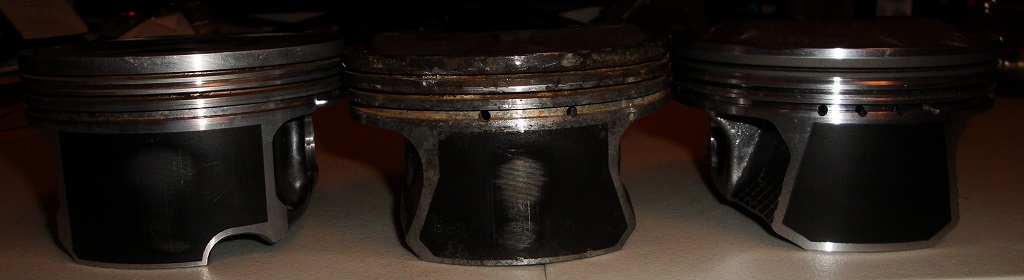
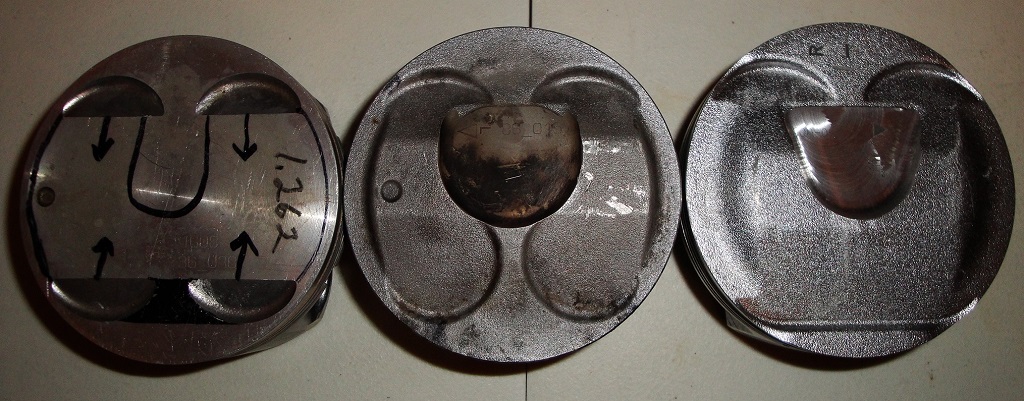
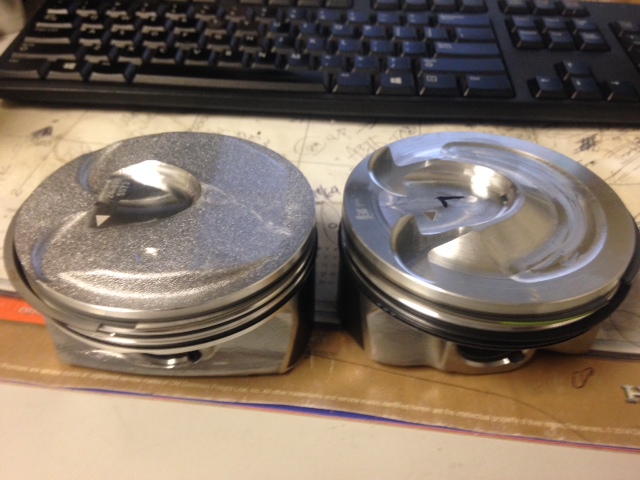
In preparation for my intended 3.6L build, I have found that GM has done some outstanding work with this motor, unlike any other V6 that I've seen across the same displacement. I have three of the 5 pistons representing the 5 iterations of the 3.6L; LY7, LLT, and LGX (LY7, LLT, LFX, LF3/4, LGX).
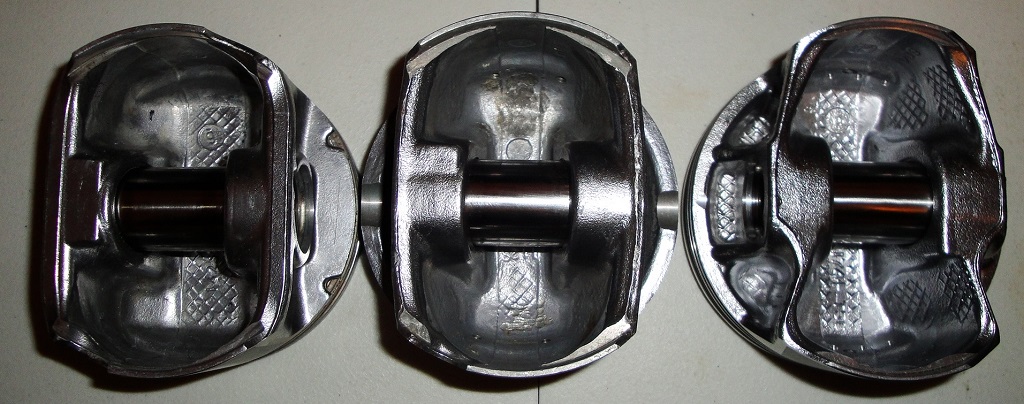
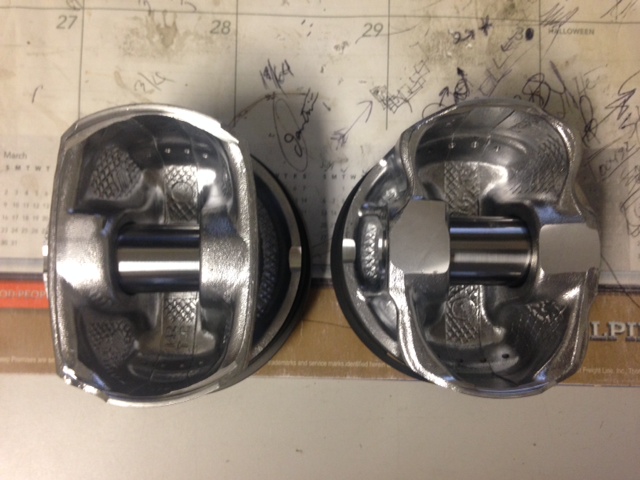
The piston weights are close in range, 390g for the LY7, LLT & likely the LFX which only has exh valve relief fill in next to the LLT piston, in order to gain the .2 compression point it has over the LLT. The LGX piston weighs 400g, and the LF3/4 turbo piston is a toss up until I get my hands on one. The pin work goes from a big fat 142g untapered LY7 pin, down to the tapered, lighter 116 g LGX pin, which is also 23 mm instead of 24 mm like the others, which are also tapered and 120g for the LLT/LFX.
The LGX piston judging from picture comparisons, appears to be the turbo LF3/4 piston with a dome instead of that depression for lower compression for boost. They are the only two pistons of the 3.6 line with a strut like bracing formation bounding the wrist pin hole making the piston look fit to be hit with a hammer safely. The skirt/side perimeter arrangement is also similar between the two which appears to be contoured in a manner that further strengthens the piston. There is a stock LGX Camaro (except for injectors and plugs) with a supercharger running 11.25 in the quarter, Hyperhawk.
GM also modified the connecting rod small end starting with the LLT, which is tapered instead of square and the rod lengths vary; 5.92, 5.94, 6.00 and 5.86, representing the LY7, LLT/LFX, LF3/4 (steel & Ti) and LGX in that order. The above partly explains the bump in rev limits, with the LGX redline set at 7200 rpm. I believe the rev limit for the turbo motors is in the 6K rpm range, but I'm not sure if it's because of piston weight (An aftermarket forged set I've seen boasted 442g) or turbine flow capacity, or GM wanted to be careful not to release a turbo powered V6 scuffing the heels of its V8 equivalent, CTS-V vs. ATS-V, like the Corvette vs. Grand National snafu many years ago.
Almost forgot, the rings are thinner for the LGX also and the the thrust side piston skirt appears to be smaller as well for an added reduction in friction surface. The top ring space has what appears to be a PTFE coating like the others, except for the LY7 and the ring land for the top ring is thicker, again suggesting it is the turbo piston fitted to the LGX.[This message has been edited by Joseph Upson (edited 09-15-2020).]
|
|
|
|
Joseph Upson
|
SEP 16, 06:46 AM
|
|
Rounded up some pictures;
LY7, LLT and LGX
LFX, LF3/4. These shots do not belong to me and were found on the Camaro forum,
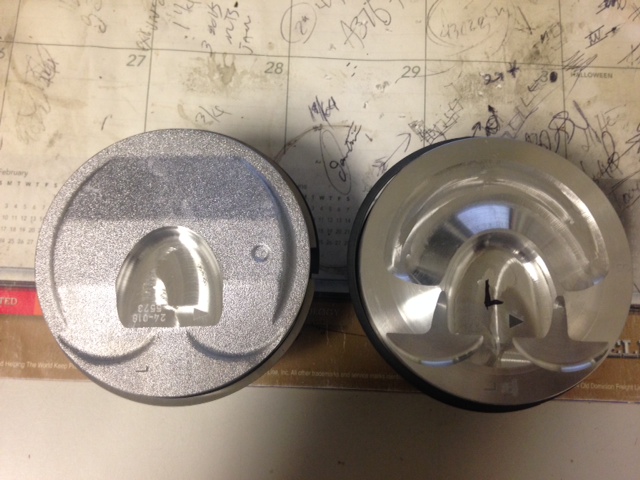
|
|
|
|