
 
     |
| Turbo 3400, F23 build, 1985 GT (Page 6/26) |

|
1985 Fiero GT
|
MAR 05, 01:41 AM
|
|
More wiring today (yesterday now I guess), got the reverse switch wired, got the speedometer working (f23 speedo in to ECM on the cam in wires, 4000 ppm speedo out on digital frequency 1, through a 1.2μf capacitor from the tweeter of an old bookshelf speaker to the yellow speedometer high wire going to the dash. Hooking it up directly did not work, speedo is expecting the AC signal from a VR style sensor, not the switched DC of the ECM output, and apparently a simple capacitor in line fixes that).
Also removed the reverse lockout from my 4 speed shifter, and the "centering spring" (holds the shifter in the far right position as default)
Megasquirt has an option to fully open the IAC valve during WOT, I'm using a Porsche/Bosch/PWM 3/4" hose IAC valve, sitting where the EGR tube would be, running into the lower intake IAC passage, then will be going into a port on the intake tubing before the throttle body (the blue tube in pictures). Would this be beneficial? In theory it would allow a decent bit of air to bypass the restrictive upper intake (3/4"all the way to the lower intake, then reduced to the 1/2" barb there, then the IAC passages), unless airflow is so unevenly distributed to cause issues, or it adds turbulence to the main stream that slows everything down. Thoughts on this? I would assume it would be somewhat well balanced, especially with the cold start injector in there (from factory, I'm not using it any more), you'd think that would be designed to be distributed fairly evenly, but who knows.
|
|
|
|
fieroguru
|
MAR 05, 07:07 AM
|
|
| quote | Originally posted by 1985 Fiero GT:
Megasquirt has an option to fully open the IAC valve during WOT, I'm using a Porsche/Bosch/PWM 3/4" hose IAC valve, sitting where the EGR tube would be, running into the lower intake IAC passage, then will be going into a port on the intake tubing before the throttle body (the blue tube in pictures). Would this be beneficial? In theory it would allow a decent bit of air to bypass the restrictive upper intake (3/4"all the way to the lower intake, then reduced to the 1/2" barb there, then the IAC passages), unless airflow is so unevenly distributed to cause issues, or it adds turbulence to the main stream that slows everything down. Thoughts on this? I would assume it would be somewhat well balanced, especially with the cold start injector in there (from factory, I'm not using it any more), you'd think that would be designed to be distributed fairly evenly, but who knows. |
|
I guess it would partially depend on how quickly the IAC goes from full open to full close. When you do WOT upshifts you will likely not want a 3/4" opening to stay open or you could likely hit the rev limiter.
With boost, the neck of the plenum will be less of an issue (just add more boost) or do the Dawg neck modification. I would do the Dawg mod simply to help remove the restriction. While you can add more boost, it would come at a penalty of more heat, which would need to be addressed. For my build, it I focused on making everything up stream of the cylinders as free flowing as possible to maximize hp with the least amount of boost/heat.
Creating and using a large air path from the the air intake track around the throttle body and into the runners, will skew the readings from the MAP sensor in the plenum. It will shift the readings higher (higher kPa) because the plenum will see less vacuum than what is present in the runners between the cylinders and the cold start ports. Having the IAC wide open will magnify the issue.
Loudias did a modification to the lower intake where he created a slot between the runner walls at the lower to middle intake gasket surface to allow some airflow equalization between runners. This showed something like a 20 hp improvement on the dyno. I would consider this modification vs. the IAC mod.
|
|
|
|
1985 Fiero GT
|
MAR 05, 08:50 AM
|
|
| quote | Originally posted by fieroguru:
I guess it would partially depend on how quickly the IAC goes from full open to full close. When you do WOT upshifts you will likely not want a 3/4" opening to stay open or you could likely hit the rev limiter.
With boost, the neck of the plenum will be less of an issue (just add more boost) or do the Dawg neck modification. I would do the Dawg mod simply to help remove the restriction. While you can add more boost, it would come at a penalty of more heat, which would need to be addressed. For my build, it I focused on making everything up stream of the cylinders as free flowing as possible to maximize hp with the least amount of boost/heat.
Creating and using a large air path from the the air intake track around the throttle body and into the runners, will skew the readings from the MAP sensor in the plenum. It will shift the readings higher (higher kPa) because the plenum will see less vacuum than what is present in the runners between the cylinders and the cold start ports. Having the IAC wide open will magnify the issue.
Loudias did a modification to the lower intake where he created a slot between the runner walls at the lower to middle intake gasket surface to allow some airflow equalization between runners. This showed something like a 20 hp improvement on the dyno. I would consider this modification vs. the IAC mod. |
|
It's a PWM solenoid, so I would assume pretty fast, I would also think megasquirt would release it as soon as TPS gets under x percent, where my foot would still be releasing the throttle, and that is not an instantaneous event either.
Yes that's one reason why I'm doing all this, 3.4 and a turbo, I don't want an engine that falls on its face due to a choked air supply (non turbo 3.4), and I will not give up the Fiero intake, so a turbo just blows right through the restriction and as a benefit makes even more power everywhere else. I was hesitant to do that on the 2.8 and 3.4 firebird engines because of reliability concerns, but the 3400 is stronger so seems a perfect match. I will not be doing the dawg mod, I can't weld aluminum (still learning to do exhaust haha), and anywhere near me would charge an arm, a leg, and take a kidney for spite, small towns in the middle of nowhere where services charge a premium, last year I got an exhaust manifold crack welded, 2" weld cost nearly $200, and I had the part cleaned and prepped already. I've sent my intake off to Quebec, Quebec to be powder coated, still expensive, but I'm tired of dealing with bad paint adhesion (failed paint twice already).
I didn't think of the map sensor, but being only at wide open throttle, how will it act with boost, I mean theoretically with an open throttle, x amount of boost, it's just going to be pretty much equalised through the intake, I don't know how sensitive this is though.
Would it even be a problem? If the map reads higher, but that is because more air is getting into the engine, wouldn't that make sense? When you open your throttle more, the map reads higher, more air is getting into the engine, IAC opens, more air goes to the heads, less vacuum to the plenum, which reads as higher map, that's expected, what would this do that it isn't supposed to. More air=less vacuum, would this setup amplify that? (10 units sucked in by throttle, 1 by IAC, would it read as 10% higher on the map, because that would be true, or more than that?)
I won't be doing that mod at the moment, maybe after more research, but the middle intake is already on, and I'm trying to get finished haha.
|
|
|
|
pmbrunelle
|
MAR 05, 01:27 PM
|
|
| quote | Originally posted by 1985 Fiero GT:
More wiring today (yesterday now I guess), got the reverse switch wired, got the speedometer working (f23 speedo in to ECM on the cam in wires, 4000 ppm speedo out on digital frequency 1, through a 1.2μf capacitor from the tweeter of an old bookshelf speaker to the yellow speedometer high wire going to the dash. Hooking it up directly did not work, speedo is expecting the AC signal from a VR style sensor, not the switched DC of the ECM output, and apparently a simple capacitor in line fixes that).
|
|
Direct Current, or DC, is a misnomer; in French it is called Courant Continu, or CC. Continous current you could say.
DC means unchanging over time.
If the DC is switched, then it is no longer purely DC; it is DC with an alternating (AC) component added on top.
Capacitors block DC current, as there is no electrical connection between both electrodes. However, AC current can pass through capacitors, as electrical charges on one electrode can attract/repel charges on the other electrode for short durations.
| quote | Originally posted by 1985 Fiero GT:
Also removed the reverse lockout from my 4 speed shifter, and the "centering spring" (holds the shifter in the far right position as default)
|
|
I'm planning on keeping my centering spring in the shifter (but messing with the springs in the F23 to make everything work); I think that it will help enhance shifter feel and mask the feeling of backlash in the mechanism.
| quote | Originally posted by 1985 Fiero GT:
Megasquirt has an option to fully open the IAC valve during WOT, I'm using a Porsche/Bosch/PWM 3/4" hose IAC valve, sitting where the EGR tube would be, running into the lower intake IAC passage, then will be going into a port on the intake tubing before the throttle body (the blue tube in pictures). Would this be beneficial? In theory it would allow a decent bit of air to bypass the restrictive upper intake (3/4"all the way to the lower intake, then reduced to the 1/2" barb there, then the IAC passages), unless airflow is so unevenly distributed to cause issues, or it adds turbulence to the main stream that slows everything down. Thoughts on this? I would assume it would be somewhat well balanced, especially with the cold start injector in there (from factory, I'm not using it any more), you'd think that would be designed to be distributed fairly evenly, but who knows. |
|
I think that you can work this out later when testing/tuning the car on the road.
If you are running in open-loop, and during a pull the measured AFR is leaner than before the change, then whatever you did increased airflow.
| quote | Originally posted by 1985 Fiero GT:
Yes that's one reason why I'm doing all this, 3.4 and a turbo, I don't want an engine that falls on its face due to a choked air supply (non turbo 3.4), and I will not give up the Fiero intake, so a turbo just blows right through the restriction and as a benefit makes even more power everywhere else.
|
|
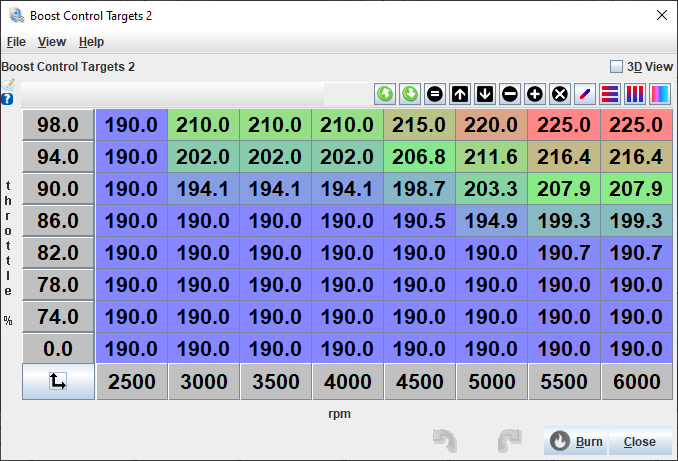
I haven't done this yet, but I'm planning on having a boost target that rises with RPM to help mask the restrictive nature of the stock intake. The car drives ok with constant boost pressure, but I think that rising boost with RPM could help make things feel a bit more linear.
 [This message has been edited by pmbrunelle (edited 03-05-2025).]
|
|
|
|
1985 Fiero GT
|
MAR 05, 06:16 PM
|
|
| quote | Originally posted by pmbrunelle:
Direct Current, or DC, is a misnomer; in French it is called Courant Continu, or CC. Continous current you could say.
DC means unchanging over time.
If the DC is switched, then it is no longer purely DC; it is DC with an alternating (AC) component added on top.
Capacitors block DC current, as there is no electrical connection between both electrodes. However, AC current can pass through capacitors, as electrical charges on one electrode can attract/repel charges on the other electrode for short durations.
I'm planning on keeping my centering spring in the shifter (but messing with the springs in the F23 to make everything work); I think that it will help enhance shifter feel and mask the feeling of backlash in the mechanism.
I think that you can work this out later when testing/tuning the car on the road.
If you are running in open-loop, and during a pull the measured AFR is leaner than before the change, then whatever you did increased airflow.
I haven't done this yet, but I'm planning on having a boost target that rises with RPM to help mask the restrictive nature of the stock intake. The car drives ok with constant boost pressure, but I think that rising boost with RPM could help make things feel a bit more linear.
|
|
Yeah, makes sense, it took an afternoon to wrap my head around how the capacitor can generate a negative voltage when the 5v is turned off, it seemed to easy of a solution haha, another note, I never realized how loud the speedometer/odometers are, they click and whir, which you don't hear when the engine is running and you're driving, but stationary with the megasquirt outputting a test signal, it was alarming the first time I did it haha.
Yeah I saw that, I'm not going to fiddle with that until after I can feel what it feels like with nothing additional.
Yeah makes sense, I will test it like you said.
Interesting, makes sense.
|
|
|
|
1985 Fiero GT
|
MAR 20, 03:54 PM
|
|
I got my intake and valve cover back from being powder coated, Chevy Torch Red, satin silver, and clear over all that, they look beautiful! Cost was about $500cad, best price I could find.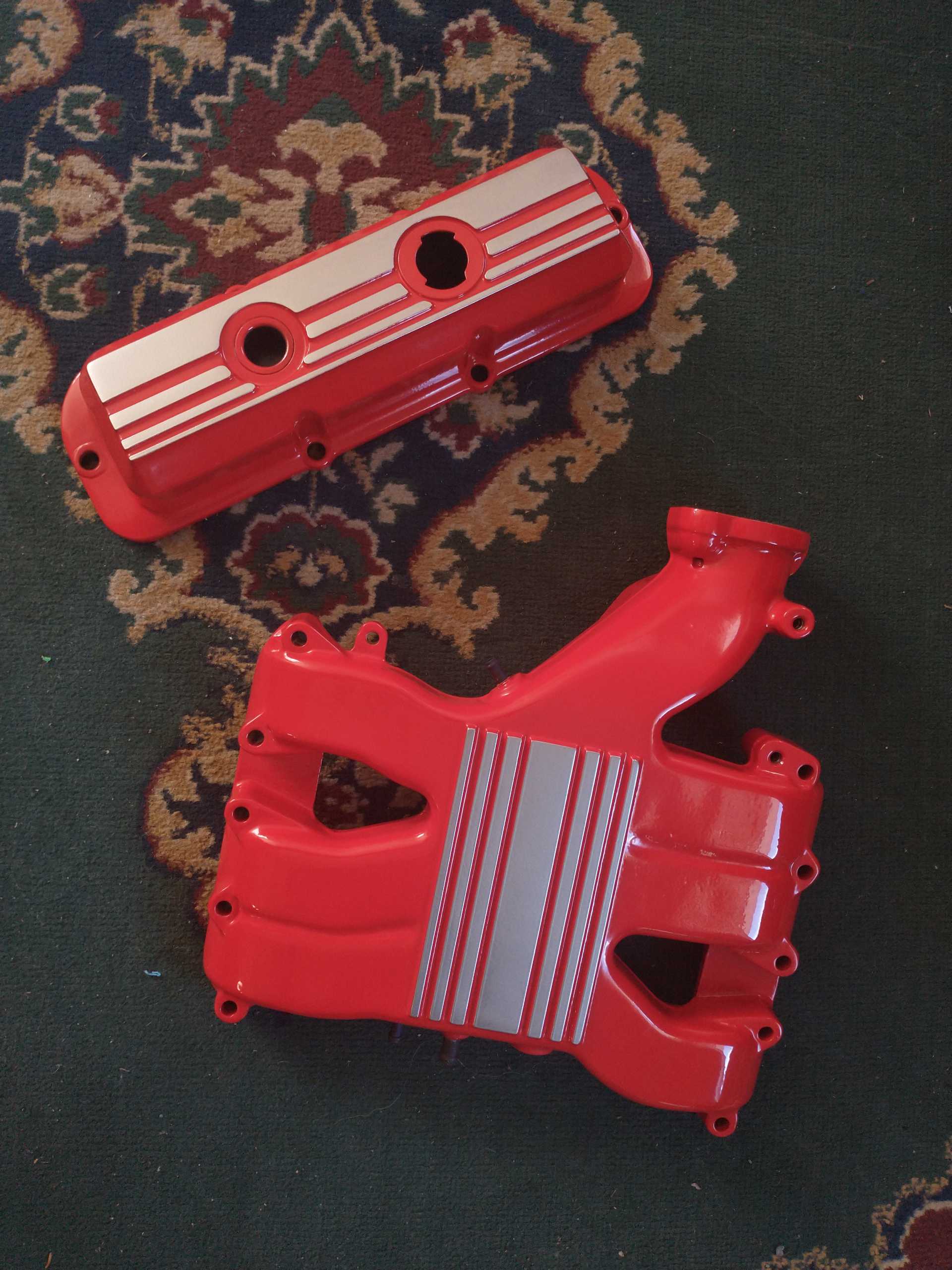
|
|
|
|
1985 Fiero GT
|
MAR 22, 12:25 AM
|
|
Did a compression test on all cylinders when I removed the spark plugs to gap them smaller, I cranked it 5 pulses, and recorded the gauge while I did that.
Cyl 1: 110 psi
Cyl 2: 125-130 psi
Cyl 3: 150 psi
Cyl 4: 135 psi
Cyl 5: 130 psi
Cyl 6: 135 psi
So I have one cylinder that's a little low (it had been lower, 100 psi, but I re-tested it after all the others, and it had improved to 110), one that's a little high (that is the one I removed the piston to check the ring gaps, I had oiled it up to put it back in) remember this is a junkyard 3400 that has run maybe 2 minutes in the last several years or more, and was stone cold, so perhaps cyl 1 will improve with time, I will check it again after it has gotten back on the road. Test was done with no upper intake, battery on charger, no fuel or spark, all plugs removed the entire test.
|
|
|
|
ericjon262
|
MAR 23, 01:34 PM
|
|
| quote | Originally posted by 1985 Fiero GT:
So I have one cylinder that's a little low (it had been lower, 100 psi, but I re-tested it after all the others, and it had improved to 110), one that's a little high (that is the one I removed the piston to check the ring gaps, I had oiled it up to put it back in) remember this is a junkyard 3400 that has run maybe 2 minutes in the last several years or more, and was stone cold, so perhaps cyl 1 will improve with time, I will check it again after it has gotten back on the road. Test was done with no upper intake, battery on charger, no fuel or spark, all plugs removed the entire test. |
|
If you have a low compression hole now, you will later too. as cheap as these engines are, I would either find another, or start measuring components and looking into machine work for a rebuild. ------------------
"I am not what you so glibly call to be a civilized man. I have broken with society for reasons which I alone am able to appreciate. I am therefore not subject to it's stupid laws, and I ask you to never allude to them in my presence again."
I invited Lou Dias to trash me in my own thread, he refused. sorry. if he trashes your thread going after me. I tried.
|
|
|
|
1985 Fiero GT
|
MAR 23, 01:57 PM
|
|
| quote | Originally posted by ericjon262:
If you have a low compression hole now, you will later too. as cheap as these engines are, I would either find another, or start measuring components and looking into machine work for a rebuild.
|
|
I can get another one easily enough if needed, but from some quick research it isn't uncommon to have a low compression cylinder after "sitting" for years, thats just old carbon, dirt etc. keeping the rings or valves from sealing on a cylinder that may have had a valve open for that time, that is something that can clear itself out mostly and resolve itself once the engine is running/oil is getting everywhereits needed. In 50 rotations of the engine (5 other cylinders tested, 5 pulses per test), compression improved by over 10% between the first and second time I tested that cylinder. I will test the 3 rear cylinders again once I've had the engine running a couple heat cycles, cyl 1 to see if the compression has improved, cyl 3 as a control, and cyl 5 to see the real number without being effected by extra oil.
|
|
|
|
La fiera
|
MAR 23, 08:03 PM
|
|
| quote | Originally posted by 1985 Fiero GT:
I got my intake and valve cover back from being powder coated, Chevy Torch Red, satin silver, and clear over all that, they look beautiful! Cost was about $500cad, best price I could find. |
|
Weather turbo or not these 60 degree engines want plenum and runner volume. The stock parts you are using lack both.
|
|
|
|