
 
     |
| High NOx Smog Failure (Defeat or Bust) (Page 6/9) |

|
sanderson231
|
APR 01, 05:15 PM
|
|
| quote | Originally posted by Notorio:
Here is an excellent thread started in 2004 with posts out to 2020. Page 1 has all the info to troubleshoot a non-functional EGR Solenoid. Click Here I'm using this as my guide to take apart and look for perhaps weak opening against the spring or dirt buildup, etc. |
|
This sounds to me like the "block-off" plate inside the EGR solenoid as referenced in the above thread is not sealing well. It is allowing an air leak while the EGR is commanded on that is breaking the vacuum that is supposed to go the EGR valve. Air should only get by the block-off plate when the EGR is commanded off. The ECM will cycle the solenoid on and off to control the EGR duty cycle. ------------------
formerly known as sanderson
1984 Quad 4
1886 SE 2.8L
1988 4.9L Cadillac
1988 3800 Supercharged
|
|

|
Patrick
|
APR 01, 05:20 PM
|
|
If I fully understand some of the previous posts up the page, there seemed to be a suggestion that there needed to be a load on the engine for the EGR valve to actually activate/open. In my experience, this is not necessary. I was doing some work on my Formula a few days ago, and while I was thinking about it, I felt the underside of my EGR valve diaphragm with a finger while I revved the engine (with 5-spd out of gear, no load on engine). It didn't take much revving at all for the diaphragm to start opening... and that's with the vacuum readings earlier reported below. This may or may not still be relevant to the discussion, but I figure the more info the better.
| quote | Originally posted by Patrick Here:
I was probably annoying my neighbors with some high revving in the driveway, and my readings never went above 2 inHg.
|
|
-----------------------------------------
| quote | Originally posted by Notorio:
One thought I had was to enlarge this TINY hole a bit ...
Another idea would be to snip a coil off this spring to make it easier to open ...
|
|
IMO, both very bad ideas!
| quote | Originally posted by sanderson231:
This sounds to me like the "block-off" plate inside the EGR solenoid as referenced in the above thread is not sealing well.
|
|
I agree. This seems like the proper avenue to explore!
I wonder if there's a chance that EGR solenoids missing the rubber tube (pictured below) for any extended period of time might've sucked in enough unfiltered air to muck up the seal for the block-off plate inside the solenoid? 
| quote | Originally posted by buddycraigg:
The fresh air port on the back of the solenoid is suppose to have a hose that goes to this metal line on the firewall.

|
|
[This message has been edited by Patrick (edited 04-01-2023).]
|
|
|
|
Notorio
|
APR 01, 05:58 PM
|
|
I agree with both of you ... a poor seal on the block off disk. Except that cleaning it didn't help.
So, currently I'm sitting in the smog station while they run the test. Fourth time's a charm? On April Fool's Day?? I have the air inlet blocked, hoping that this subtle mod passes muster. The CARB diagram doesn't have THAT line going anywhere so I surmised this would be low risk.
|
|
|
|
Notorio
|
APR 01, 06:03 PM
|
|
|

|
Patrick
|
APR 01, 06:36 PM
|
|
| quote | Originally posted by Notorio:
So, currently I'm sitting in the smog station while they run the test. Fourth time's a charm? On April Fool's Day??
|
|
| quote | Originally posted by Notorio:
PASS. Only 130 ppm NOx.
|
|
So... are you joking with us? 
If not, what does this result tell us? If the EGR solenoid fresh air port wasn't required in the first place, it wouldn't be there. Passing the smog test by blocking this port is fine, in regards to getting the nuisance test out of the way... but what is this actually telling us? What have we learned about the EGR system, and it's inability to to open the EGR valve (on this particular engine) without drastic measures? And what is the downside if the fresh air port is left plugged to allow the EGR valve to continue to function?[This message has been edited by Patrick (edited 04-01-2023).]
|
|
|
|
Notorio
|
APR 01, 06:55 PM
|
|
| quote | Originally posted by Patrick:
So... are you joking with us? |
|
Happily, the answer is NO. It actually PASSED with a mere 130 ppm NOx at both 15 and 25 mph. They ran in 2nd gear. I was actually mentally prepared to have it FAIL again because I didn't believe that the Exhaust Gas that flows through an 8 mm opening into the Intake Manifold would do much of anything. So I'll leave my little plug in place and be Less Polluting, happily ever after. Next week, time to stand in the line at the DMV, then hope and pray that the paperwork gets straightened out without undue cost and frustration.
FOR FUTURE READERS: I really think the internal leak, inside the EGR Solenoid is the culprit. Perhaps I needed to dress the rim that the washer seals against but I didn't want to bend back the metal tabs a second time, figuring they'd give up the ghost. In my case, the 2 inches of vacuum wouldn't open the EGR valve whereas for you it might be fine. Several people have reported 2 inches works for them.
In any event, with the little vacuum plug in place on the air inlet, the EGR will open any time the throttle plate starts to open. All's well that ends well. 
|
|
|
|
Patrick
|
APR 01, 07:25 PM
|
|
Notorio, I don't know if the paragraph I added to my previous post was there when you last responded.
| quote | Originally posted by Patrick:
What does this result tell us? If the EGR solenoid fresh air port wasn't required in the first place, it wouldn't be there. Passing the smog test by blocking this port is fine, in regards to getting the nuisance test out of the way... but what is this actually telling us? What have we learned about the EGR system, and it's inability to to open the EGR valve (on this particular engine) without drastic measures? And what is the downside if the fresh air port is left plugged to allow the EGR valve to continue to function?
|
|
I'm curious... When you disassembled your EGR solenoid, did you find a foam rubber "filter" (mentioned previously in the forum) inside of the fresh air port? I don't know it's density, but I wonder if it's possibly not so much just a filter, but maybe also a restriction for the air flow... a restriction that you've now accomplished (albeit more so) through other means. I'm just thinking out loud here, and I might be totally out in left field.[This message has been edited by Patrick (edited 04-01-2023).]
|
|
|
|
Notorio
|
APR 01, 07:57 PM
|
|
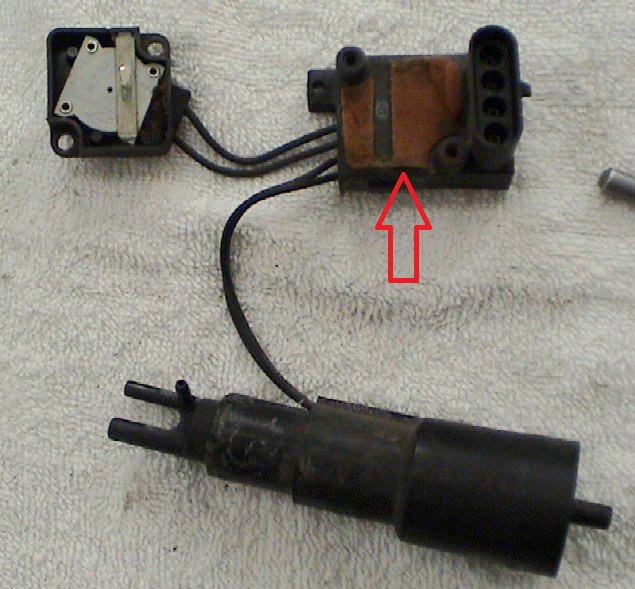
This is the only filter I saw, the one on the Sensor, which was completely disintegrated. This picture below is from the BuddyCraig post I linked in earlier.
I was not able to get the solenoid completely apart  so I don't know if there is another filter hiding in there. I haven't found the post with a picture of that. Do you know which one it is? so I don't know if there is another filter hiding in there. I haven't found the post with a picture of that. Do you know which one it is?
|
|
|
|
sanderson231
|
APR 01, 08:11 PM
|
|
| quote | Originally posted by Patrick:
If I fully understand some of the previous posts up the page, there seemed to be a suggestion that there needed to be a load on the engine for the EGR valve to actually activate/open. In my experience, this is not necessary. I was doing some work on my Formula a few days ago, and while I was thinking about it, I felt the underside of my EGR valve diaphragm with a finger while I revved the engine (with 5-spd out of gear, no load on engine). It didn't take much revving at all for the diaphragm to start opening... and that's with the vacuum readings earlier reported below. This may or may not still be relevant to the discussion, but I figure the more info the better.
|
|
Because the vacuum source for the EGR soldenod is ported, the TB butterfly has to be somewhat open to get enough vaccum to open the EGR valve. If the rpms are raised to 1800 rpm in neutral there won't be much vacuum available because the butterfly doesn't have to open much to achieve 1800 rpm with no load. This relates to the FSM test that says there is supposed to be 2-10 " Hg vacuum at 1800 rpm. That test is supposed to be done with some load on the engine. This was proved by the road test that showed 10"Hg of ported vacuum available at 25 mph. The no load test at 1800 rpm showed much less - less than 2" IIRC. Blipping the throttle open will created some ported vacuum and get the EGR to move.------------------
formerly known as sanderson
1984 Quad 4
1886 SE 2.8L
1988 4.9L Cadillac
1988 3800 Supercharged
|
|
|
|
Patrick
|
APR 01, 08:25 PM
|
|
| quote | Originally posted by sanderson231:
Blipping the throttle open will created some ported vacuum and get the EGR to move.
|
|
"Blipping the throttle open" can mean different things to different people. For some, that might mean redlining the engine for a brief moment. However, I'd like to make it clear that my EGR valve begins to open at the very slightest opening of the throttle while briefly revving up to maybe 2500 RPM.
| quote | Originally posted by Notorio:
I was not able to get the solenoid completely apart so I don't know if there is another filter hiding in there. I haven't found the post with a picture of that. Do you know which one it is?
|
|
I'll poke around and see if I can find an image of this EGR solenoid foam filter.
|
|
|
|