
 
     |
| V8 vs V6 (Page 6/9) |

|
fieroguru
|
JAN 13, 07:14 PM
|
|
| quote | Originally posted by Will:
There hasn't historically been the capability to have a first gear >4:1 AND a top gear ~0.6:1 in the same transmission.
|
|
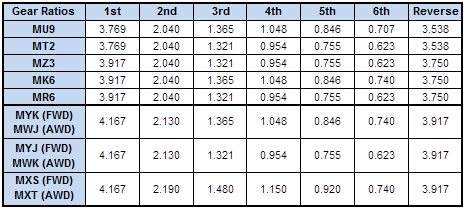
Good thing the F40 came along. One of its applications does exactly this and another is close.
|
|
|
|
Skybax
|
JAN 13, 08:32 PM
|
|
Wiki has been caught many times removing creditable and factual information to support a narrative therefore I don't go to their site for anything anymore, that's why I prefer to ask the person who actually drives the car.[This message has been edited by Skybax (edited 01-13-2022).]
|
|
|
|
pmbrunelle
|
JAN 13, 09:04 PM
|
|
| quote | Originally posted by fieroguru:
Good thing the F40 came along. One of its applications does exactly this and another is close.
|
|
The F40 still has perceived problems (well, in my view) where the top gears (such as 5, 6) are too close to each other. A factor of 1.2-ish between 5&6 isn't really worth it, unless you're driving 250 km/h and need every bit of power before/after the shift to keep from losing speed. I've never driven that fast...
On the other hand, the factor between 1&2 is huge, around 1.9, creating a no-man's land where an intermediate gear would be nice.
It seems like too much gear ratio progression, creating gaps in lower gears, and redundancy in the higher gears. Keeping the same span, the ratios could be more evenly distributed.
Focus groups like cars that are made this way?
In this table, the Acura NSX transmission variants in the three rightmost columns look pretty sweet:
https://www.nsxprime.com/wiki/Gear_Ratios
|
|
|
|
Daryl M
|
JAN 14, 04:37 PM
|
|
| quote | Originally posted by Will:
Ummm...
It's sort of a self-fulfilling prophesy...
If your engine has a small bore and small valves for its displacement, do you concentrate on top end power or low RPM torque? (In addition to port development, like BMW's S54)
If your engine has a big bore and big valves for its displacement, why concentrate on low RPM torque when you can go for top end power?
A 5 liter engine makes 5 liters of torque regardless of its bore and stroke.
Lower cruise RPM for any engine gives better mileage and slower wear. It doesn't even have to be a "low RPM" engine. LS3's and LT1's turn <2000 RPM at 80 mph. While they're biased toward the top end, they make "enough" low RPM torque to handle tall gearing. Most of the ability to cruise at low RPM comes from transmissions like CVTs and 8 speed automatics. There hasn't historically been the capability to have a first gear >4:1 AND a top gear ~0.6:1 in the same transmission.
Compare the Cadillac 4.9--square bore/stroke but done by 4500 RPM--to the S54--slightly undersquare, but makes power to 8000 RPM--to see that there's a lot more to it than just bore and stroke.
|
|
Not sure I can agree with your logic about the 4.9. If the reason it was done at 4500 was bore and stroke, the LS4 would suffer the same fate, but it doesn't. Stroke shouldn't limit rpm until piston speeds start getting to 150 fps. Or so I've been told. That means that your 3.5 inch stroke engine doesn't have a big problem with spontaneous disassembly till almost 8000 rpm. I would guess that the 4.9 only revs to 4500 because it has heads, exhaust and intake designed for lugging around a giant heavy Cadillac at low rpm.
|
|
|
|
Will
|
JAN 14, 09:06 PM
|
|
| quote | Originally posted by Daryl M:
Not sure I can agree with your logic about the 4.9. If the reason it was done at 4500 was bore and stroke, the LS4 would suffer the same fate, but it doesn't. Stroke shouldn't limit rpm until piston speeds start getting to 150 fps. Or so I've been told. That means that your 3.5 inch stroke engine doesn't have a big problem with spontaneous disassembly till almost 8000 rpm. I would guess that the 4.9 only revs to 4500 because it has heads, exhaust and intake designed for lugging around a giant heavy Cadillac at low rpm.
|
|
Right, the 4.9 is RPM limited because of its heads... But the S54 is an example of a highly developed undersquare engine that can spin to 8000.
Honda K24's and Mitsu 4G64's with ~4" strokes regularly exceed 8000 RPM. On the domestic side, mountain motors run >5" of stroke to 8000 RPM.
However, most of the time discussion is around average, rather than peak piston speed. Even the Honda F20 (84mm stroke) only hits ~83 fps average at 8900 RPM.
|
|
|
|
Will
|
JAN 14, 09:09 PM
|
|
As do GM's 6 speed automatics... but that takes a minimum of 6 gears and those have only been around the last 15 years. The newer crop of 8 and 10 speed transmission do even better. The 2.8 Babymax diesel with 8 speed transmission can get close to 30 MPG moving 2500 and 3500 full size vans... and the transmission is a huge component of that.[This message has been edited by Will (edited 01-14-2022).]
|
|
|
|
Will
|
JAN 14, 09:10 PM
|
|
| quote | Originally posted by pmbrunelle:
That reminds me...
I wish I could have the opportunity to drive something like that, but I don't think it's gonna happen. |
|
That's... umm... two transmissions 
|
|
|
|
Daryl M
|
JAN 14, 10:58 PM
|
|
| quote | Originally posted by Will:
Right, the 4.9 is RPM limited because of its heads... But the S54 is an example of a highly developed undersquare engine that can spin to 8000.
Honda K24's and Mitsu 4G64's with ~4" strokes regularly exceed 8000 RPM. On the domestic side, mountain motors run >5" of stroke to 8000 RPM.
However, most of the time discussion is around average, rather than peak piston speed. Even the Honda F20 (84mm stroke) only hits ~83 fps average at 8900 RPM.
|
|
As for aftermarket modifications on engines, there is a reason why manufacturers don't build engines like that. Longevity. A well built performance engine with parts built from special alloys can rev to higher piston speeds, but not reliably. This is where the long rod designed engine comes into play. A block with a tall deck height allows for less connecting rod angle change. That helps lessen stress on parts like rods and Pistons. Performance engines also don't give much consideration to things like heating and cooling cycles that over the years contribute to metal fatigue. Production engines, first and foremost, must last . Hotroders don't make that a high priority.
|
|
|
|
reinhart
|
JAN 15, 12:44 AM
|
|
| quote | Originally posted by Will:
My '07 Grand Cherokee has a Ben OM642 3.0 liter 75 degree v6. |
|
75? Interesting. I wonder how they balance that.
|
|
|
|
reinhart
|
JAN 15, 12:48 AM
|
|
| quote | Originally posted by pmbrunelle:
I do feel that when we talk about bottom end torque, we should not be speaking about torque at a specific RPM, but we should be speaking about horsepower at some percentage of redline.
Car engine tachometers could be calibrated in %redline, like this Boeing 737-300 tach:
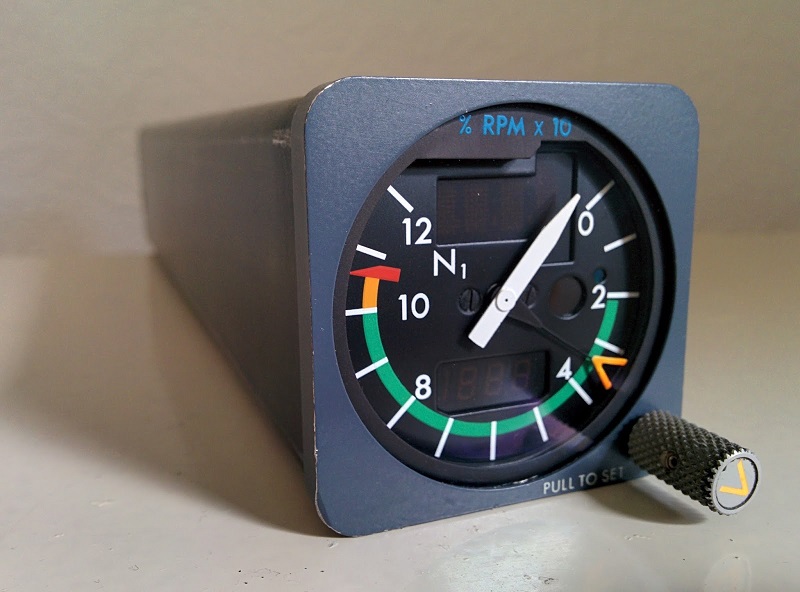
Is an 8000 RPM redline engine more fun than a 5000 RPM redline engine? If gearing compensates for different RPMs, the driver might not be able to tell the difference between both engines, if the instrument cluster doesn't have an RPM readout.
In my mind, it makes a lot of sense to normalize the horizontal axis of dyno graphs to %redline, for better comparison between engines. |
|
That should be "Percent of RPM Divided By 10", rather than "multiplied by 10", at least based on this particular gauge.
|
|
|
|