
 
     |
| My 1988 LFX F40 build. (Page 53/68) |

|
Daryl M
|
OCT 02, 07:14 PM
|
|
Clutch problem update:
I am hoping the brain trust can decipher the new twist to this problem, so here it is. I separated the engine from the transmission. As I turn the input shaft of the F40 , the axles turn as expected. Changing to different gears resulted in the axles turning at different speeds as expected, but if someone holds the axles still, the input shaft can still be turned. I thought that the shafts were supposed to be geared together. What I thought was a clutch always disengaged was really a transmission problem. What am I missing here? What should I be looking for?
|
|
|
|
Daryl M
|
OCT 02, 08:55 PM
|
|
|
L [This message has been edited by Daryl M (edited 10-02-2020).]
|
|
|
|
Raydar
|
OCT 03, 08:31 AM
|
|
If both axles are held still, you should not be able to turn the input shaft. If just one axle is held still, the input shaft should be able to turn the other axle. If you hold the input shaft still, and turn one axle, the other axle should turn in the opposite direction.
Unless you have a POSI unit (LSD) - which would be quite uncommon, and spendy - you have an "open" differential.[This message has been edited by Raydar (edited 10-03-2020).]
|
|
|
|
Daryl M
|
OCT 03, 10:15 AM
|
|
| quote | Originally posted by Raydar:
If both axles are held still, you should not be able to turn the input shaft. If just one axle is held still, the input shaft should be able to turn the other axle. If you hold the input shaft still, and turn one axle, the other axle should turn in the opposite direction.
Unless you have a POSI unit (LSD) - which would be quite uncommon, and spendy - you have an "open" differential.
|
|
Yup, that's how it should work, but it isn't. I'm wondering what can break or be assembled wrong to give the results I'm seeing. I picked up this transmission at a wreaking yard in Riverside, California in 2016. They said it came from a running car.
|
|
|
|
Raydar
|
OCT 03, 10:36 AM
|
|
| quote | Originally posted by Daryl M:
Yup, that's how it should work, but it isn't.
... |
|
Oh. Sorry. Ouch!
I can speak in generalities, but I don't know anything about the internals of an F40. Over my head.
Perhaps Joseph can chime in.
Edit -
Are you sure it's all the way in gear? I've seen other trannies that had enough drag to move stuff in neutral that shouldn't be turning. Of course if you reached out and grabbed it, it would stop.
Sorry. Don't mean to sound condescending. Just can't imagine anything that would break, and cause the symptoms you are describing. Clutching at straws, here.[This message has been edited by Raydar (edited 10-03-2020).]
|
|
|
|
Joseph Upson
|
OCT 03, 12:10 PM
|
|
| quote | Originally posted by Raydar:
Oh. Sorry. Ouch!
I can speak in generalities, but I don't know anything about the internals of an F40. Over my head.
Perhaps Joseph can chime in.
Edit -
Are you sure it's all the way in gear? I've seen other trannies that had enough drag to move stuff in neutral that shouldn't be turning. Of course if you reached out and grabbed it, it would stop.
Sorry. Don't mean to sound condescending. Just can't imagine anything that would break, and cause the symptoms you are describing. Clutching at straws, here.
|
|
Probably the greatest issue that put these transmissions on the market brand new (first GM generation) and steeply discounted, is the fact that there were many complaints about shifting them into gear when cold, particularly while the engine was running. Sometimes it was necessary to shut the engine off and put the transmission in first and then start the engine up, until the transmission warmed up (which I had to do a few times). My first F40 was from a salvaged vehicle and it eventually failed behind considerably more torque than what it was designed to handle in about a year. The second transmission was new from bmwguru (thanks for that man), still first design, held up to the same motor over 5 yrs, although with considerably less off the line torque than it had initially (but still too much) and to my knowledge did not fail after the car was sold over 3 yrs ago.
Without a history to assess, there's no telling what condition the transmission was in when purchased. It could have been in trouble in the car it came from, especially if the owner had trouble shifting it and applied excessive force to the shifter to make it go into gear. Slam those levers with force by hand into position and make sure you have it in gear, or the appearance of "Has to be in gear" and see if the condition changes. If it doesn't, the transmission is broken. It could have been damaged on impact if the donor was wrecked.[This message has been edited by Joseph Upson (edited 10-03-2020).]
|
|
|
|
fieroguru
|
OCT 03, 12:30 PM
|
|
Check to make sure all gears have axle rotation while rotating the input shaft. If it is only 1 gear doesn't have rotation, a single gear could be stripped. If you lost half the gears, one of the two main shaft pinion gears could have stripped. If all the gears are gone, then if could be the ring gear or the spider gears stripped. Any of these failure modes would leave lots of metal bits in the transmission, so drain the transmission oil and check for metal chunks.
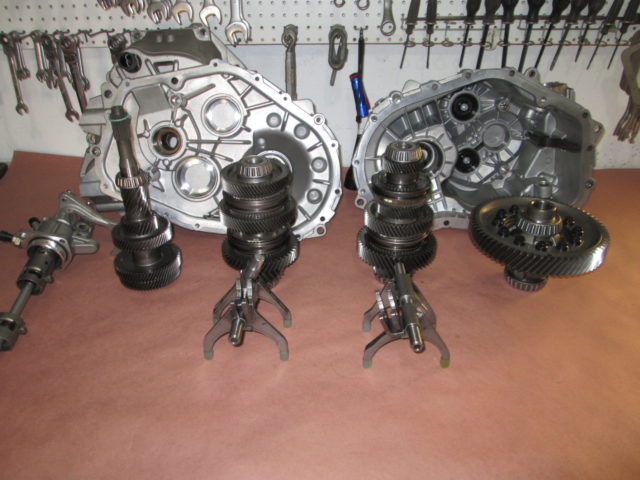
The F40 is super easy to disassemble. Put the shifter in neutral, removed the flange bolts and pull it out. Remove the case half bolts from the bellhousing area (these are easy to miss) as well as the ones from the passenger side of the differential housing. Set the transmission on the bellhousing face. Remove all the rest of the bolts, and gently pry open the case. Carefully lift the gear side case off and you will be left with all the shafts and gears exposed like this:
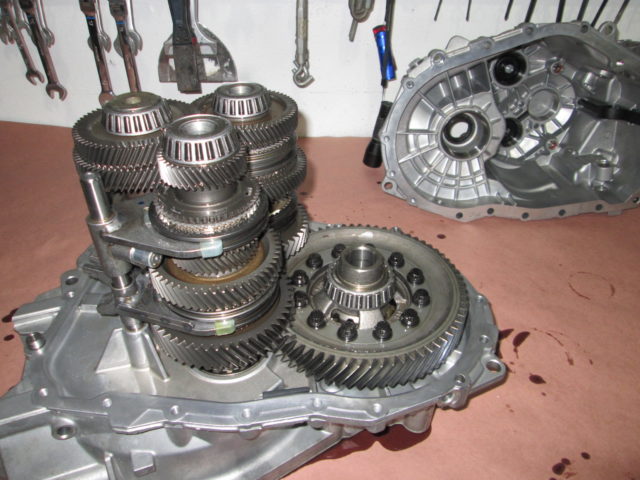
From there, you can remove the shift forks/shafts, as well as the gear stacks (just wiggle them side to side so the interlocking gears have room to pass by each other).
 [This message has been edited by fieroguru (edited 10-03-2020).]
|
|
|
|
Daryl M
|
OCT 03, 02:38 PM
|
|
| quote | Originally posted by fieroguru:
Check to make sure all gears have axle rotation while rotating the input shaft. If it is only 1 gear doesn't have rotation, a single gear could be stripped. If you lost half the gears, one of the two main shaft pinion gears could have stripped. If all the gears are gone, then if could be the ring gear or the spider gears stripped. Any of these failure modes would leave lots of metal bits in the transmission, so drain the transmission oil and check for metal chunks.
The F40 is super easy to disassemble. Put the shifter in neutral, removed the flange bolts and pull it out. Remove the case half bolts from the bellhousing area (these are easy to miss) as well as the ones from the passenger side of the differential housing. Set the transmission on the bellhousing face. Remove all the rest of the bolts, and gently pry open the case. Carefully lift the gear side case off and you will be left with all the shafts and gears exposed like this:
From there, you can remove the shift forks/shafts, as well as the gear stacks (just wiggle them side to side so the interlocking gears have room to pass by each other).
|
|
Thanks , the photos help.
|
|
|
|
Daryl M
|
OCT 03, 02:41 PM
|
|
| quote | Originally posted by Joseph Upson:
Probably the greatest issue that put these transmissions on the market brand new (first GM generation) and steeply discounted, is the fact that there were many complaints about shifting them into gear when cold, particularly while the engine was running. Sometimes it was necessary to shut the engine off and put the transmission in first and then start the engine up, until the transmission warmed up (which I had to do a few times). My first F40 was from a salvaged vehicle and it eventually failed behind considerably more torque than what it was designed to handle in about a year. The second transmission was new from bmwguru (thanks for that man), still first design, held up to the same motor over 5 yrs, although with considerably less off the line torque than it had initially (but still too much) and to my knowledge did not fail after the car was sold over 3 yrs ago.
Without a history to assess, there's no telling what condition the transmission was in when purchased. It could have been in trouble in the car it came from, especially if the owner had trouble shifting it and applied excessive force to the shifter to make it go into gear. Slam those levers with force by hand into position and make sure you have it in gear, or the appearance of "Has to be in gear" and see if the condition changes. If it doesn't, the transmission is broken. It could have been damaged on impact if the donor was wrecked.
|
|
Yes, used stuff is iffy at best. It doesn't help that I have little experience with manual transmissions. I just am at a loss as to what would cause this sort of issue.
|
|
|
|
Raydar
|
OCT 03, 06:55 PM
|
|
| quote | Originally posted by fieroguru:
<snip>
...
|
|
Thanks Paul. I "called out" Joseph, but I totally forgot that you had essentially field-stripped several of these things.[This message has been edited by Raydar (edited 10-03-2020).]
|
|
|
|