|
| Slight Regular Misfire and No Power After Upgrades (Page 4/6) |

|
Patrick
|
AUG 12, 01:32 PM
|
|
| quote | Originally posted by Notorio:
For cylinder #6, I somehow damaged the rings during the very rough start-up that opened a leak path for oil (up onto the spark plug) and for air-gas (down into the oil pan) such that the cylinder doesn't fire, even though Gas, Air, and Spark are present, yielding the 'misfire' that started this investigation.
|
|
What was there about the "very rough start-up" that would have damaged the rings, the piston and/or the cylinder walls on one cylinder of the six?
|
|

|
Notorio
|
AUG 12, 02:01 PM
|
|
| quote | Originally posted by Patrick:
What was there about the "very rough start-up" that would have damaged the rings, the piston and/or the cylinder walls on one cylinder of the six? |
|
My theory is that it was the severe water-in-the-gas issue. The engine bucked and coughed and spluttered to life with a very rough idle and misfire. I thought perhaps by chance fuel injector #6 got the lion's share of water vs the other cylinders. The walls of the cylinder look fine. When I took the engine apart initially all 6 cylinders looked about the same in terms of deposits so the rings must have been damaged after that. The only thing I can think of is the water ...[This message has been edited by Notorio (edited 08-12-2020).]
|
|

|
Patrick
|
AUG 12, 04:18 PM
|
|
| quote | Originally posted by Notorio:
My theory is that it was the severe water-in-the-gas issue. I thought perhaps by chance fuel injector #6 got the lion's share of water vs the other cylinders. ... so the rings must have been damaged
|
|
I'm definitely no expert, but I'd think if there was that much water that the cylinder would've hydrolocked and stopped the engine from running. 
The following article does say that pistons can be damaged, but doesn't actually mention rings.
Hydrolocked Engine – What Is It – What Damage Can It Do
|
|
|
|
Notorio
|
AUG 13, 11:29 AM
|
|
| quote | Originally posted by Patrick:
I'm definitely no expert, but I'd think if there was that much water that the cylinder would've hydrolocked and stopped the engine from running.
The following article does say that pistons can be damaged, but doesn't actually mention rings.
Hydrolocked Engine – What Is It – What Damage Can It Do |
|
Good reference on hydrolock. I guess I will have to drop the oil pan, ream the ridge, and push the piston out the top to see if the Rings or the Piston are damaged and leaking. Any other theories out there? Recommendations? Today I'll rotate the crank to get #6 and #4 at the same height and run another Kerosene leak-down test. This way I will see if the horrible result on #6 is repeatable and also see if #4 hardly leaks at all, like #2.
|
|
|
|
pmbrunelle
|
AUG 13, 12:05 PM
|
|
| quote | Originally posted by Notorio:
Good reference on hydrolock. I guess I will have to drop the oil pan, ream the ridge, and push the piston out the top to see if the Rings or the Piston are damaged and leaking. Any other theories out there? Recommendations? Today I'll rotate the crank to get #6 and #4 at the same height and run another Kerosene leak-down test. This way I will see if the horrible result on #6 is repeatable and also see if #4 hardly leaks at all, like #2. |
|
The plan makes sense.
Since you don't have many miles on the engine, there probably isn't much of a ridge, so you should be able to push out the piston as-is.
|
|
|
|
Patrick
|
AUG 13, 01:58 PM
|
|
| quote | Originally posted by pmbrunelle:
Since you don't have many miles on the engine, there probably isn't much of a ridge, so you should be able to push out the piston as-is.
|
|
The images Here don't appear to show a newly rebuilt engine.
Notorio, what is the history of the bottom end of this engine?
|
|
|
|
Notorio
|
AUG 13, 02:29 PM
|
|
| quote | Originally posted by Patrick:
The images Here don't appear to show a newly rebuilt engine.
Notorio, what is the history of the bottom end of this engine? |
|
The bottom, with 98k miles, only got a new high-volume oil pump. I can 'feel' a ridge but am going to try to measure it.
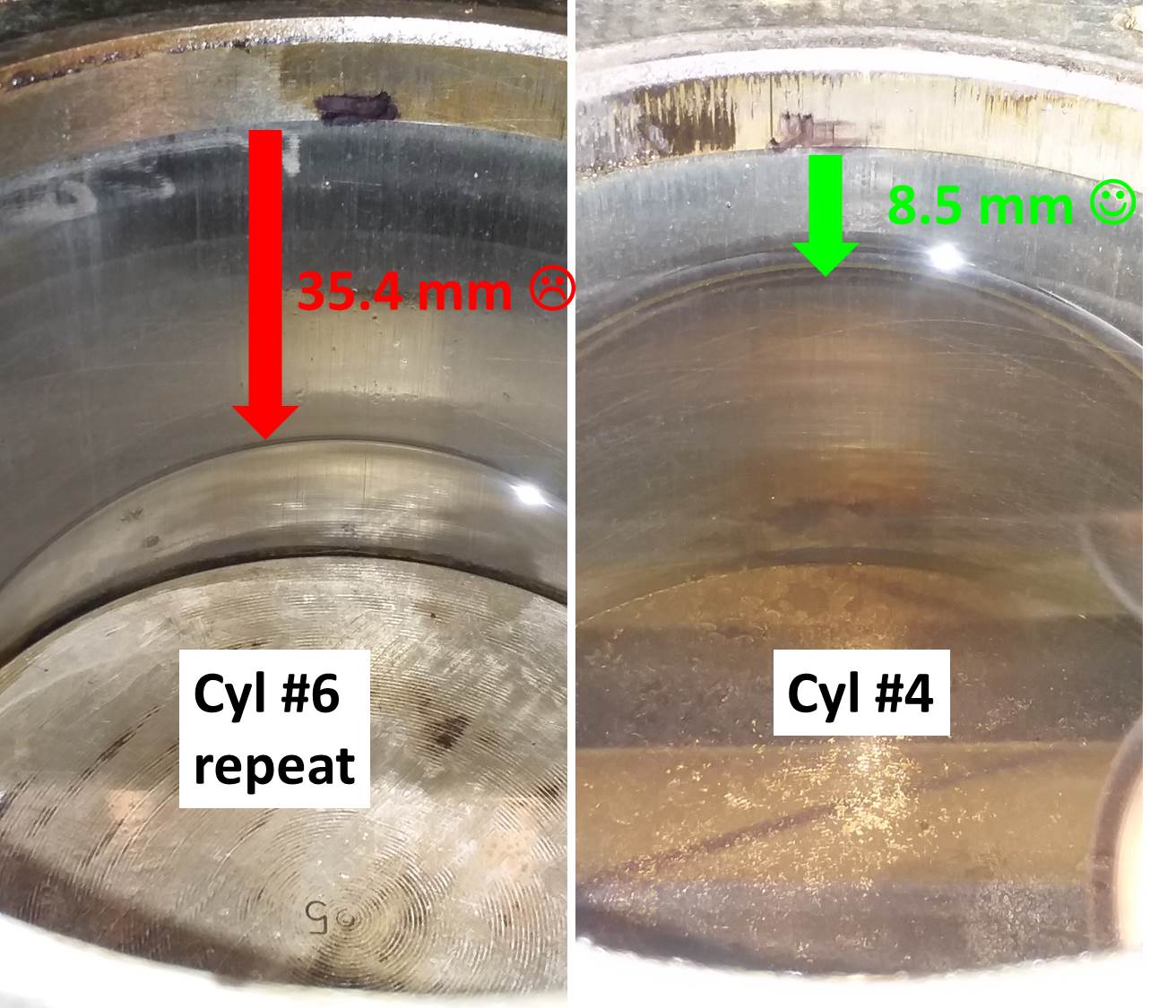
Here is the result from rerunning the Kerosene leak-down test on #6 (bad cylinder) and comparing now to #4 as a second reference for a 'good' cylinder. I promise I didn't put my thumb on the scale ... #6 is dead on it's prior result and #4 performs just like #2 did. So if there are no objections out there I'm taking this as comfirmation that #6 piston has been damaged sufficiently to have a significant leak-down problem. Looks like I'm going to have to take the oil pan off 
|
|
|
|
Patrick
|
AUG 13, 03:43 PM
|
|
| quote | Originally posted by Notorio:
So if there are no objections out there I'm taking this as comfirmation that #6 piston has been damaged sufficiently to have a significant leak-down problem. Looks like I'm going to have to take the oil pan off
|
|
This is rather beyond my experience level. If it turns out that the piston needs to come out of there, I'm certainly interested in seeing what the actual issue is.
|
|
|
|
pmbrunelle
|
AUG 13, 06:40 PM
|
|
I (incorrectly) assumed that this was a rebuilt engine.
Yeah, I think it's time to take out that piston.
This is what I found in my Fiero 2.8 V6:
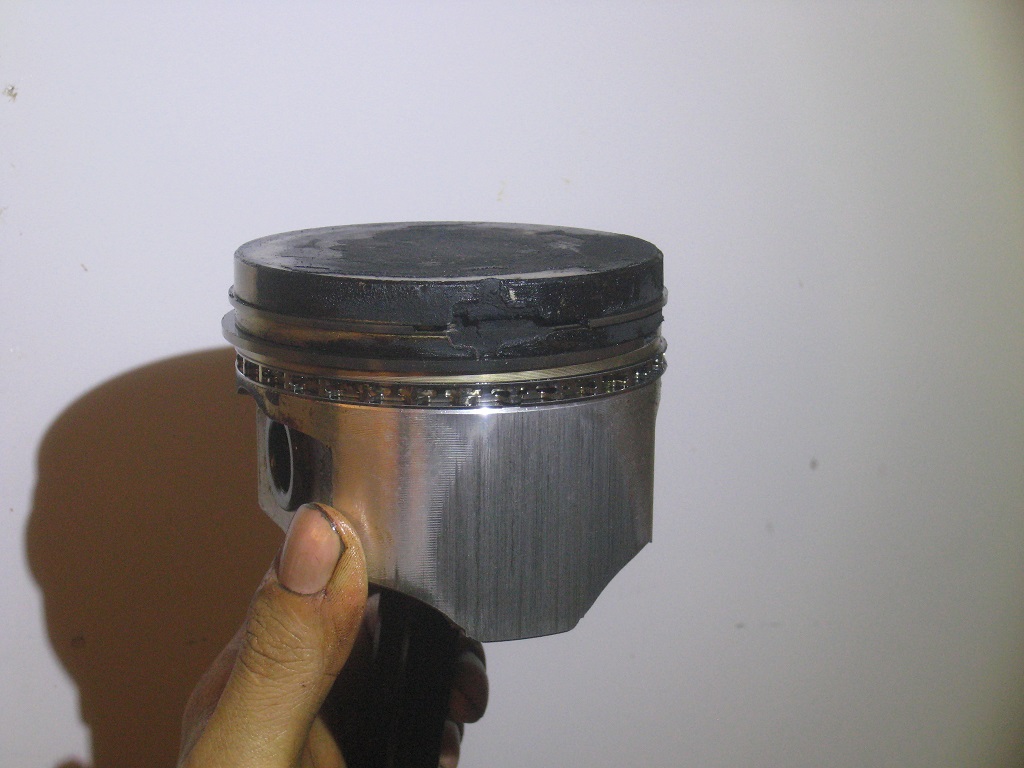
The damage wasn't really visible from above; I only knew the extent of what had happened once I removed the piston.
From the driver's perspective, this engine was still running and driving OK.[This message has been edited by pmbrunelle (edited 08-13-2020).]
|
|
|
|
Patrick
|
AUG 13, 07:27 PM
|
|
| quote | Originally posted by pmbrunelle:
This is what I found in my Fiero 2.8 V6...
|
|
Any idea what might've caused that?
|
|
|