
 
     |
| 3.4 L32 V6/60... questions... compared to L44 (Page 3/9) |

|
82-T/A [At Work]
|
MAY 11, 12:57 PM
|
|
| quote | Originally posted by lou_dias:
I lost something like 6 ft*lbs below 4500 (which I already had plenty of torque) but gained so much more power after 4800. The dyno I included speaks for itself. With a proper cam, the limitation isn't the heads as others will try to convince you otherwise. That said the heads are ported. I've made separate videos on my heads.
https://rumble.com/v2aonfa-...-v6-heads-redux.html
Follow the link to Fierosound's engine build about the roller lifters with iron heads. There's no needs to worry about the aluminum heads' splayed valves. The lifters go straight up and down, you just need shorter pushrods. They had to lower the height of the engine for FWD cars, hence they also use smaller valve covers. That's what pushed that design. If you look at LS3 heads, they are straight. Don't buy into the hype.
|
|
Few questions if you don't mind! (thank you for answering them)...
- I noticed you mention in your video that you're using the Fiero Store's stainless steel valves and valve springs. Quick question about that... how do you like them? What was it specifically that made you want to go down that path and use the Fiero Store's SS valves. I'm sure you don't have a before and after on JUST that... but curious what your thoughts are on using them?
- Exhaust Manifolds... I have a couple of junk Fiero V6 exhaust manifolds, and was thinking of cutting off the base and using them as a guide to help port my exhaust ports (rather than going the tape and etch route). Did you use any kind of template or something to help you in that area, or did you just mark it off (or use the exhaust staining) and grind that way?
- Water ports... I noticed both on your video, and in my own experience, that the water ports are always much smaller than the intake opening. I'm curious if it's not beneficial in any way to also port-match the water ports between the intake and the cyl head. Not like smoothing it out, because I recognize that a gritty interior passage just serves as more surface area with which to transfer heat, but... is there any benefit to port-matching the water ports?
- "Don't buy into the hype." I actually don't know what you're talking about here, haha... I haven't been involved in any of the back and forth.
Also, +1 for using Rumble...
|
|
|
|
82-T/A [At Work]
|
MAY 11, 01:48 PM
|
|
| quote | Originally posted by Raydar:
Having built a 3.4, I think you'll like the H272 cam. I used the Comp 1.52 rockers. Just be aware that you will need to machine the spring pockets in the heads, or use some different springs. Otherwise the springs will coil-bind. (If it's the same cam I'm thinking of, the valve lift is .454/.480, I/E, with 1.52 rockers.)
|
|
When you say machined spring pockets... I had my engine rebuilt and they put thick washers under the springs to reinforce the head (for my older engine). I had a totally different performance cam. But when you say "use different springs," what would you recommend? When I get this motor, I would honestly prefer to not have to do any machining at all if possible since it'll have already been rebuilt. All I'll be doing is possibly replacing the valves (lapping them the old fashioned way with the spindle and suction cup, haha), and porting everything. If I can just buy the right springs, rather than having to modify the cyl head seats, that would be more ideal. Thanks!!!
| quote | Originally posted by Raydar:
I would recommend the Dawg intake mod, and a bored throttle body and neck - at the very minimum. If you can find a Trueleo, that would be the stuff.
|
|
I've got the bored throttle body and neck, but don't have the dawg mod to expand the overall opening of the neck, so I will definitely do that, or something close to it. Goal is for me to keep it stock looking though, so the Trueleo isn't an option. I think if I wasn't concerned about looks... I'd probably go with a 3500 engine from the Pontiac Montana. Came stock w/ 185hp and more torque than all the other implementations of that motor.
| quote | Originally posted by Raydar:
I used a Cloyes timing set that allowed for cam adjustment. I installed my cam retarded, relative to the crank, to help out the top end.
|
|
I think I'm going to do this as well. I have a set of Cloyes timing gears that i put on my other engine... are they still available?
Thank you!
|
|
|
|
lou_dias
|
MAY 11, 02:00 PM
|
|
| quote | Originally posted by 82-T/A [At Work]:
Few questions if you don't mind! (thank you for answering them)...
- I noticed you mention in your video that you're using the Fiero Store's stainless steel valves and valve springs. Quick question about that... how do you like them? What was it specifically that made you want to go down that path and use the Fiero Store's SS valves. I'm sure you don't have a before and after on JUST that... but curious what your thoughts are on using them?
- Exhaust Manifolds... I have a couple of junk Fiero V6 exhaust manifolds, and was thinking of cutting off the base and using them as a guide to help port my exhaust ports (rather than going the tape and etch route). Did you use any kind of template or something to help you in that area, or did you just mark it off (or use the exhaust staining) and grind that way?
- Water ports... I noticed both on your video, and in my own experience, that the water ports are always much smaller than the intake opening. I'm curious if it's not beneficial in any way to also port-match the water ports between the intake and the cyl head. Not like smoothing it out, because I recognize that a gritty interior passage just serves as more surface area with which to transfer heat, but... is there any benefit to port-matching the water ports?
- "Don't buy into the hype." I actually don't know what you're talking about here, haha... I haven't been involved in any of the back and forth.
Also, +1 for using Rumble... |
|
The Fiero Store SS valves very slightly bump compression over stock and near the base of the valve get about 1 mm narrower to increase flow over stock.
You should try to get some Trueleo headers. My exhaust ports were done/started on a machine to make them perfectly round and centered then internally blended by hand.
The Fiero cooling system is plenty fine so if it ain't broke, I don't fix it. 
Headers and Cross-over:
https://www.youtube.com/watch?v=A6b6oFadliQ
Installed along with the old Trueleo intake after my refresh to the 4900rpm 480/480 roller cam:
https://www.youtube.com/watch?v=6IUNb-H53Io[This message has been edited by lou_dias (edited 05-11-2023).]
|
|
|
|
zkhennings
|
MAY 11, 04:44 PM
|
|
I have no beef with anyone about anything, I don't care one bit what heads anyone wants to put on what bottom end, but the splayed valve tech is objectively really nice, it does an excellent job de-shrouding the valves as the valve moves away from the cylinder wall. Most DOHC high flowing motors have the same concept as they all have hemi heads (like a Chrysler hemi engine does with 2 valves, hence the name, hemispherical combustion chamber), and the valves are splayed but in a different plane. I have watched a lot of videos on head flow and de-shrouding the valves massively increases flow on Chevy V8s, as the biggest restriction by far in the head is nowhere in the port, it is when the air needs to flow around and past the valve. Port shape is all about helping the air slip past the valve and into the combustion chamber. You lose somewhere around 20% of flow out of the valve when it is butted up next to the cylinder wall.
On the intake side, the flow around the valve also greatly benefits from getting rid of the tulip shaped part of the valve. Here you can see an image comparing an LZ9 intake valve to a 2.8 intake valve, notice how much flatter the LZ9 valve is. You can make these mods yourself with a drill and an angle grinder, a drill to spin the valve and an angle grinder to remove material. On the exhaust side the tuliping helps as gas is flowing past the valve in the reverse direction and the tuliping plays a positive role in redirecting it to flow out the port.
You can see how in the newer motors they have reduced the diameter of the valve stem, and they have flattened the back of the valve, both for lightness and for flow. This is LZ9 intake valve vs 2.8 intake valve.
|
|
|
|
La fiera
|
MAY 11, 06:13 PM
|
|
If you don't ditch the stock Fiero intake with Dawg mod or anything else you'll be very disappointed. The difference between the L44 and the L32 is not only the displacement, but another parameter that a lot of people don't take into account because they've heard it is not important. I'm taking about rod to stroke ratio or rod ratio which is the relation between the rod lenght and stroke. I have to go to a meeting and when I come back later tonight I can get deeper in the discussion so you can understand why is it when you dress the 3.4L with all the Fiero intakes and exhaust it falls off on its face much earlier in the RPM range. And how you can compensate for that.
Meantime I'll leave you with my 2 experiments. And no, there's not turbo, supercharger or nitrous, all NA.

Stock 2.8 VS Same 2.8 built without generic parts from catalogs. (Intake, CNC heads stock valves & custom cam.)

3.4L (Intake, CNC heads oversized valves, custom cam and 3.4DOHC pistons)
|
|
|
|
pmbrunelle
|
MAY 11, 06:38 PM
|
|
| quote | Originally posted by zkhennings:
I have no beef with anyone about anything, I don't care one bit what heads anyone wants to put on what bottom end, but the splayed valve tech is objectively really nice |
|
Objectively... I would say that the iron heads with all their 90° angles and parallel valves are really nice with regards to the number of machining setups and ease of setup.
The splayed valve heads don't seem nice at all with regards to having to set up a production line to make them...
|
|
|
|
MarkS
|
MAY 11, 10:07 PM
|
|
|
|
|
zkhennings
|
MAY 12, 12:40 AM
|
|
|
I think one of his key goals is to keep it looking stock, it will still be a big improvement.
|
|
|
|
lou_dias
|
MAY 12, 08:47 PM
|
|
What most people don't realize is that 'Mustang' brand dynos are wildly different because they get 'tuned' by each shop individually. The particular one I went to got his within 5% of dynojet dynos...most are 15% lower... So my 187 rwhp is 95% of what it would have done on a local dynojet (which are pretty standardize for output results). You'd have to go to two local dynos and do your own comparison if you have a Mustang and Dynojet dyno shop(s) around. I had more work into my motor (hence 249 ft*lbs) but at the same time I was restricted by the stock intake neck as that pre-dated my DAWG mod...which is also why my peak rpm was <=4500 rpm...when it should have been at 5200 rpm.
I did go onto remove that restriction but you'll notice my future dyno got lower... Why? They co-inside with putting on bigger, wider, heavier wheels. So I sacrificed "rwhp" in the name of launching and grip on the track. It was worth it because that was how I was measuring 'performance' for my use-case....the oval track.
The bottom line is that a properly built 3.4 can and will do >200 rwhp...as the above dynos, La Fiera and others have proven.[This message has been edited by lou_dias (edited 05-12-2023).]
|
|
|
|
La fiera
|
MAY 12, 10:28 PM
|
|
| quote | Originally posted by zkhennings:
the splayed valve tech is objectively really nice, it does an excellent job de-shrouding the valves as the valve moves away from the cylinder wall. Most DOHC high flowing motors have the same concept as they all have hemi heads (like a Chrysler hemi engine does with 2 valves, hence the name, hemispherical combustion chamber), and the valves are splayed but in a different plane. I have watched a lot of videos on head flow and de-shrouding the valves massively increases flow on Chevy V8s, as the biggest restriction by far in the head is nowhere in the port, it is when the air needs to flow around and past the valve. Port shape is all about helping the air slip past the valve and into the combustion chamber. You lose somewhere around 20% of flow out of the valve when it is butted up next to the cylinder wall.
On the intake side, the flow around the valve also greatly benefits from getting rid of the tulip shaped part of the valve. Here you can see an image comparing an LZ9 intake valve to a 2.8 intake valve, notice how much flatter the LZ9 valve is
|
|

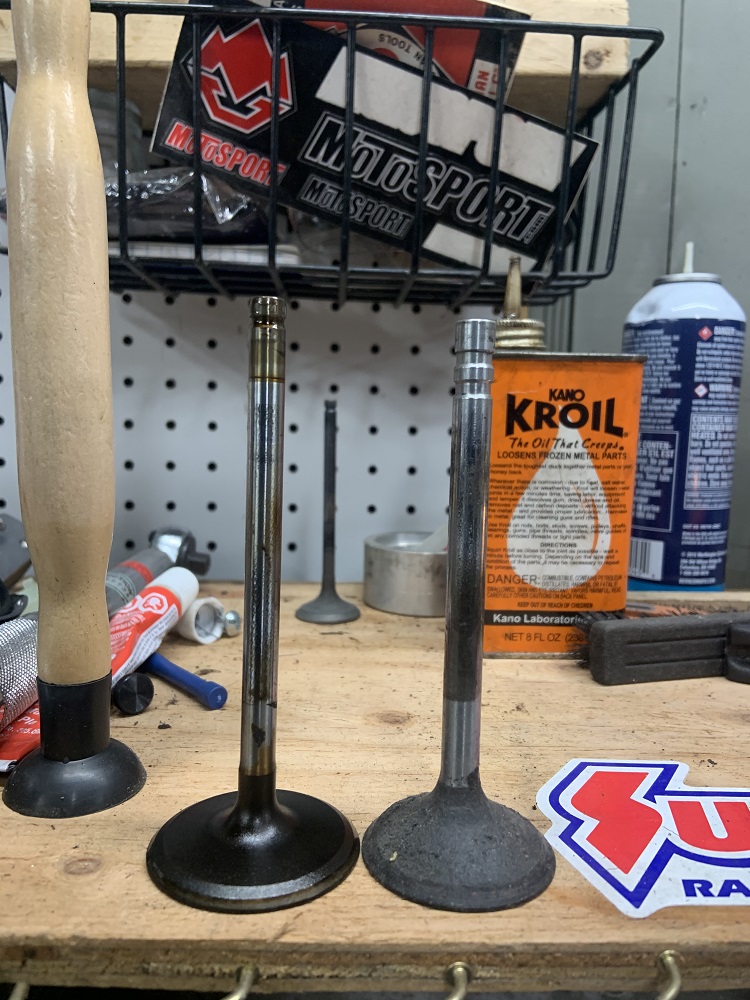
My intake valves VS stock 2.8/3.4.
Yes, the splayed is nice but when I wanted to take that advantage to use it on my stroker I found that the camshaft profile reveled its flaw. When I installed the cam profile specifically made for the displacement, due to the LSA and Overlap the intake and exhaust valves hit each other and locked together. So, as you can see all those DOHC engines have the valve area to use a lot less overlap and less aggressive LSA's but when it comes to the Hemis, they are leaving a lot on the table because they can't get aggressive on LSA's and overlap for the displacement.
I fixed the shrouding problem by widening the bore and voila, problem solved. Same head went from 193CFM to past 220CFM by increasing the bore and making the intake valve 5% bigger and reducing the valve stem by 20%. The junyard 39000/3500 motors everyone uses to upgrade their Fieros cost money, a bunch of time and lots of custom work. I'm with Lou, why spend so much money and more important time when for the same money or a bit more you can put together a 3.4/3400 iron headed package than can outperfom any LZ/LX9? To each their own
This is the perfect example.
https://youtu.be/vdTY9J9crQw
Again, like Zkennings said, I don't care what you use and I respect that. It is your car/engine/project.[This message has been edited by La fiera (edited 05-12-2023).]
|
|
|
|