
 
     |
| High NOx Smog Failure (Defeat or Bust) (Page 3/9) |

|
Kitskaboodle
|
MAR 13, 06:22 PM
|
|
| quote | Originally posted by Notorio:
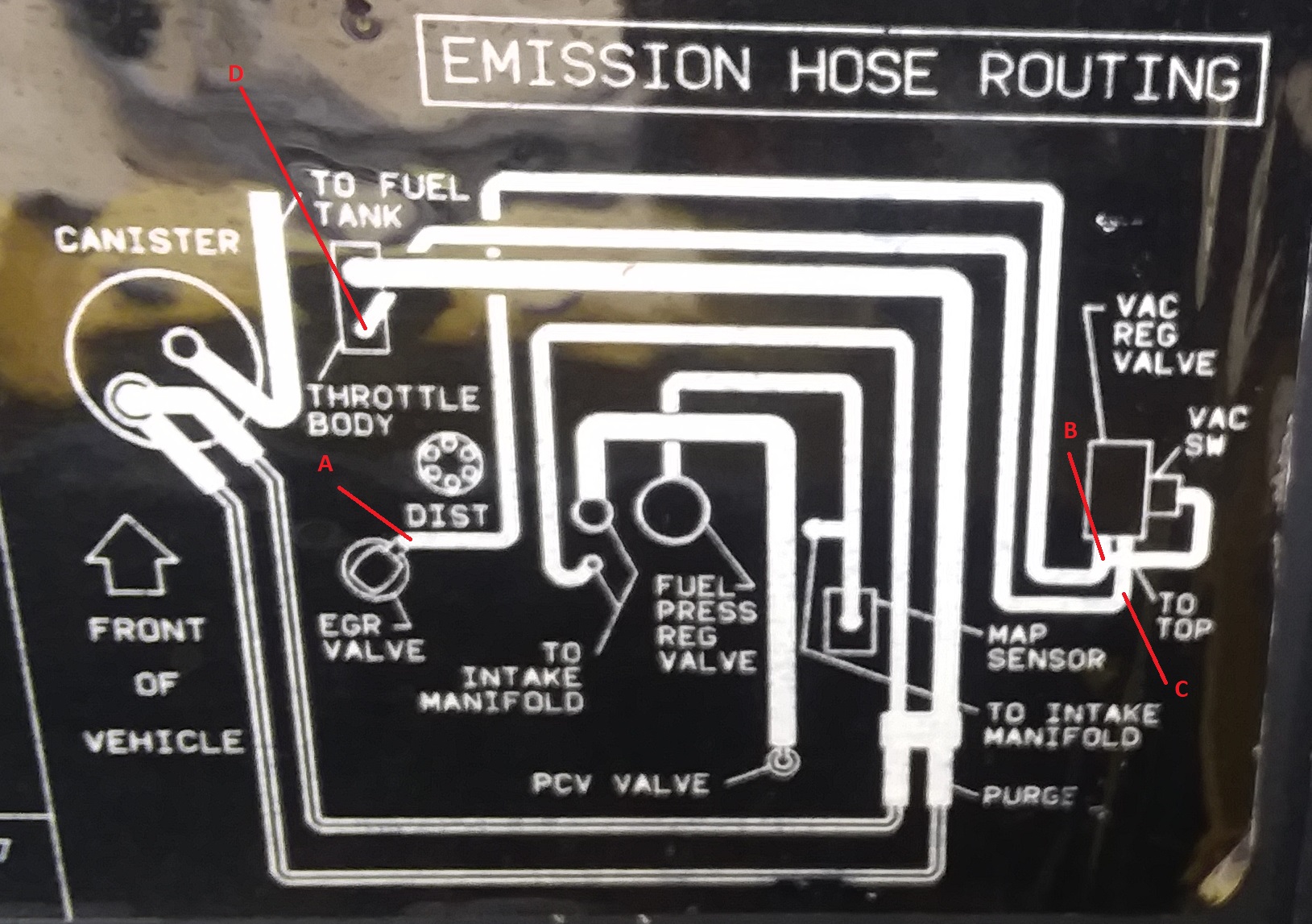
Kit, I think I'm onto something. Here is the EGR data as a result of (trying to) follow the confusing Field Service Manual's flowchart. It boils down to:
1) does the EGR Solenoid open around 1800 rpm
2) does the vacuum applied to the EGR Valve exceed 2" of Hg (and is it less than 10".)
The vacuum gauge that I have is VERY hard to read below perhaps 4". I did multiple measurements and MOSTLY have convinced myself that the EGR Solenoid DOES work, that the lines from the Throttle Body to the Solenoid to the Valve DO NOT leak, however, the vacuum the EGR sees is marginally LESS than what will open the valve using a manual pump. i.e. the 2" reading that I think I see at the Valve is less than the 3" the Valve needs to open. If I apply the alleged 2" with a manual pump the valve stays closed. At about 3" the valve opens the the IDLE starts to stumble.
Referring to the diagram below, I started my measurements at A but worked myself back to D to test for leaks in the vacuum circuit. The reading is the SAME at A, B, C, and D. If there is a drop-off, the gauge is too insensitive to pick it up. Anyway, I think the question is now HOW do I increase the ported vacuum from the Throttle Body to something more like 4-5"??
p.s. I MIGHT just fashion myself a Water Manometer so I can see very clearly if the System Vacuum really is sufficient to open the EGR Valve.
|
|
What you are concluding is exactly what I had concluded: that despite all systems checking ok (vacuum lines & elbow integrity, egr solenoid, egr valve, throttle body lines, etc.) the egr valve must NOT be getting enough ported vacuum to open properly or enough. As you did, i was able to fully open my egr valve doing a manual test with my Mighty Mite vacuum tester but as I recall, I remember having to apply a good 4-5 hg’s to get it to open properly.
Kit
|
|
|
|
Notorio
|
MAR 13, 07:08 PM
|
|
| quote | Originally posted by sanderson231:
Some other thoughts:
1) partially clogged EGR passage in intake manifold creating flow restriction
...
EGR is commanded on at 1200 rpm and MAP's less than 60 kPa. However the duty cycle is not large 11.7 % to 19.5% depended in MAP so normal vaccum to EGR valve may not be that high.
|
|
Appreciate you thinking about this issue. On Friday I should be able to get back to Fiero trouble-shooting. I'll definitely check on that possible restriction. Also posting next steps in response to Kit.
BUT, where do you find the 1200 rpm number? My 88 service manual says 1800 rpm and 2" Hg.
|
|
|
|
Notorio
|
MAR 13, 07:14 PM
|
|
| quote | Originally posted by Kitskaboodle:
What you are concluding is exactly what I had concluded: that despite all systems checking ok (vacuum lines & elbow integrity, egr solenoid, egr valve, throttle body lines, etc.) the egr valve must NOT be getting enough ported vacuum to open properly or enough. As you did, i was able to fully open my egr valve doing a manual test with my Mighty Mite vacuum tester but as I recall, I remember having to apply a good 4-5 hg’s to get it to open properly.
Kit
|
|
I am in good company then! (Misery loves company, right??)
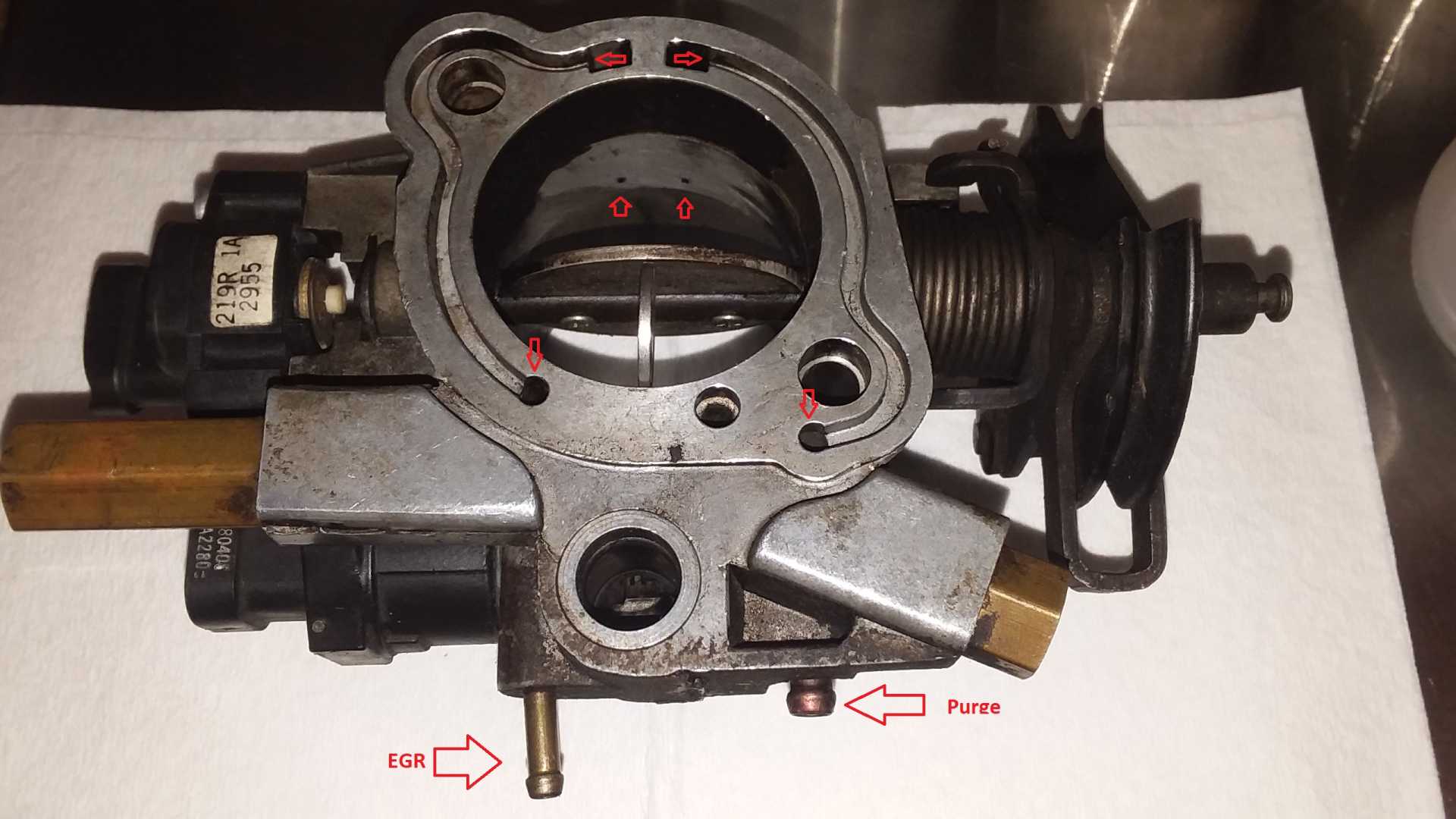
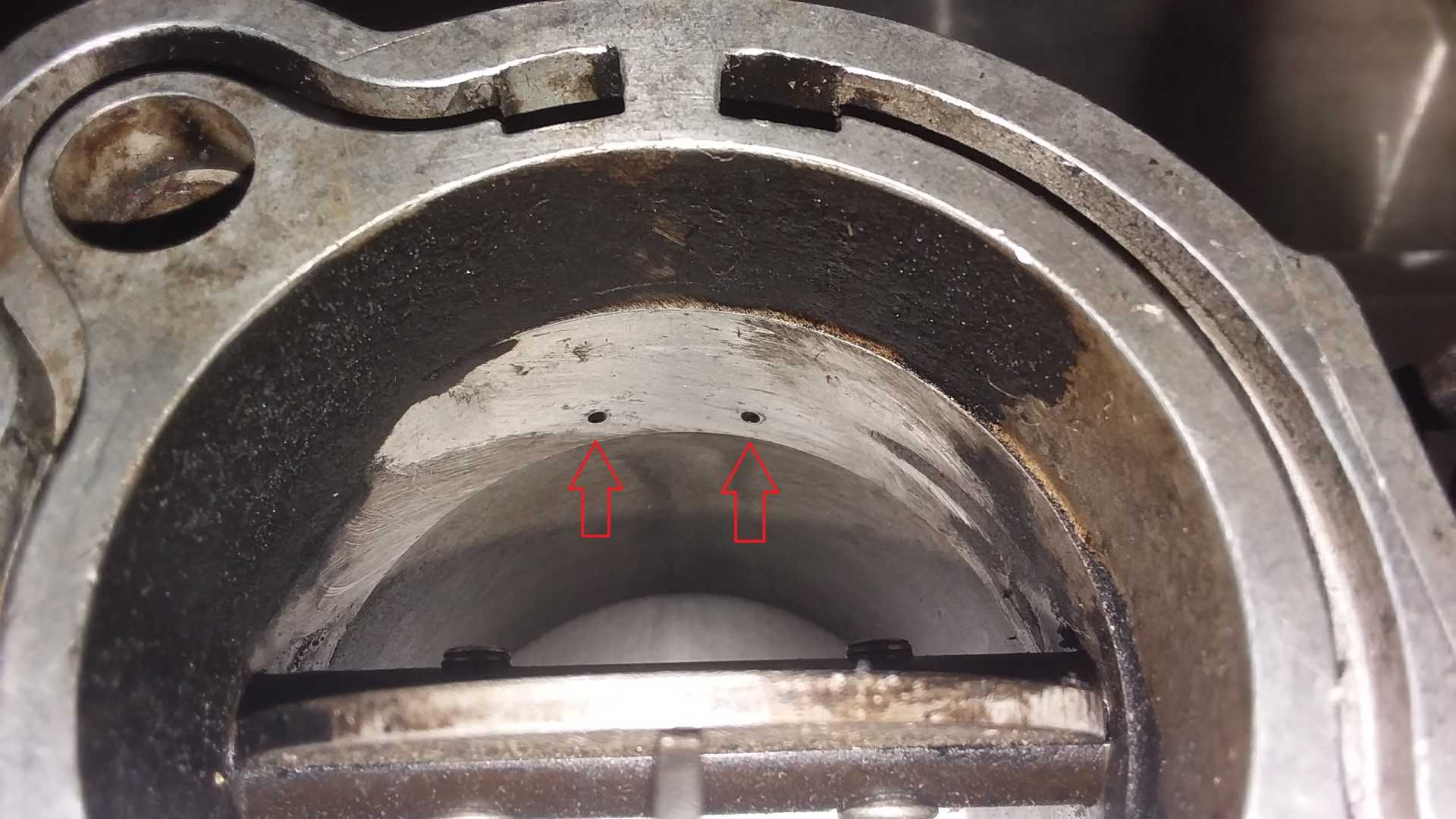
Friday I should be able to get back to this. I recalled I had a spare Throttle Body so I got that out and was quite surprised to see that the ported vacuum path for the small EGR nipple and the large Purge nipple are exactly the same. I haven't measured the tiny, pin-point openings in the TB but they sure LOOK the same to me. Anyway, Friday I will measure the vacuum at BOTH nipples, to see how they compare.
If there are no clogs or restrictions, my seat-of-the-pants idea was to enlarge the diameter of the hole in the TB, by say, 50%. Thoughts on this?? Another option would be to drill out the EGR nipple and replace with larger diameter. This being UNDER the TB perhaps it wouldn't fail visual inspection.
|
|
|
|
sanderson231
|
MAR 14, 10:04 AM
|
|
| quote | [B]Originally posted by Notorio:[/B
BUT, where do you find the 1200 rpm number? My 88 service manual says 1800 rpm and 2" Hg. |
|
I have Tunercat and I looked at the AKYN broadcast code EPROM calibration for an 88 Fiero. EGR is commanded at 1200 rpm.
------------------
formerly known as sanderson
1984 Quad 4
1886 SE 2.8L
1988 4.9L Cadillac
1988 3800 Supercharged
|
|
|
|
Raydar
|
MAR 14, 01:53 PM
|
|
FWIW, I have fought this battle before. Problem ended up being the rubber elbow that plugged on to the throttle body port. The end where the plastic hardline plugged in was deteriorated. But you've already looked at that, so...
One thing I thought about, in the middle of it all, was just running a hose from the TB port, up under the plenum, and straight back to the EGR valve, bypassing the solenoid. But that will allow the code to set, unless you "tee in" the switch on the solenoid. That should provide plenty of EGR, provided the engine doesn't misfire. It's a crapshoot, though.
Over the years, some people have dumped a bunch of Naptha into their tank.[This message has been edited by Raydar (edited 03-14-2023).]
|
|
|
|
Notorio
|
MAR 14, 02:00 PM
|
|
| quote | Originally posted by sanderson231:
I have Tunercat and I looked at the AKYN broadcast code EPROM calibration for an 88 Fiero. EGR is commanded at 1200 rpm.
|
|
Hmmmn, don't know what to make of that. Does this show an increasing Voltage to the EGR Solenoid, say just becomes non-zero at 1200 rpm and ramps up to X at 1800 rpm and higher?
|
|
|
|
Notorio
|
MAR 14, 02:04 PM
|
|
| quote | Originally posted by Raydar:
FWIW, I have fought this battle before. Problem ended up being the rubber elbow that plugged on to the throttle body port. The end where the plastic hardline plugged in was deteriorated. But you've already looked at that, so...
One thing I thought about, in the middle of it all, was just running a hose from the TB port, up under the plenum, and straight back to the EGR valve, bypassing the solenoid. But that will allow the code to set, unless you "tee in" the switch on the solenoid. That should provide plenty of EGR, provided the engine doesn't misfire. It's a crapshoot, though.
Over the years, some people have dumped a bunch of Naptha into their tank.
|
|
Maybe you didn't see that I measured the vacuum at the TB port and it is no higher than what arrives via the whole circuit (through the solenoid.) I'm hoping there is build-up in the TB part of the circuit, which I'll try to ascertain on Friday (i.e. lots of TB cleaner and high-pressure air). While I'm playing with that I'll also try your Direct Hose suggestion.
re: additives, I'm going to go with a gallon of Ethanol added to the tank, unless somebody knows why that would be detrimental ...
|
|
|
|
sanderson231
|
MAR 14, 04:52 PM
|
|
| quote | Originally posted by Notorio:
Hmmmn, don't know what to make of that. Does this show an increasing Voltage to the EGR Solenoid, say just becomes non-zero at 1200 rpm and ramps up to X at 1800 rpm and higher? |
|
The EGR solenoid is controlled by pulse width modulation. The EGR solenoid is supplied with 12V. The ECM grounds the EGR solenoid to energize it it many times per second. The on-time of the pulses determines how much vacuum the EGR valve will see. I believe an oscilliscope would be necessary to see the actual milisecond pulse width.
As shown below, there is a table in the PROM that shows % EGR vs MAP (kPa) vs RPM.
         80     75   70     65     60    55     50    45     40    30    20    10
400   0.0	0.0	0.0	0.0	0.0	0.0	0.0	0.0	0.0	0.0	0.0	0.0
800   0.0	0.0	0.0	0.0	0.0	0.0	0.0	0.0	0.0	0.0	0.0	0.0
1200 0.0	0.0	0.0	0.0	11.7	11.7	15.6	19.5	19.5	19.5	19.5	11.7
1600 0.0	0.0	0.0	0.0	11.7	11.7	15.6	19.5	19.5	19.5	19.5	11.7
2000 0.0	0.0	0.0	0.0	11.7	11.7	15.6	19.5	19.5	19.5	19.5	11.7
2400	0.0	0.0	0.0	11.7	11.7	15.6	23.4	23.4	23.4	19.5	15.6  15.6
2800	0.0	0.0	0.0	0.0	0.0	0.0	0.0	7.8	23.4	19.5	15.6  15.6
The top row is kPa. The first column is RPM. Sorry the formatting is screwed up. PFF doesn't like tables
------------------
formerly known as sanderson
1984 Quad 4
1886 SE 2.8L
1988 4.9L Cadillac
1988 3800 Supercharged[This message has been edited by sanderson231 (edited 03-14-2023).]
|
|
|
|
sdgdf
|
MAR 14, 05:50 PM
|
|
| quote | Originally posted by Notorio:
Gents,
I'm ready to roll this baby off the nearest cliff. |
|
You could just roll it into a state with more reasonable emissions 
Only advice I can give is that when I use the search function on the forum, there are a lot of threads where people had high NOx. A lot of people solved their problem and the threads give a lot of ideas how.
One of my Fieros had high NOx the last year it had to pass inspection and I solved it just by driving the car for an hour before getting to the inspection place. My problem was my birthday is in winter and I was driving to the closest emissions place and didn't give the car time to warm up properly. Also if they're doing it in the wrong gear or something take it to a different shop.
|
|
|
|
FieroJimmy
|
MAR 14, 08:18 PM
|
|
| quote | Originally posted by sanderson231:
The EGR solenoid is controlled by pulse width modulation. The EGR solenoid is supplied with 12V. The ECM grounds the EGR solenoid to energize it it many times per second. The on-time of the pulses determines how much vacuum the EGR valve will see. I believe an oscilliscope would be necessary to see the actual milisecond pulse width.
As shown below, there is a table in the PROM that shows % EGR vs MAP (kPa) vs RPM.
80 75 70 65 60 55 50 45 40 30 20 10
400 0.0 0.0 0.0 0.0 0.0 0.0 0.0 0.0 0.0 0.0 0.0 0.0
800 0.0 0.0 0.0 0.0 0.0 0.0 0.0 0.0 0.0 0.0 0.0 0.0
1200 0.0 0.0 0.0 0.0 11.7 11.7 15.6 19.5 19.5 19.5 19.5 11.7
1600 0.0 0.0 0.0 0.0 11.7 11.7 15.6 19.5 19.5 19.5 19.5 11.7
2000 0.0 0.0 0.0 0.0 11.7 11.7 15.6 19.5 19.5 19.5 19.5 11.7
2400 0.0 0.0 0.0 11.7 11.7 15.6 23.4 23.4 23.4 19.5 15.6 15.6
2800 0.0 0.0 0.0 0.0 0.0 0.0 0.0 7.8 23.4 19.5 15.6 15.6
The top row is kPa. The first column is RPM. Sorry the formatting is screwed up. PFF doesn't like tables |
|
If you use the [ CODE][ /CODE] tags it should format properly.
code:
80 75 70 65 60 55 50 45 40 30 20 10
400 0.0 0.0 0.0 0.0 0.0 0.0 0.0 0.0 0.0 0.0 0.0 0.0
800 0.0 0.0 0.0 0.0 0.0 0.0 0.0 0.0 0.0 0.0 0.0 0.0
1200 0.0 0.0 0.0 0.0 11.7 11.7 15.6 19.5 19.5 19.5 19.5 11.7
1600 0.0 0.0 0.0 0.0 11.7 11.7 15.6 19.5 19.5 19.5 19.5 11.7
2000 0.0 0.0 0.0 0.0 11.7 11.7 15.6 19.5 19.5 19.5 19.5 11.7
2400 0.0 0.0 0.0 11.7 11.7 15.6 23.4 23.4 23.4 19.5 15.6 15.6
2800 0.0 0.0 0.0 0.0 0.0 0.0 0.0 7.8 23.4 19.5 15.6 15.6
Or, at least pretty close.
|
|
|
|