|
| Thermostat housing cap, which is the proper one? (Page 3/4) |

|
Cliff Pennock
|
FEB 05, 12:27 PM
|
|
|
I'm pretty sure I read somewhere (although I can't find where) that the Stant 10232 is supposed to do that.
|
|
|
|
Cliff Pennock
|
FEB 05, 12:53 PM
|
|
Here is the Stant 10232:
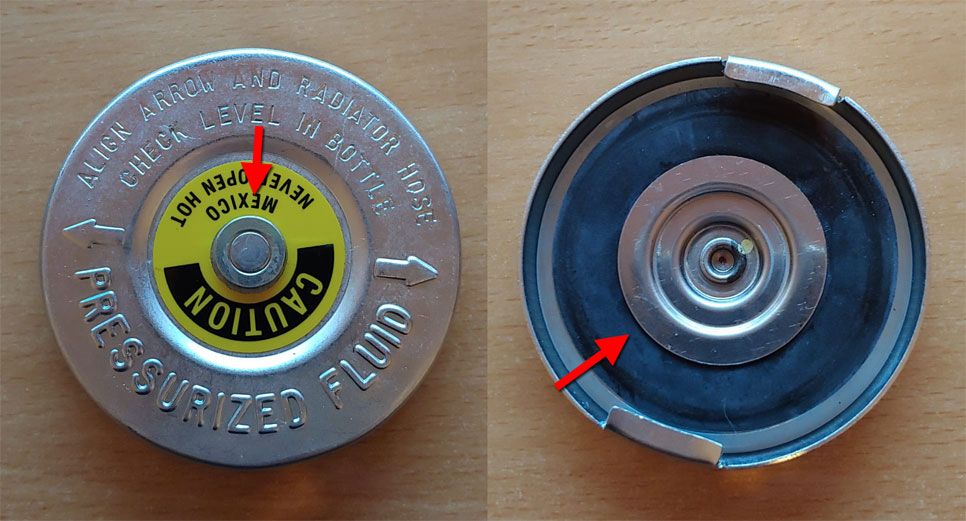
The middle parts (arrows) can move up and down. I can actually blow air through it. Like I said, I remember reading somewhere it is supposed to work that way.
Someone else here with a Stant 10232 who can confirm the middle part is moving?
|
|
|
|
claude dalpe
|
FEB 05, 03:05 PM
|
|
It's done like that cliff it's to be able to compress it to pass the thermostat housing lock and not break the cap gasket
Try it on the thermostat housing and when it is screwed in place you will find that the rivet on the top of the cap no longer moves, it is compressed and there is no leak.
It is the correct cap that you have Stant 10232
0 pressure means that it does not open under pressure
A radiator cap ex: 16 lbs means that it will open at 16 lbs to let the pressure out of the radiator so as not to blow the radiator
|
|
|
|
Cliff Pennock
|
FEB 05, 03:38 PM
|
|
| quote | Originally posted by claude dalpe:
when it is screwed in place you will find that the rivet on the top of the cap no longer moves, it is compressed and there is no leak.
|
|
Ok, that sounds logical enough. 😊
|
|
|
|
theogre
|
FEB 05, 10:01 PM
|
|
| quote | Originally posted by Cliff Pennock:
I also looked up several threads here on PFF about the cap and just about everyone is using the Stant 10232 which is the wrong cap. I'm guessing that if you use the open vent cap, you're losing a lot of coolant as steam and the radiator cap never opens. |
|
No. Is Not the Wrong part and you Won't leak Coolant using it. (Unless the T-stat Housing is damaged...)
Stant 10232 is the T-stat cap and is 0PSI and "Non vented" but those terms Does Not Apply to this Cap.
Those entries Only likely to fill in spaces in the databases to make Stant Catalogs but Mean Nothing to this cap.
GM RC40 Is T-stat cap.
Old one is make so nothing will move/rotate means made to an old design. And often easy to get damage because seal fights you turning the cap on/off.
Nearly All Stant "Radiator" Caps including 10232 are made so the "guts" including all seal(s) can rotate relative to the top to make them easier to install and remove.
Stant sell this feature under "SWIV-EL®" logo/brand and that Trademark is often on Older box/package.
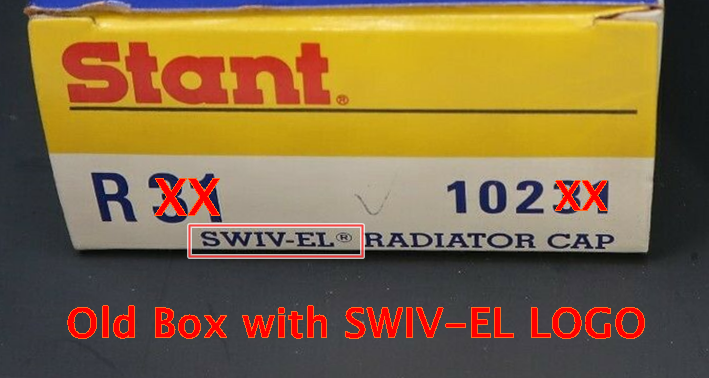
Old Blister packs had it too.
Stant "SWIV-EL®" feature Has Nothing To Do with a Cap is Vented or Non-vented.
|
|

|
Patrick
|
FEB 05, 10:36 PM
|
|
|
|
|
theogre
|
FEB 06, 12:14 AM
|
|
Many keep small oil filter or other band/strap wrench for that.
Even w/ Stant "SWIV-EL®" T-stat cap can be hard to remove and/or install.
More so for people install them without coating the flange with silicone or permatex brake grease.
Rust love attacking there because SS cap and mild steel T-stat house and no clearance so seize up easy.
Do Not use other oils/grease for same reason don't use on brake parts.
E2A---> Stant new web site and recent packages seems to drop SWIV-EL marks. I have both caps bought 5+ years ago w/o the mark. I look at then today to get a better pic then above.
Stant web is useless and parts lookup doesn't work when you find that thru google.
Stant was sold a few year back. Many think Motorad took but few sources should know said no but different private group.
(Motorad makes nearly all "store brand" caps and own label too. Rad caps are ok. "Fiero type" T-stat would fit some T-stat housings.)[This message has been edited by theogre (edited 02-06-2022).]
|
|
|
|
theogre
|
FEB 06, 01:56 AM
|
|
digging thru archive.org found PDF of older catalogs etc. including Stant_Vintage_Guide.pdf covers pre 1995 https://web.archive.org/web...d_file/view/214/129/
radiator caps https://web.archive.org/web....cfm?location_id=179
SWIV-EL radiator caps https://web.archive.org/web...=546&location_id=179
| quote | SWIV-EL® Radiator Caps
The Stant SWIV-EL® radiator cap design allows the cap to be installed and removed much easier than conventional radiator caps, because the shell of the cap rotates independently from the upper sealing gasket, stem and bottom plate. The octagonal shape is easier to grip than the round OEM design, too.
Stant SWIV-EL radiator caps have been designed to function on older open cooling systems and overflow reservoir type systems. |
|
Note that shape often isn't octagonal but "standard" shapes as other types. Even the "SWIV-EL® Radiator Caps" DL shows a "standard" top.
While doesn't show on recent packages... SWIV-EL is a Live TM at USPTO...
uspto.gov trademark, search, Word Mark SWIV-EL
Registration Date March 19, 1991
Renewal 3RD RENEWAL 20210622
Live/Dead Indicator LIVE
|
|
|
|
Cliff Pennock
|
FEB 07, 07:26 AM
|
|
| quote | Originally posted by theogre:
Old one is make so nothing will move/rotate means made to an old design. And often easy to get damage because seal fights you turning the cap on/off.
Nearly All Stant "Radiator" Caps including 10232 are made so the "guts" including all seal(s) can rotate relative to the top to make them easier to install and remove.
Stant sell this feature under "SWIV-EL®" logo/brand and that Trademark is often on Older box/package. |
|
Awesome. Makes a lot of sense. I'll reinstall it. 😊
|
|
|
|
wilberto
|
FEB 13, 04:38 PM
|
|
|
1985 Pontiac Fiero Service Manual, Section 6B, page 2, states " A pressure-vent cap is used on the cross-flow radiator to allow a buildup of 103 kPa (15 psi)
|
|
|

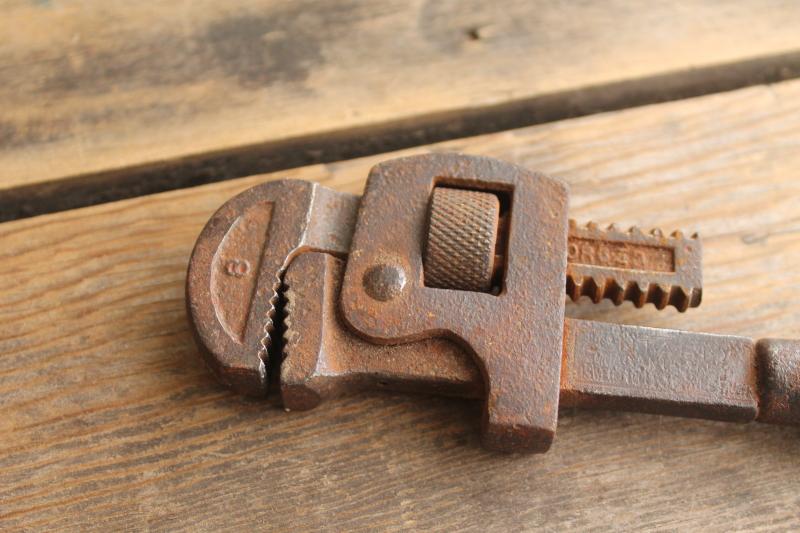
 That's when the big ol' pipe wrench would need to come out.