
 
     |
| Turbo 3400, F23 build, 1985 GT (Page 24/26) |

|
1985 Fiero GT
|
AUG 08, 05:54 PM
|
|
Valve springs changed a while ago, now it revs much more freely.
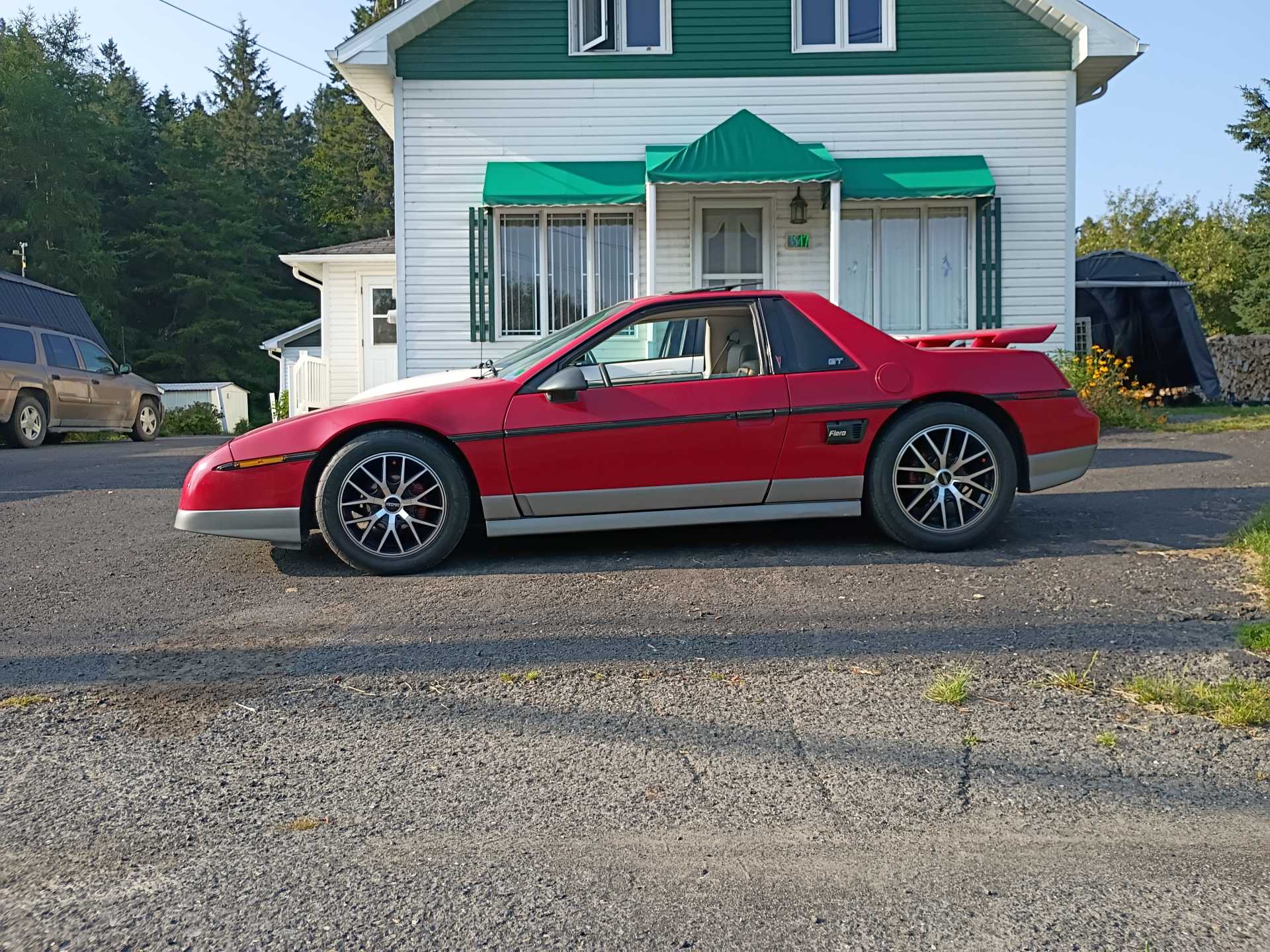
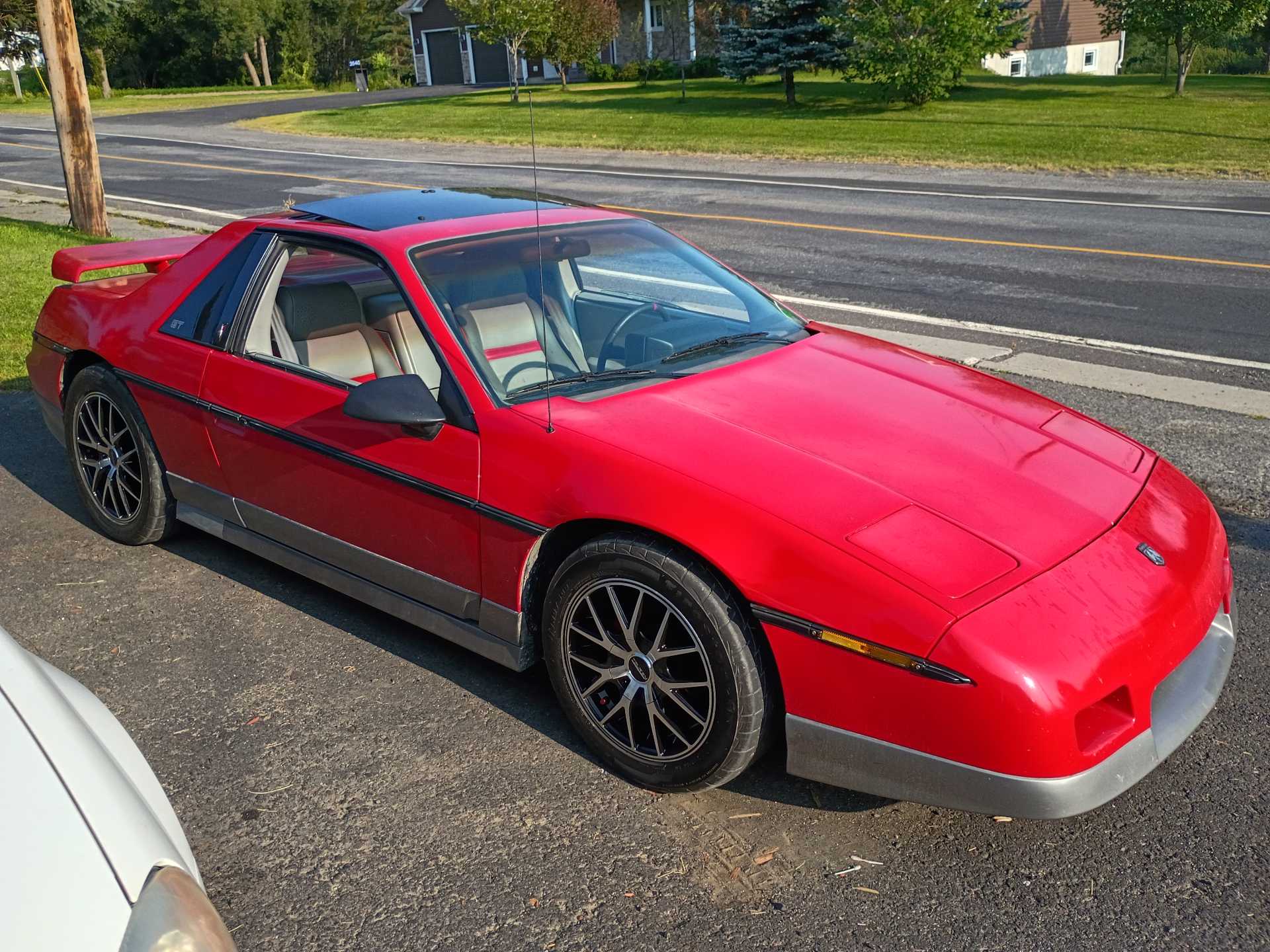
I got some touren wheels, 16x7 42mm front, 17x7.5 42mm rear, and Firestone Firehawk Indy 500 tires, 205/55r16 front, and 235/50r17 rear. I wanted a significant outer diameter increase for the rear, as I wanted a lower cruise rpm, now 2400@110 km/h. I might have wanted wider rear tires, but they aren't available with enough sidewall for the bad roads here, and a large enough diameter to put the rpms where I want. The only matching rims front and back with different widths I could find were only half an inch, in my budget, that's why I don't have wider tires on the rear, the tires match the rims pretty well and have a good sidewall and diameter.
I put coil overs on the rear, 10" 250lb eibach springs, and did my best to calculate flat ride and shift the balance slightly towards the rear because of my rear sway bar (it was slightly more oversteer than I could want) and to match the rear to the front (Camaro springs cut down) but some calculation was wrong as I didn't have to cut the springs down as much as I expected (first cut was supposed to be a safe, tall cut, instead was basically right on my intended final result). Anyhow maybe it isn't matched as well as I thought, but it rides great, basically feels like it did, but just a bit stiffer. Also lowered the front bump stops, jacked up the suspension with no spring to make sure the wheel clears the wheel well and lowered the bump stop to get it closer, ended up being about 5/8" shorter.
With the wheels being spaced farther inwards, and 205 front instead of 215, steering effort was greatly reduced, like by a lot, I'm also experimenting with removing the steering shock, now that the wheels have higher offset, bumps don't act on the steering as much, and I like it, slightly more movement of the wheel going over bumps than with the shock, but much less than my dad's stock Fiero with seemingly a blown steering shock. Perfectly drivable and enjoyable, and makes inputs feel even lighter and quicker.
Stock (but great shape/fresh premium pads) brakes feel slightly less effective with the larger diameters, but still good, and I don't mean less effective in total stopping power, as the old tires locked up before the brakes topped out, but everything requires a little more brake input, but I can still get the tires to squeal/lock if I want to.
I have an autocross tomorrow, so I'll see how everything is balanced driving on a course, I know on the road everything feels great, but I haven't had a chance to take some corners to feel the front/rear traction balance much yet.
|
|
|
|
1985 Fiero GT
|
AUG 09, 04:31 PM
|
|
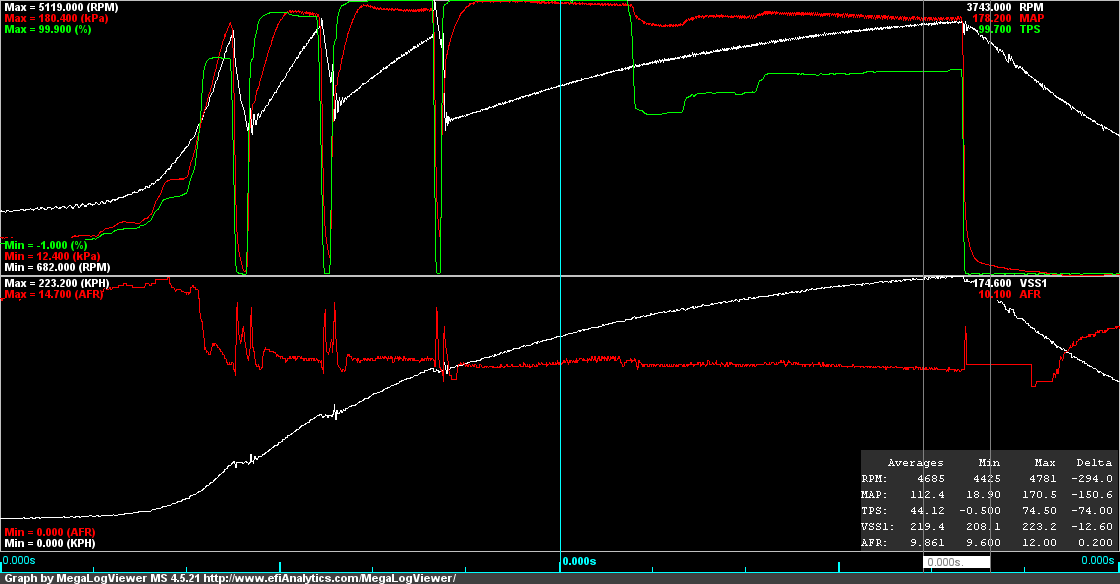
I did the autocross, my Fiero feels much more balanced now than before with stock suspension and a rear swaybar. The tires grip very well, and the engine and transmission were great. I myself tend to get lost on autocross courses, especially the huge one here at the closed Loring AFB, so my times weren't very good compared to others in my class, but they are much better than they were 2 years ago. upon exiting the autocross area, there's a closed 1.5 mile taxiway/runway you drive down, and I opened up the throttle, I hit 223 km/h @ 75% tps, 170 kpa, and about 4800rpm (first time going that fast, so I was easing into it, that is I was until the headlight doors popped up, then I slowed down. Also to verify the calculated ecm datalog speed, I calculated the speed based on rpm, gearing, and tire size). Definitely had much more to go, but that was enough for me!
|
|
|
|
pmbrunelle
|
AUG 13, 08:53 PM
|
|
Sounds like the car is running well.
How is it at 223 km/h? Does the front end feel light in the steering?
I see you still have the hardtop. You are autocrossing the car, and handling does seem to be important. Are you sure that the T-top modification is a good idea? It is going to be a weight adder, and a strength/stiffness reducer.
How do T-top Fieros drive?
|
|
|
|
1985 Fiero GT
|
AUG 14, 01:00 AM
|
|
| quote | Originally posted by pmbrunelle:
Sounds like the car is running well.
How is it at 223 km/h? Does the front end feel light in the steering?
I see you still have the hardtop. You are autocrossing the car, and handling does seem to be important. Are you sure that the T-top modification is a good idea? It is going to be a weight adder, and a strength/stiffness reducer.
How do T-top Fieros drive? |
|
It is so far!
Planted, solid, almost serene. It feels no different going straight at 220 than straight at 110, there were no curves or bumps, so I can't speak about that, as it didn't need hardly any steering input, I mean I felt comfortable enough to take a hand off and wind my windows up at about 160 (it was getting a little too hard on the ears haha), it certainly feels much much better at those speeds than my dad's Fiero at just 80, it has a lot of bad bushings and a bad alignment.
I've autocrossed only twice now, I've never driven a t top Fiero, so I don't know how that will effect stiffness, and while handling is indeed important, my Fiero is not so much a sports car in your definition. I like the GT designation, comfortable for Highway driving, good, not necessarily best handling, a fun amount of power, but perfectly drivable and smooth when required, a nice combination of luxury/performance. My Fiero doesn't have AC, and I like driving with a lot of airflow, and being in more of a "fishbowl" with lots of glass or open air all around me, so for the looks inside and out, and the added airflow, it will be worth less chassis stiffness. Realistically with these tires and springs/sway bars/bushings I have, it handles almost a little too good, my 140lbs is losing traction in the seat before the tires! If this were a track car or more sport over touring oriented, I would likely have racing seats or something with better side support, but for me the Mr Mike's seats are staying, no question about that haha. I also don't think the weight will be increased much, the whole roof panel can't weigh more than 25 pounds extra, and the sunroof I have already is pretty comparable to the 2 t top panels, they almost seem to be a thinner glass, I don't know.
If I get a chance to go that fast again, I'll make sure to pop the hood first, to relieve some of that air pressure. Speaking about performance vs comfort, I don't want to do a hood vent, because then my only source of air with a closed cabin would be heated up by the air from under the hood, I enjoy how cool the air comes in compared to front engined cars, if I had AC that wouldn't matter either, but I don't so for me maybe having slightly cooler vent air is more important than maybe having less pressure buildup over 200km/h.
|
|
|
|
1985 Fiero GT
|
AUG 17, 10:52 PM
|
|
My select cable is freezing up when the engine is cold, it is the one nearest the exhaust, so I believe that it has somewhat melted, when hot, it is still sticky but not frozen. So far that has not impacted driveability to much, I park it in the gear I'll next need, by the time I've manoeuvred out of my car tent it's heated up enough to find the gears with some effort. I've reached out to California push/pull to have cables that are several inches longer than the ones I'm using, to be able to route them much further from the exhaust. The shift and select cables are sitting with the shift on top, and select between it and the y pipe heat shield, pretty tight against it, so it makes sense that the select is having problems and not the shift. Otherwise the engine bay heat is very normal, I had people at autocross comment that it was much cooler than expected, opening the trunk after a run. The turbo being directly beneath the decklid vent definitely helps there, the heat rises up and straight out, asking with the airflow when moving.
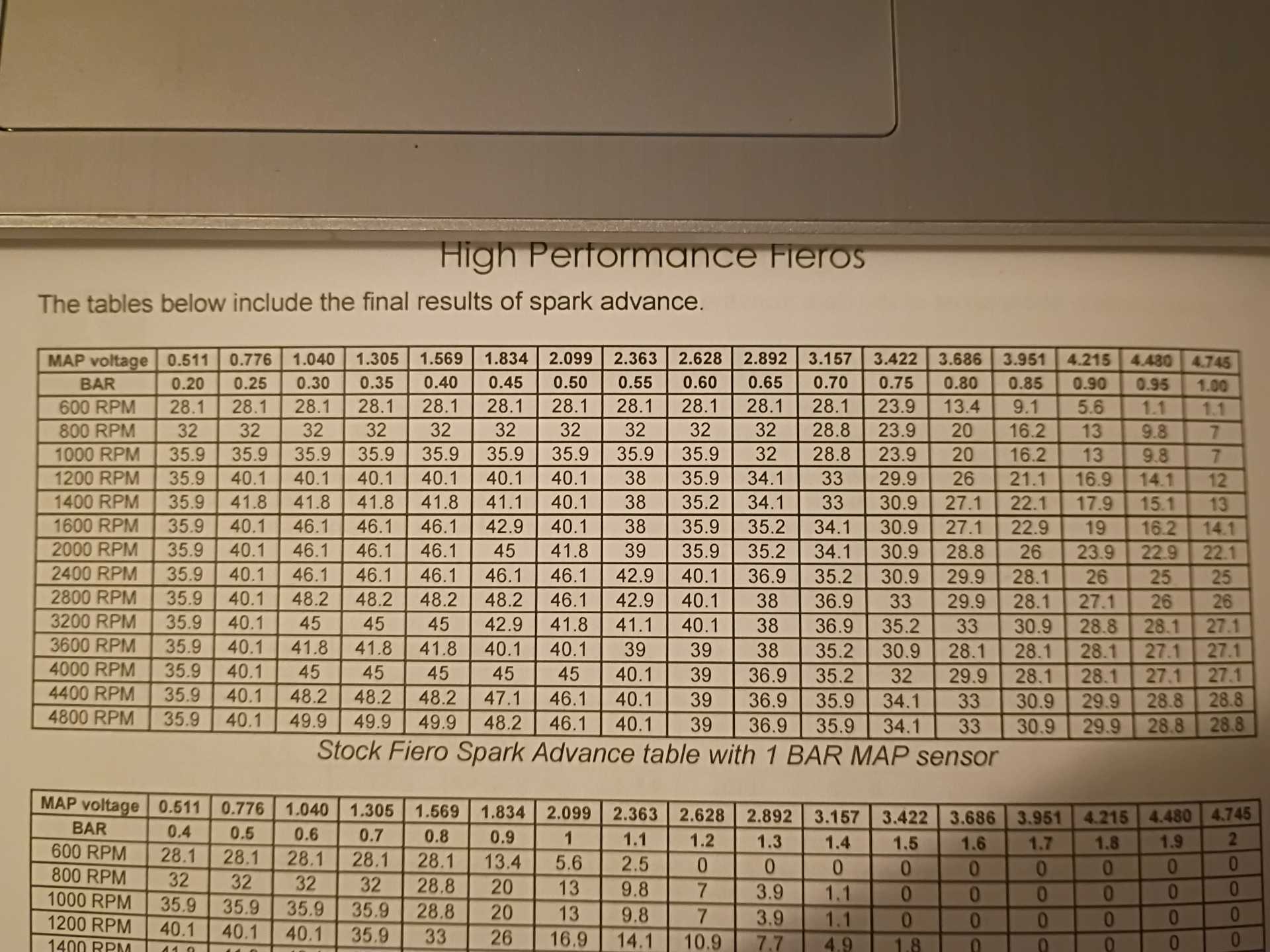
I have been working on the ve table, getting things leaned out significantly, and normal driving more efficient, that's going pretty well. I also did more looking into the spark tables and compared what I had (fairly close to an older table from PMBrunelle), and the original 2.8 table as shown in the book "High Performance Fieros", and the stock table has spark advance much much higher than I was running. I don't know what PMBrunelle has settled on at the moment, but for the last few days I've been running the stock table in the vacuum section, and I haven't noticed any pinging/noises/whatever. I haven't necessarily noticed a power improvement, because when I'm heavily scrutinizing all the sounds and whatnot coming from an engine, I don't notice power differences, I will likely switch the tune back and forth a few times to compare when I'm not specifically scrutinizing everything else. I'm also experimenting a little bit to try and get back the burble my stock engine and my dad's Fiero had, I haven't finished that, but that's why I have some very retarded parts at the bottom.
This is my current spark table, based as close as possible to the Fiero original, erring on the side of less though for in between values where the tables didn't line up.
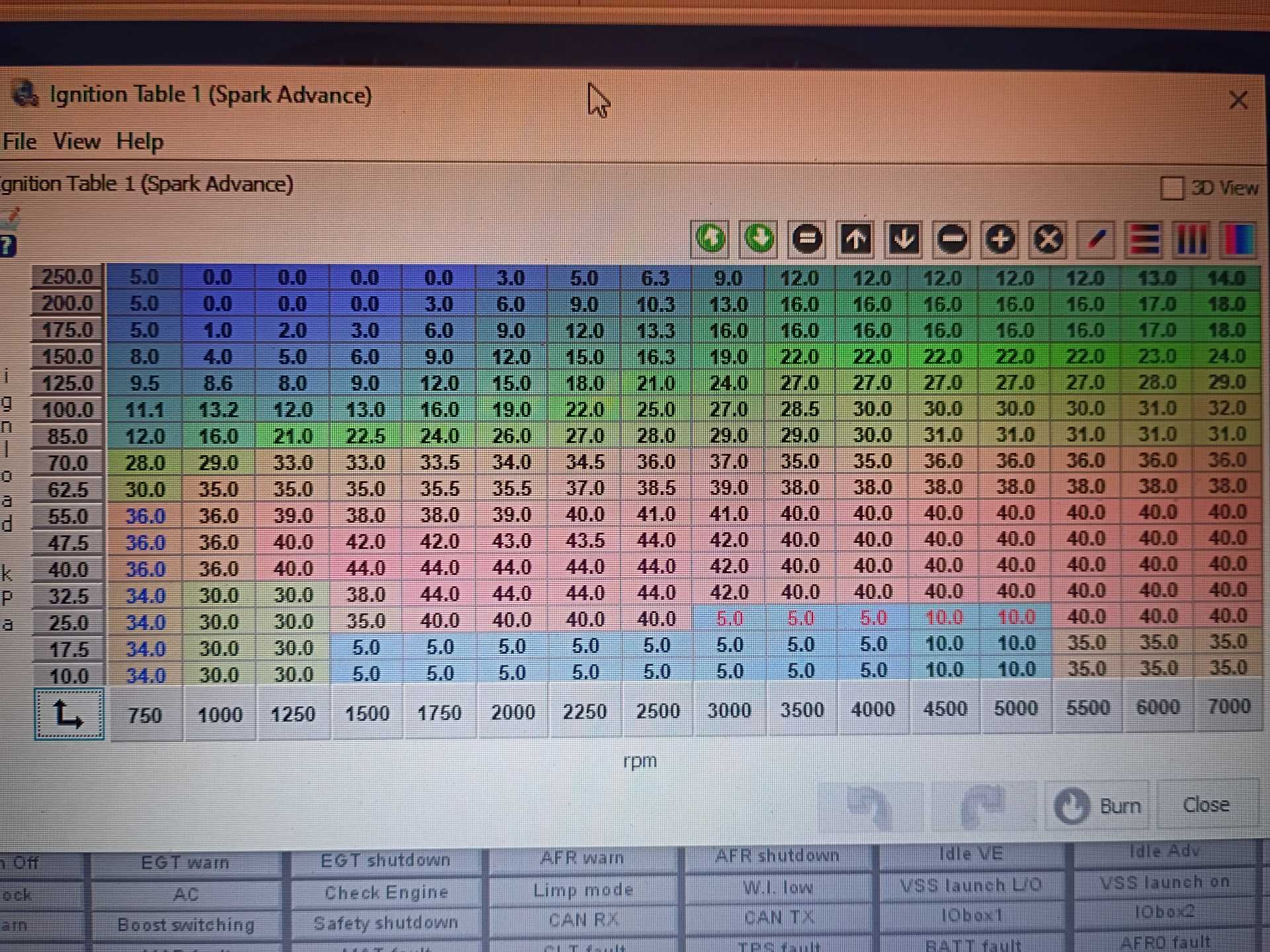
The book values for the stock table:
I've done a few 0-60s, and they are now a consistent 5.5-5.7 seconds, now they are not GPS/app based, instead coming directly from the datalog, as real time from 0 to 60 (0-96.5km/h), so no arguing it's validity this time haha! Speed is not calculated by pulses per mile because that changes with the tire, instead it's calculated directly by advertised tire outer diameter (from manufacturer), and the number of teeth on the speed sensor (29). This has been verified with phone GPS across several speeds as being accurate within 1km/h, and the speed signal to the dash is just a 4000 ppm output from the ECM, and the dash is also surprisingly accurate (I didn't have to fiddle with the ppm settings to get it accurate). If I recall the app 0-60 number when PMBrunelle took me for a drive in the White Bug, it was also about 5.5 seconds, but he was going really easy on the 4 speed, that will likely be improved with the 5 speed.
I've been using 10w40 oil so far, but the selection is horrible, basically all there is in my area is Castrol conventional, and I am wanting to go to synthetic or semi synthetic, and there don't seem to be any options for that unless I want really pricey racing stuff that's like $75 for a jug. This is a roller camshaft, so zinc and whatnot don't matter as much as a stock 2.8. there's 15w40 diesel oil available for about $50 a jug, and 10w30 Mobil 1 synthetic on sale for $36. How strict are the oil requirements?
My rod bearings measured at 0.001", spec is 0.0007-0024", so I'm within the lowest fifth of the spec, mains are 0.0015-0020", spec 0.0008-0025", do I need 10w40 or heavier, or is a better quality synthetic 10w30 going to be as good or better than the cheap conventional 10w40?[This message has been edited by 1985 Fiero GT (edited 08-17-2025).]
|
|
|
|
pmbrunelle
|
AUG 20, 11:14 PM
|
|
| quote | Originally posted by 1985 Fiero GT:
My select cable is freezing up when the engine is cold, it is the one nearest the exhaust, so I believe that it has somewhat melted, when hot, it is still sticky but not frozen. So far that has not impacted driveability to much, I park it in the gear I'll next need, by the time I've manoeuvred out of my car tent it's heated up enough to find the gears with some effort. I've reached out to California push/pull to have cables that are several inches longer than the ones I'm using, to be able to route them much further from the exhaust. The shift and select cables are sitting with the shift on top, and select between it and the y pipe heat shield, pretty tight against it, so it makes sense that the select is having problems and not the shift.
|
|
You might try dripping some motor oil into the select cable. On my Muncie, the Rodney Dickman cable became sticky with engine heat. Oil was a pretty long-term fix, only needing to be re-applied after maybe two years.
| quote | Originally posted by 1985 Fiero GT:
I also did more looking into the spark tables and compared what I had (fairly close to an older table from PMBrunelle), and the original 2.8 table as shown in the book "High Performance Fieros", and the stock table has spark advance much much higher than I was running. I don't know what PMBrunelle has settled on at the moment, but for the last few days I've been running the stock table in the vacuum section, and I haven't noticed any pinging/noises/whatever.
|
|
The less dense the air/fuel mixture, the slower the flame propagates through the combustion chamber, so the more spark advance is needed to maximize work on the piston. The stock timing table reflects this tendency.
This is what I was running last with the Muncie (such as during the ride I gave you):
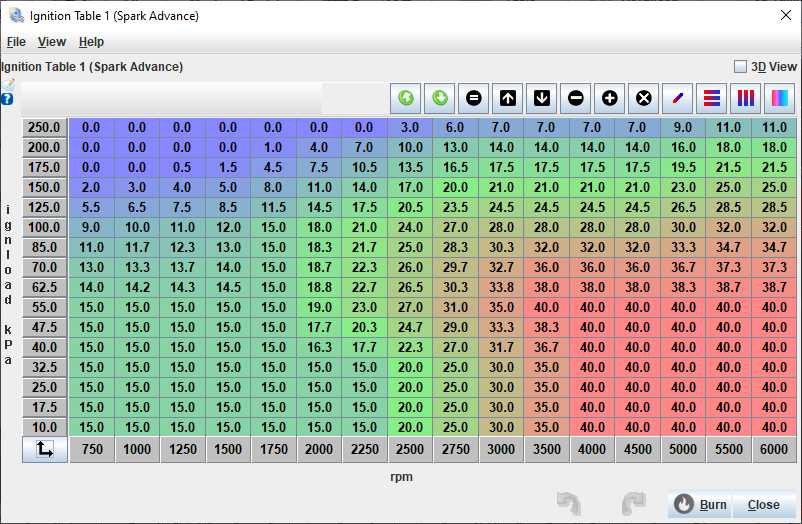
Below 55 kPa in the lower RPM ranges, I'm having the timing advance become more retarded rather than more advanced. I was having bucking/oscillation problems at low throttle, and shaping the timing table like this (retard in the problem area, with gentle transitions to the rest of the table) mostly fixed those problems. This behaviour was sometimes implemented on older cars with the vacuum advance canister being connected to a ported vacuum source, rather than to manifold vacuum, sometimes to reduce NOx emissions at low throttle.
If you don't have driveability problems, then there's no reason for you to shape your timing table like this.
With my Getrag F23, I expect to cruise on the highway at lower RPMs, perhaps around 2500 RPM, so I adjusted the spark timing table to have more advance in that area than before:
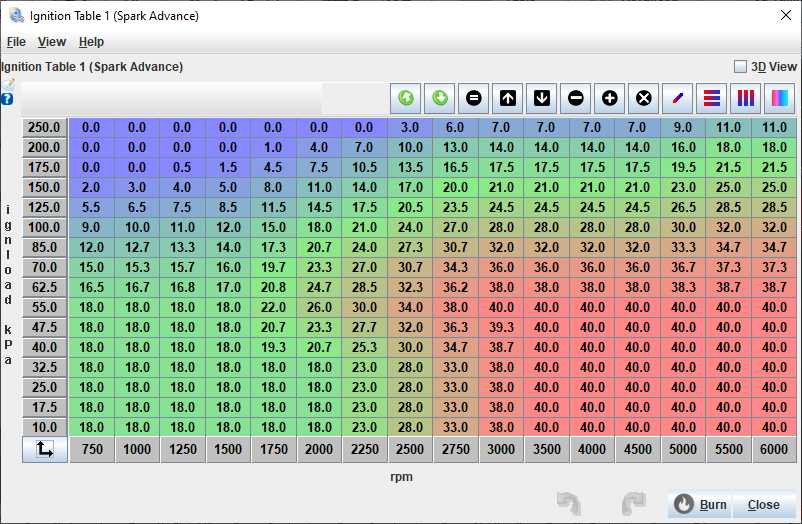
This will need to be tested when I get my car running again.
How does the car drive if you keep the MAP between 17.5 kPa and 25 kPa? Does the timing jump around too much?
| quote | Originally posted by 1985 Fiero GT:
I've been using 10w40 oil so far, but the selection is horrible, basically all there is in my area is Castrol conventional, and I am wanting to go to synthetic or semi synthetic, and there don't seem to be any options for that unless I want really pricey racing stuff that's like $75 for a jug. This is a roller camshaft, so zinc and whatnot don't matter as much as a stock 2.8. there's 15w40 diesel oil available for about $50 a jug, and 10w30 Mobil 1 synthetic on sale for $36. How strict are the oil requirements?
My rod bearings measured at 0.001", spec is 0.0007-0024", so I'm within the lowest fifth of the spec, mains are 0.0015-0020", spec 0.0008-0025", do I need 10w40 or heavier, or is a better quality synthetic 10w30 going to be as good or better than the cheap conventional 10w40?
|
|
Thicker oil is basically insurance against failure at the expense of higher drag (and hence reduced power / fuel economy).
You don't have extreme pressure in your engine, but you do have a turbo, so to prevent oil coking in the turbo, synthetic would be a good idea.
If you can only have the synthetic oil in 30-weight, I would prefer to stick with the 40-weight conventional. I would prefer to protect the engine more at the expense of risking oil coking in the turbo, which is more easily/cheaply replaced.
|
|
|
|
1985 Fiero GT
|
AUG 21, 12:05 AM
|
|
| quote | Originally posted by pmbrunelle:
You might try dripping some motor oil into the select cable. On my Muncie, the Rodney Dickman cable became sticky with engine heat. Oil was a pretty long-term fix, only needing to be re-applied after maybe two years.
|
|
I will try that, I've now driven about 350 kms like this, it heats up and unsticks quickly, but when fully cold is immovable, I'll try oiling it.
| quote | Originally posted by pmbrunelle:
Below 55 kPa in the lower RPM ranges, I'm having the timing advance become more retarded rather than more advanced. I was having bucking/oscillation problems at low throttle, and shaping the timing table like this (retard in the problem area, with gentle transitions to the rest of the table) mostly fixed those problems. This behaviour was sometimes implemented on older cars with the vacuum advance canister being connected to a ported vacuum source, rather than to manifold vacuum, sometimes to reduce NOx emissions at low throttle.
If you don't have driveability problems, then there's no reason for you to shape your timing table like this.
With my Getrag F23, I expect to cruise on the highway at lower RPMs, perhaps around 2500 RPM, so I adjusted the spark timing table to have more advance in that area than before: |
|
Ok, makes sense. For your tires (255/40R17?), should theoretically be ~2350 rpm@100 or ~2575@110km/h
| quote | | Originally posted by pmbrunelle:How does the car drive if you keep the MAP between 17.5 kPa and 25 kPa? Does the timing jump around too much? |
|
That is almost impossible to do, it idles at 28-30kPa or so, and 0% throttle engine braking is 15-20kpa, I've only seen 10kPa in the datalogs a couple of times, at the initial release of the throttle after an acceleration, before the idle valve starts to reopen. When driving, the only time I see the timing starting to retard is when I am fully or almost fully engine braking, but certainly not at any point where I am cruising/maintaining speed.
| quote | Originally posted by pmbrunelle:Thicker oil is basically insurance against failure at the expense of higher drag (and hence reduced power / fuel economy).
You don't have extreme pressure in your engine, but you do have a turbo, so to prevent oil coking in the turbo, synthetic would be a good idea.
If you can only have the synthetic oil in 30-weight, I would prefer to stick with the 40-weight conventional. I would prefer to protect the engine more at the expense of risking oil coking in the turbo, which is more easily/cheaply replaced. |
|
And does synthetic not have better load capacity etc. than conventional? That doesn't have enough of an impact to let a grade thinner synthetic perform as well as a grade thicker conventional? I guess I'll have to keep an eye out for synthetic or semi synthetic 10w40.
|
|
|
|
pmbrunelle
|
AUG 25, 07:02 PM
|
|
| quote | Originally posted by 1985 Fiero GT:
And does synthetic not have better load capacity etc. than conventional? That doesn't have enough of an impact to let a grade thinner synthetic perform as well as a grade thicker conventional? I guess I'll have to keep an eye out for synthetic or semi synthetic 10w40. |
|
The viscosity of the oil (together with the rotation of the crankshaft) keeps the shaft centered within the bearing. The amount of load the oil can take without squeezing out and having metal-to-metal contact depends on the viscosity.
Besides the resistance to breakdown, I do not know enough about the difference between conventional and synthetic to comment intelligently.
|
|
|
|
La fiera
|
AUG 26, 09:21 PM
|
|
| quote | Originally posted by pmbrunelle:
The viscosity of the oil (together with the rotation of the crankshaft) keeps the shaft centered within the bearing. The amount of load the oil can take without squeezing out and having metal-to-metal contact depends on the viscosity.
Besides the resistance to breakdown, I do not know enough about the difference between conventional and synthetic to comment intelligently. |
|
We have to take into account how those viscosities behave when heat is applied to the oil via work of the engine. A 10w-30 at 200F is not 10W-30, it's way thinner than that. That means if the oil's temp keeps increasing due to the work load demand of the engine (a turbo puts lots of heat on the oil) what you end up is an oil with the viscosity of water, in other words no protection. Even if you have the perfect bearing clearances for that thin oil, that thin film has no shear strength. That's why if you decide to use a turbo and autocross and do track weekends or whatever, the best insurance like you mentioned Patrick is to go for the thicker option. 10W-40 is the minimum I use in my engines. For dyno tuning and track I use Valvoline 20W-50 VR1 full synthetic, Scheaffer racing oil10W-40 and 20W-50.
Now, the main advantage of full synthetic oil is besides being way more slippery than conventional is the way it deals with the heat. Compared to conventional oil, synthetics have a much higher viscosity index. Viscosity index refers to how the oil changes viscosity with heat. The higher the index the slower and gradual the change in viscosity as the oil heats up thus maintaining its shear strength film longer. This index gets reduced as the oil goes through heat/cold cycles and contamination from combustion residual in the crankcase. That's why if you are going to go to do some track days or autocross and you have 2 months with that oil, protect your investment and get a new oil change before beating on your engine. Another important aspect of conventional or synthetic is the additive package they use. There are conventional oils out there that outperforms all the "Full Synthetic" Castrol and Mobil 1 that you can buy in convenience stores.
|
|
|
|
1985 Fiero GT
|
AUG 27, 10:18 PM
|
|
| quote | Originally posted by pmbrunelle:
The viscosity of the oil (together with the rotation of the crankshaft) keeps the shaft centered within the bearing. The amount of load the oil can take without squeezing out and having metal-to-metal contact depends on the viscosity.
Besides the resistance to breakdown, I do not know enough about the difference between conventional and synthetic to comment intelligently. |
|
| quote | Originally posted by La fiera:
We have to take into account how those viscosities behave when heat is applied to the oil via work of the engine. A 10w-30 at 200F is not 10W-30, it's way thinner than that. That means if the oil's temp keeps increasing due to the work load demand of the engine (a turbo puts lots of heat on the oil) what you end up is an oil with the viscosity of water, in other words no protection. Even if you have the perfect bearing clearances for that thin oil, that thin film has no shear strength. That's why if you decide to use a turbo and autocross and do track weekends or whatever, the best insurance like you mentioned Patrick is to go for the thicker option. 10W-40 is the minimum I use in my engines. For dyno tuning and track I use Valvoline 20W-50 VR1 full synthetic, Scheaffer racing oil10W-40 and 20W-50.
Now, the main advantage of full synthetic oil is besides being way more slippery than conventional is the way it deals with the heat. Compared to conventional oil, synthetics have a much higher viscosity index. Viscosity index refers to how the oil changes viscosity with heat. The higher the index the slower and gradual the change in viscosity as the oil heats up thus maintaining its shear strength film longer. This index gets reduced as the oil goes through heat/cold cycles and contamination from combustion residual in the crankcase. That's why if you are going to go to do some track days or autocross and you have 2 months with that oil, protect your investment and get a new oil change before beating on your engine. Another important aspect of conventional or synthetic is the additive package they use. There are conventional oils out there that outperforms all the "Full Synthetic" Castrol and Mobil 1 that you can buy in convenience stores. |
|
Interesting, I will have to try to figure out more research on this, because if 10w30 synthetic has a better shear strength at temperature than 10w40 non synthetic, then I might as well get that. I will also look more for synthetic or semi synthetic 10w40 around here.
|
|
|
|