
 
     |
| The White Bug (Page 23/46) |

|
pmbrunelle
|
OCT 22, 11:23 PM
|
|
| quote | Originally posted by Will:
The latent heat of vaporization of water is considerable... you can still get good charge cooling from vaporizing hot water. Just don't displace too much air with water vapor at crappy flowing intake ports.
|
|
Well, I did water injection tests for the first time on Tuesday.
Keeping manifold pressure constant (MAP of 160 kPa), I wanted to study the effect of water injection on engine torque.
If the water spray displaces air, then less air will enter the cylinder, and torque will be reduced. I suppose that water could reduce torque by some other mechanism as well.
To estimate engine torque, I datalogged WOT pulls in 2nd gear from idle to the rev limiter (6200 RPM). I then looked at how long it look for the engine to go from 4000 RPM to 6000 RPM. I did all the pulls on the same section of road, all within one hour.
I did three types of test:
1. Water injection off
2. Simple on/off control, activation above 2375 RPM and 137.5 kPa MAP. Estimated water/fuel ratio (WFR) of 0.33 at redline, 0.54 at 2500 RPM.
3. Water solenoid is pulsed like a fuel injector (firing once per cam revolution). WFR is more constant, ranging from 0.26 at redline, and 0.34 at 3000 RPM.
code:
Test #	ADI Status	Time (s)
1	Off		1.61
2	Simple on/off	1.62
3	Pulsed		1.60
4	Off		1.58
5	Simple on/off	1.82
6	Pulsed		1.60
7	Off		1.58
8	Simple on/off	1.59
9	Pulsed		1.57
If the engine is not over-watered (i.e. the WFR is within a reasonable range), I conclude that water injection does not reduce engine torque.
Test #5 is an anomaly. I think the engine was overwatered; in that instance, the engine was struggling to idle after the pull. I suspect that I began the pull with the engine in an already "drowned in water" state.
When driving at low speed/load, if the water injection is activated, then you feel the engine stumble and reduce torque output. It is possible to stall the engine in this way. Too much water can make restarting difficult, and it can take a while (like one minute of driving) to clear the excess water.
If I tune the setup to only spray during high boost WOT when necessary, I don't think there will be any unwanted side effects (oil contamination, stalling).[This message has been edited by pmbrunelle (edited 10-22-2020).]
|
|
|
|
La fiera
|
OCT 23, 08:39 AM
|
|
| quote | Originally posted by pmbrunelle:
Well, I did water injection tests for the first time on Tuesday.
Keeping manifold pressure constant (MAP of 160 kPa), I wanted to study the effect of water injection on engine torque.
If the water spray displaces air, then less air will enter the cylinder, and torque will be reduced. I suppose that water could reduce torque by some other mechanism as well.
To estimate engine torque, I datalogged WOT pulls in 2nd gear from idle to the rev limiter (6200 RPM). I then looked at how long it look for the engine to go from 4000 RPM to 6000 RPM. I did all the pulls on the same section of road, all within one hour.
I did three types of test:
1. Water injection off
2. Simple on/off control, activation above 2375 RPM and 137.5 kPa MAP. Estimated water/fuel ratio (WFR) of 0.33 at redline, 0.54 at 2500 RPM.
3. Water solenoid is pulsed like a fuel injector (firing once per cam revolution). WFR is more constant, ranging from 0.26 at redline, and 0.34 at 3000 RPM.
code:
Test #	ADI Status	Time (s)
1	Off		1.61
2	Simple on/off	1.62
3	Pulsed		1.60
4	Off		1.58
5	Simple on/off	1.82
6	Pulsed		1.60
7	Off		1.58
8	Simple on/off	1.59
9	Pulsed		1.57
If the engine is not over-watered (i.e. the WFR is within a reasonable range), I conclude that water injection does not reduce engine torque.
Test #5 is an anomaly. I think the engine was overwatered; in that instance, the engine was struggling to idle after the pull. I suspect that I began the pull with the engine in an a
the already "drowned in water" state.
When driving at low speed/load, if the water injection is activated, then you feel the engine stumble and reduce torque output. It is possible to stall the engine in this way. Too much water can make restarting difficult, and it can take a while (like one minute of driving) to clear the excess water.
If I tune the setup to only spray during high boost WOT when necessary, I don't think there will be any unwanted side effects (oil contamination, stalling).
|
|
Back in 2003-2005 I had a Dodge Spirit Turbo SOHC 2.5L and I experimented with water injection because it didn't mater what type of race fuel I used, the engine knocked bad.
I had different set ups for the location of the water nozzles. In my testing concluded that the further away from the TB I placed the nozzles, the more timing I could add and
the more power, specially torque the engine developed. I started with 250WHP (knocking) and 275WTQ and when I was satisfied with the power and torque for road racing
not peak power, I ended with 420WHP and 477WTQ.
What I learned was that the more atomized the water/meth the better and smoother the power delivery was and to do that I increased the pump's water psi to max and
went down a bit on nozzle's flow. By forcing more water pressure through the smaller nozzles, the mist was also much cooler.
The result was a super atomized fog-like cooler mist. It was so atomized and foggy that when I tested it outside the pipe the mix would take a long time to fall to the ground.
Also the nozzle placement was paramount. The best results I had was installing 2 nozzles in series. The smaller of the 2 was installed right after the turbo, about 32 inches
away from the TB. And the larger nozzle 2 inches before the TB to get rid of the heat that 1st nozzle couldn't absorbed. I was also running on the leaner side, no need to enrichen for charge cooling.
It was a simple on/off system that was triggered at 15psi manifold pressure.
The use of the lower plenum's cold start passages to install the nozzles is a very clever approach but I believe you can get better results if the nozzles are place further away from
the combustion chambers giving the water/meth more time to absorb the heat out of the incoming air.[This message has been edited by La fiera (edited 10-23-2020).]
|
|
|
|
pmbrunelle
|
OCT 24, 02:07 PM
|
|
I have never had knock on this engine so far.
Since the water injection system is a bit tricky to install after the fact, I decided to do it in advance, to be prepared when knock occurs. Pressure now is 90 psi across the water nozzles.
Eventually, as I increase the boost, I might reach the knock limit. That's when I will see if the port water injection is effective, or if I should change things.
I still have stock heads, including casting flash in the ports, so that limits cylinder filling. If I decide to port the heads, that also might get me to the knock limit (if boost alone doesn't get me there).
I know about your Dodge, I saw the build thread! What kind of WFR were you running on the Dodge?
|
|
|
|
La fiera
|
OCT 26, 07:02 AM
|
|
| quote | Originally posted by pmbrunelle:
What kind of WFR were you running on the Dodge? |
|
I had no idea of the ratio. I just set it up where I could run 30psi of boost with an extra 7 to 10 degrees of ignition timing without knock.
The sweet spot was right at1650F EGT, before or after that the engine dropped power.
|
|
|
|
pmbrunelle
|
OCT 26, 05:23 PM
|
|
Water injection tests will have to continue next year!
As winter approaches, there is too much risk of the water freezing in the system and breaking things.
I drained the tank, and refilled it with a 50-50 mix of antifreeze-water. I ran the pump to circulate the 50-50 mix throughout the system.
There was some pure water that was trapped in the intake and nozzles. I decided to turn on the water injection until the antifreeze-water replaced the pure water in the nozzles.
Once there was the white antifreeze smoke coming out the exhaust pipe, I knew that the water injection system had no more pure water in it.

NOT a head gasket leak![This message has been edited by pmbrunelle (edited 10-27-2020).]
|
|
|
|
DimeMachine
|
OCT 27, 09:30 PM
|
|
| quote | Originally posted by pmbrunelle:
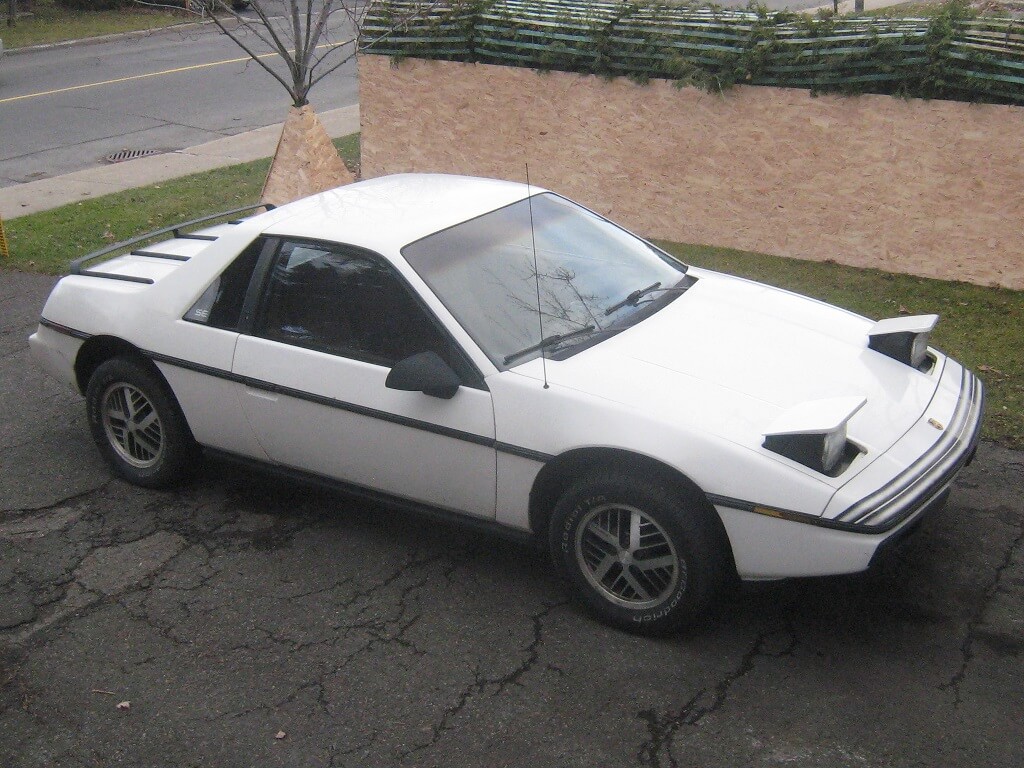
I purchased this Fiero in December 2016. A mostly bone-stock 1985 SE, with 53k miles.
Minimal rust and fairly decent paint; should look good enough (by my standard) with a wash and wax, and some minor fixes (dew wipes, headliner, that sort of thing).
It came with the automatic transmission, but that's fine; transmissions can be changed.
Half an hour into the 2 hour drive home, the 2.8 started knocking; the car had to be towed.
The engine's death signaled to me: PROJECT TIME!
Time to do the turbo project I've always wanted for a Fiero, get rid of the slushbox, and fix the "incidentals" while I'm at it.
Now that I've been working on the car a little while, I guess it's a good time to make a project thread.
 |
|
1. Very cool thread - nice attention to detail.
2. 2.8 knocking.....That is th 79th time I have heard of the stock 2.8 motors having bearings go bad... Why are they so vulnerable?[This message has been edited by DimeMachine (edited 10-27-2020).]
|
|
|
|
pmbrunelle
|
OCT 27, 11:27 PM
|
|
It seems that the Fiero 2.8 (pre-88 at least) rod bearings aren't well-oiled.
For instance, the 2.8 has two pressurized oil galleries up top that supply the lifters and cam bearings. Then, oil from the top end goes down to each main bearing. When the cam bearings wear out, they leak more oil, and less oil makes it to the bottom end. Some engines have another oil gallery dedicated to supplying the mains with oil.
Once oil does eventually get to a main bearing journal, the oil then has to flow through a drilled hole in the crankshaft to get to the rod bearing. On the Fiero 2.8, from what I remember, the main bearings are smooth, having a simple round hole where pressurized oil enters the bearing. On the later model main bearings, there is a circumferential groove to allow a high flow of pressurized oil to feed directly into the drilled hole on the crankshaft as it rotates, so the Fiero 2.8 is less good in that respect.
Those with original 2.8s may want to replace the cam bearings as a preventative measure. I haven't paid serious attention to see if later-model main bearings can drop into the Fiero 2.8.
On the White Bug I have grooved main bearings, and I had the local engine machine shop replace the cam bearings.[This message has been edited by pmbrunelle (edited 10-27-2020).]
|
|
|
|
pmbrunelle
|
NOV 22, 03:49 PM
|
|
I'm thinking about brake modifications. One idea I have is to use 88 calipers at all four corners, with bigger discs.
With the 84-87 Fiero, the parking brake cables are typically routed below the CV joints.
With 88 rear calipers oriented with the cable entry at the bottom, the bleeders end up below. Not a good situation.
Looking at the 88 rear caliper castings (in photos, I don't have any on hand), they appear to be mostly symmetrical, with a bleeder port drilled on one side or another, depending on the side.
Can I simply swap the piston and hardware left-right, to end up with calipers I can use on an 84-87 with the bleeders oriented correctly?
|
|
|
|
fieroguru
|
NOV 22, 04:03 PM
|
|
When 88 calipers are used on the rear of the 84-87, to make the parking brake work, they mount the calipers upside down. They take the calipers off, flip them over and use a block of wood between the pads to bleed them. Once bled, then put the calipers back on the car with the bleeders pointing down.
Not something I am recommending, just there were a couple of versions of iterations of the 12" C4 rotor upgrade that used the 88 Fiero calipers on the 84-87 that required this setup.
|
|
|
|
Will
|
NOV 22, 04:08 PM
|
|
| quote | Originally posted by pmbrunelle:
Can I simply swap the piston and hardware left-right, to end up with calipers I can use on an 84-87 with the bleeders oriented correctly? |
|
Probably... Take them apart and see. Check to see if the pistons are handed for the parking brake mechanism.
|
|
|
|