
 
     |
| Different 3.4l piston/head compatibility (Page 2/7) |

|
1985 Fiero GT
|
AUG 10, 11:34 AM
|
|
| quote | Originally posted by 82-T/A [At Work]:
That's all a really good point. I think 7.7:1 is pretty low... I don't think you'd be happy, and I'd question, quite frankly, how the engine would perform on the street... especially having to deal with stop and go traffic. But at 8.5:1 compression, that's really not so far off from the 8.9:1 compression. |
|
What's at 8.9:1 compression? The DOHC pistons are apparently at 9.7 or so.
I'm this dream engine I'm speccing out, I'd be happy with around my Fiero's current power up to 3000rpm, it's torquey, and with the 3400, I'd get a little more, with 7.7:1, that would limit the off boost performance, which I wouldn't like very much, 8.5:1 would be my current power level at low rpm (any extra power from 3400 maybe negated by a turbo that isn't making boost yet), but in mid rpms, it gains power, and high rpms it wouldn't hit a wall like a naturally aspirated Fiero. I've never read anyone use the 3.4pr pistons in a 3400 block, with 3.4pr heads, I assume, if you can put DOHC pistons in the 3.4pr to increase compression, just like in the 3400, you can also do the opposite, 3.4pr pistons in DOHC and 3400, and I'm assuming that with the 3.4pr heads and pistons, compression is what the 3.4 would be, 8.5:1.
|
|
|
|
82-T/A [At Work]
|
AUG 10, 12:01 PM
|
|
| quote | Originally posted by 1985 Fiero GT:
What's at 8.9:1 compression? The DOHC pistons are apparently at 9.7 or so. |
|
8.9:1 compression is the standard compression for a stock 2.8 Fiero V6.
8.5:1 compression was standard for almost all engines after ... I forget what year, but the mid 1970s. I don't know how much experience you have with the much older engines from the 60s... (ignore this if you already know), but most of the high performance motors from the late 1960s and early early (like 1970, 1971) had well over 10:1 compression. I have a 1969 Olds 455 big block which had 11.25:1 compression, stock (if I recall correctly). That of course dramatically improves the efficiency of the engine and of course produces more horsepower. I could never turbo that. But at some point in the mid 1970s... either for the purpose of reducing horsepower (from the insurance lobby) or to reduce emissions (can't remember for which was the intended purpose), they mandated lower engine compression. I can look up the old eCFR (which has since been rescinded), but all the late 70s and early 80s motors had 8.5:1 compression, and they did just fine. I think the Iron Duke from 84+ had 9.0:1 compression.
| quote | Originally posted by 1985 Fiero GT:
I'm this dream engine I'm speccing out, I'd be happy with around my Fiero's current power up to 3000rpm, it's torquey, and with the 3400, I'd get a little more, with 7.7:1, that would limit the off boost performance, which I wouldn't like very much, 8.5:1 would be my current power level at low rpm (any extra power from 3400 maybe negated by a turbo that isn't making boost yet), but in mid rpms, it gains power, and high rpms it wouldn't hit a wall like a naturally aspirated Fiero. I've never read anyone use the 3.4pr pistons in a 3400 block, with 3.4pr heads, I assume, if you can put DOHC pistons in the 3.4pr to increase compression, just like in the 3400, you can also do the opposite, 3.4pr pistons in DOHC and 3400, and I'm assuming that with the 3.4pr heads and pistons, compression is what the 3.4 would be, 8.5:1. |
|
A 3.4 w/ 8.5:1 compression would by no means be similar to a 2.8 with 8.9:1 compression. You'd still have decidedly more power and better response than the 2.8 for the simple fact that you'd have more off-the-line torque, which would more than make up for the .4:1 compression loss.
But yeah, I totally get what you're saying. Especially as I'm sure you've driven other motors where the higher the rpm, the more power you gain. Once you start modifying your Fiero's engine to the point where you start to feel that wall... it becomes a source of frustration, and you focus on it. Like I said, when I rebuilt my 2.8 into a 3.1 with the Fireball cam, it brought out the same feelings with me. It's that point where now your engine is starting to make more power and the LIMFAC (as they say) is the intake plenum's neck. With my Pontiac Solstice, no matter what I did to it, or what performance parts I added to it (2.4 VVT / EcoTec), it never got to a point where I started losing power in the top end. You want to have that feeling of just continually racing through the top of the RPMs... since really it's part of what makes that whole experience. Especially being in a Fiero, a mid-engined sports car with a throaty sound, your body demands / insists Ferrari high-revving performance that just isn't there in the top end. Even modern DOHC cars... like the 2002 Crown Victoria LX that I inherited from my grandfather (which just sits in the garage). It's a SOHC to be clear, but it pulls hard all the way until the point that it snaps into 2nd. There's no "wall."
No matter what you do... you'll have to resolve the intake plenum. It was designed exceptionally well for a stock 2.8 Fiero engine... significantly better than all the other 2.8 intakes out there, and Pontiac spent significant engineering money designing it specifically for the Fiero (economically at scale). But yeah... DAWG mod is in your future if you want to keep that intake.
For what it's worth. I intend to do the DAWG mod also, and I also intend to pay for an "extrude-hone" service as well to smooth out the entire intake process. It's going to cost me a couple of thousand bucks from throttle body to intake manifold... but it'll dramatically improve the flow and remove any restrictions.
|
|
|
|
82-T/A [At Work]
|
AUG 10, 12:06 PM
|
|
Extrude Hone process:
It's expensive... but worth it if there's a specific goal you have.
|
|
|
|
1985 Fiero GT
|
AUG 10, 12:30 PM
|
|
| quote | Originally posted by 82-T/A [At Work]:
...
|
|
Makes sense, I wouldn't be looking for a 400hp monster haha, but I've always kindof wanted to recreate the "Porsche eater" Fiero turbo prototypes, I know my 2.8 would be rather disappointing/unreliable, so when I learned that the 3400 block can bolt to the Fieros top end, and they are fairly well known for reliability and power holding (apparently good to like 400+HP?), I thought it would be the ideal setup for a Fiero intake (just love it way to much to get rid of), and a reliable turbocharged engine, without worrying about the bearings or oiling system of a 2.8. sure the intake might not be "optimised", but that wall will be much less apparent, or entirely gone, with forced induction, I'm not even one to use the upper rpms much or at all haha, 99% of my fun driving is between 2500 and 4500 rpm, but I've always wanted to have a factory looking turbo v6 Fiero, and I've never seen anyone build a 3400 for that, it seems like a prime choice to me haha, but what do I know haha. The 3400 might be able to rev higher to, I'll have to check that, Hmm, might be even more fun haha.
|
|
|
|
Dennis LaGrua
|
AUG 10, 12:47 PM
|
|
|
I built a 3.4L P/R engine with ported heads a cam . MSD ignition a turbo and Ross Forged pistons and after 15 years its powerful and still holding together. The stock Fiero plenum may be an intake restriction but boosting will supply compressed air (more air in the same cubic space) . I've kept the boost at 9 psi and the power is just a bit short of my 3800SC. I like the 3800SC better as it gets better gas mileage and the boost is intercooled. ------------------
" THE BLACK PARALYZER" -87GT 3800SC Series III engine, custom ZZP /Frozen Boost Intercooler setup, 3.4" Pulley, Northstar TB, LS1 MAF, 3" Spintech/Hedman Exhaust, P-log Manifold, Autolite 104's, MSD wires, Custom CAI, 4T65eHD w. custom axles, Champion Radiator, S10 Brake Booster, HP Tuners VCM Suite.
"THE COLUSSUS"
87GT - ALL OUT 3.4L Turbocharged engine, Garrett Hybrid Turbo, MSD ign., modified TH125H
" ON THE LOOSE WITHOUT THE JUICE "
|
|
|
|
1985 Fiero GT
|
AUG 10, 12:50 PM
|
|
| quote | Originally posted by Dennis LaGrua:
I built a 3.4L P/R engine with ported heads a cam . MSD ignition a turbo and Ross Forged pistons and after 15 years its powerful and still holding together. The stock Fiero plenum may be an intake restriction but boosting will supply compressed air (more air in the same cubic space) . I've kept the boost at 9 psi and the power is just a bit short of my 3800SC. I like the 3800SC better as it gets better gas mileage and the boost is intercooled.
|
|
Cool! 15 years, that's great!
|
|
|
|
pmbrunelle
|
AUG 10, 12:59 PM
|
|
| quote | Originally posted by 1985 Fiero GT:
As for price and availability, I just found one for 500cad in my area, no 3.4 Camaro engine within 750kms of me
|
|
There is basically not much point in looking for a 3.4 Camaro engine. You can install 3.4 Camaro pistons in the 3400 block if you want and have the starter mount already in the correct position, roller cam, cross-bolted mains, etc.
| quote | Originally posted by 1985 Fiero GT:
What are the pros and cons of 7.7:1 3400 pistons versus 8.5:1 3.4pr pistons, how much power off boost, how much boost is safe, and power on boost?
|
|
| quote | Originally posted by 82-T/A [At Work]:
That's all a really good point. I think 7.7:1 is pretty low... I don't think you'd be happy, and I'd question, quite frankly, how the engine would perform on the street... especially having to deal with stop and go traffic. But at 8.5:1 compression, that's really not so far off from the 8.9:1 compression. |
|
My V6 Fiero has 3100 pistons in it (with iron heads) and 7.4:1 compression. For me, I think that the driveability is fine with sedate driving. No tendency to overheat.
Torque doesn't suddenly drop off a cliff because the compression is below 8:1; the engine still works.
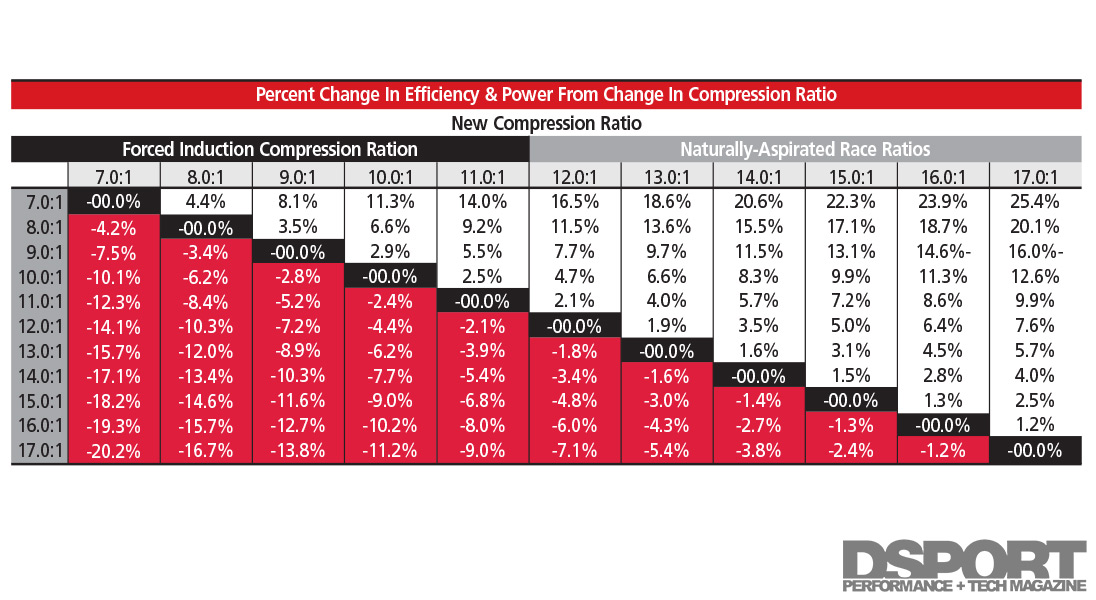
Source: https://dsportmag.com/the-t...ompression-benefits/
I think that the biggest consequence of a low compression ratio is that there is a lot of exhaust gas left over in the cylinder at the end of the exhaust stroke.
When there is a lot of exhaust gas diluting the intake charge, then the AFR needs to be rich to ensure an ignitable mixture.
In the AFR table of my Fiero, we see that I have enriched the mixture in the lower RPM area:
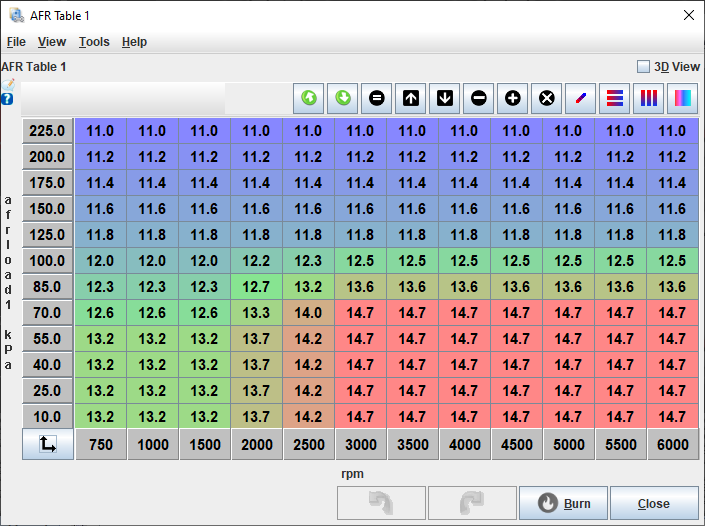
My Fiero is somewhat of a gas guzzler in town, so I think the low compression results in low fuel economy firstly due to the need for a richer mixture, and secondly due to reduced expansion during the power stroke. Driveability is okay.[This message has been edited by pmbrunelle (edited 08-10-2024).]
|
|
|
|
1985 Fiero GT
|
AUG 10, 01:11 PM
|
|
| quote | Originally posted by pmbrunelle:
My V6 Fiero has 3100 pistons in it (with iron heads) and 7.4:1 compression. For me, I think that the driveability is fine with sedate driving. No tendency to overheat.
Torque doesn't suddenly drop off a cliff because the compression is below 8:1; the engine still works.
|
|
Ok, thanks for chiming in, about how much power could be expected from the 7.7 vs 8.5:1, and which would be recommended, 95% street driving, curvy mountain roads, etc, the less boost lag the better, fuel economy isn't important (as long as it's not like 25l/100km, my Fiero gets 10 right now), I'm thinking probably the 8.5:1, less boost, less time to spool up, better temps, but still some headroom for turbocharging? I mean if it's a difference between 200 and 350hp, then definitely go with the higher one, but if it's only a few hp, with more drawbacks, might not be worth it.
|
|
|
|
pmbrunelle
|
AUG 10, 02:54 PM
|
|
| quote | Originally posted by 1985 Fiero GT:
about how much power could be expected from the 7.7 vs 8.5:1 |
|
Refer to the chart I posted above for the direct effect of compression ratio on torque.
If you're wondering how much more power is possible due to greater boost pressure due to the lower compression ratio, this is difficult for me to answer.
My Fiero has run up to 15 psi non-intercooled without water injection and been fine with 91 AKI E10 gasoline.
You can look at different builds that people have done to try and get a handle on what works.
| quote | Originally posted by 1985 Fiero GT:
which would be recommended, 95% street driving, curvy mountain roads, etc |
|
This statement needs to be translated into an actual requirement, such as XXX Nm torque in the Y to Z RPM range.
| quote | Originally posted by 1985 Fiero GT:
fuel economy isn't important (as long as it's not like 25l/100km, my Fiero gets 10 right now) |
|
My Fiero does about 15 L/100km city / 10 L/100 km highway.
|
|
|
|
1985 Fiero GT
|
AUG 10, 09:59 PM
|
|
| quote | Originally posted by pmbrunelle:
...
|
|
Hmm, now I don't know, this is honestly the first time actually looking into turbos seriously, there's a lot to learn, I have no idea on target power, but from what I'm reading, 15lbs of boost roughly doubles na power? If a 3.4pr makes 160 stock, my porting and everything I've done to the 2.8 and can transfer to a 3400 has added estimated 20hp (based on other people's dyno results with the same mods and my 0-60 time), making a 3.4 closer to 180, remove 5% from compression drop, 170hp na, that would be about 340hp at 15psi boost? I'm sure with inefficiencies, real world data, etc, it would be less than that, but is my math mathing?
Whew, just got through reading all 11 pages of "The White Bug", lots of great information that's applicable for this, I'd probably end up with the 7.7:1 compression, and boosting it from there.[This message has been edited by 1985 Fiero GT (edited 08-11-2024).]
|
|
|
|