
 
     |
| 3.4 L32 V6/60... questions... compared to L44 (Page 2/9) |

|
82-T/A [At Work]
|
MAY 10, 07:35 PM
|
|
| quote | Originally posted by zkhennings:
I was referring to the 3.4 would probably be happy revving out to 6k if it can breathe, the 2.8 can probably go a little higher due to rod/stroke ratio and lighter pistons.
|
|
Ok, that's what I had kind of heard / thought... so I'm not missing a whole lot. But... let me ask you. I've gotten in touch with the rebuilder who's providing the engine to AutoZone. I've asked them if they're willing to do some additional work to the engine before they send it to me. If I ask them to rebalance the rotating assembly to a significantly higher degree than they normally do to "spec" ... will this help me in any way?
| quote | Originally posted by zkhennings:
Check out Eric Weingartner's vids, super informative. The iron heads are exceptionally egregious when it comes to extremely poor blending of where the valve seat has been machined relative to the cast port bowl that is flowing into it.
There are several vids in this series:
https://www.youtube.com/watch?v=-Y5RODX3L0k&t=1s
|
|
This is awesome... when I did my intake port matching like 15-20 years ago, I used those shitty conical grinding stones that you'd buy at the local auto parts stores. Definitely not what he's using. I'm definitely going to watch these... thanks!
| quote | Originally posted by zkhennings:
You don't want a flat HP graph, you want a flat torque curve and a linear hp curve that is constantly rising until your ideal shift point. In fact even if you do sacrifice bottom end torque, it only helps save the drivetrain and makes the car more driveable as you aren't lighting up the tires coming out of a turn as you get on the gas. A torque curve that is falling the entire rev range (flat hp graph) will only feel like the car is pulling slower as you climb up the revs. Flat torque curve makes the car pull hard at all times. Do you want your Fiero to feel like a diesel truck or like a sports car?
|
|
That makes sense. On your graph, your torque is VERY surprisingly flat once it hits it's peak. I've never seen that before in a V6/60... is this normal? All the graphs that I've seen, the torque curve slowly tapers off... but yours looks more like a sine wave once it hits it's peak, which is wild.
| quote | Originally posted by lou_dias:
The F-body 3.4 is stuck at 160 hp out of the box because it's still using a stock Fiero cam and ports cast for 2.8L worth of flow.
|
|
The CompCams H272 cam, that's got a longer duration, correct? If I'm not mistaken, the duration refers to the length of time the valves stay open, so even with everything else being stock, I should still see SOME improvement with the H272 and 1.52:1 roller rockers (both of which I already have anyway), right?
| quote | Originally posted by lou_dias:
They all use higher compression than the F-body 3.4
|
|
Yeah, I noticed that the 3.4 has a compression of 9.0:1, which is at least superficially better than the 8.9:1 of the 2.8, haha. Mine has been rebuilt, so there's been some surface work to it... so maybe it'll be a 9.1:1... one can only hope! Haha.
| quote | Originally posted by lou_dias:
The stock Y pipe sucks too...
You'll still need to modify the intake and throttle-body for more flow though. That's unavoidable as again it was barely good enough for a 2.8L engine.
|
|
Back in the 2000s, someone on Fiero.NL was selling aftermarket and ceramic coated performance Y-pipes. I bought one of those that was mandrel bent with a 2" overall diameter, with the professionally designed Y section, etc. So what I have is at least decent.
My throttle body has already been bored (with it mounted to the intake)... it was done by Darrel Morse back in like 2000 or something like that. I still need to open up the underside of the neck though. Even though some work was done to it... obviously, that's going to be my biggest bottle-neck of everything.
| quote | Originally posted by lou_dias:
It hasn't caught on because most Fiero owners are cheap. They'd rather spend 20 years on one swap with a used engine than a few months and some coin on a proper performance rebuild with essentially a brand new engine.
|
|
Hahah, I hope you're not lumping me into this. It's not about being cheap (though there's no reason to waste money). I'm more about getting a reasonable power increase, keeping the Fiero totally stock looking, while improving reliability as much as possible.
So I'd love to have a 3400 block like what was in the Grand Ams during the late 2000s. I loved those engines, they were smooth, pulled hard... and sounded awesome... like a more refined Fiero engine. But for me, getting rid of the Fiero intake plenum is a big no-no. I'm also going to stick with the distributor (even though I could go to DIS), simply because for me it's about maintaining originality.
This was my first car... literally... my 87 Fiero was THE car I drove in high school. Dude... all the chicks dug my Fiero, it was bad-ass. And when I moved to Miami, I used to cruise around in it all the time in the late 90s... up and down Fort Lauderdale and South Beach. Hahaha... It was always awesome when I took a girl out on a date (who knew nothing about cars) and they'd say... "Hey, this is a really nice car!"
Oddly enough, my wife HATES Fieros, and I had blown the engine and bought a 1997 Grand Am when I'd met her in 2000. She said if she knew I had a Fiero, she wouldn't have dated me because all the Fiero owners when she was in high school were assholes. Hahaha...
Anyway, my priorities are:
- Originality
- Reliability
- Performance
- Economy
Really... I could care less about economy... because more than likely, once I actually totally restore my Fiero, it'll sit in the garage next to my 2002 Crown Victoria (which has 46k miles on it), and it'll never get driven and probably started once every 6 months.
|
|
|
|
zkhennings
|
MAY 10, 08:04 PM
|
|
I did not realize the 3.4 bottom end and DOHC bottom end are identical. I know the 3.4 DOHC has a better oil pump but it also has to feed all those cams. Still figured there were some differences.
In regards to the waviness of the dyno plot up top, it could be they didn’t use enough smoothing factor, or it could be the beginning of valve float as I was running the performance cam and 1.6 ratio stamped steel rockers with stock valve springs.
But yes the 260H cam has 260 degrees of duration on intake and exhaust, much higher then the stock 2.8 cam, and this plus the other specs of the cam help the engine breathe better which lets the power keep climbing. I don’t think my cam caused me to lose any bottom end really compared to stock.
A more aggressive cam would lose some bottom end but make more power up top than what you see on my dyno. This is because as duration gets longer on intake and exhaust they start to overlap, and at low engine speeds you lose a bunch of intake charge out of the exhaust because the intake valve stays open longer and the exhaust valve opens earlier. But to take full advantage of it you will need more extreme intake and exhaust mods to support the extra flow. The sweet spot is where you take full advantage of the flow you have and no more. 272 cam may be perfect, as I felt my engine could have used a touch more cam. Expect to buy stiffer valve springs though, may require some machining to the seat to get the correct install height, but there may be offset keepers available to change install height without and machine work necessary.
The 3500 bottom end would be a good upgrade too but require more work, you’d have to get different pistons. The roller cams are basically able to open the valve faster and hold it near peak longer, so it will increase flow, and it’s also an extremely robust bottom end that you can put a fiero top end on top of (and install a dist as is). This would be Fiero heads and intake, and even timing cover alternator waterpump etc. It would appear as stock as a 2.8.[This message has been edited by zkhennings (edited 05-10-2023).]
|
|
|
|
pmbrunelle
|
MAY 10, 08:06 PM
|
|
| quote | Originally posted by 82-T/A [At Work]:
Hahah, I hope you're not lumping me into this. It's not about being cheap (though there's no reason to waste money). I'm more about getting a reasonable power increase, keeping the Fiero totally stock looking, while improving reliability as much as possible.
So I'd love to have a 3400 block like what was in the Grand Ams during the late 2000s. I loved those engines, they were smooth, pulled hard... and sounded awesome... like a more refined Fiero engine. But for me, getting rid of the Fiero intake plenum is a big no-no. I'm also going to stick with the distributor (even though I could go to DIS), simply because for me it's about maintaining originality.
|
|
Maybe you misunderstood, but Lou was talking about using the 3400 block (without cylinder heads) and bolting the Fiero heads and intake onto the 3400 block, maintaining the original appearance.
I was talking about using the 3500 LX9 block (without cylinder heads) and bolting the Fiero heads and intake onto it, for even more displacement, still keeping the original Fiero appearance.
|
|
|
|
82-T/A [At Work]
|
MAY 10, 08:28 PM
|
|
| quote | Originally posted by zkhennings:
The 3500 bottom end would be a good upgrade too but require more work, you’d have to get different pistons. The roller cams are basically able to open the valve faster and hold it near peak longer, so it will increase flow, and it’s also an extremely robust bottom end that you can put a fiero top end on top of (and install a dist as is). This would be Fiero heads and intake, and even timing cover alternator waterpump etc. It would appear as stock as a 2.8.
|
|
| quote | Originally posted by pmbrunelle:
Maybe you misunderstood, but Lou was talking about using the 3400 block (without cylinder heads) and bolting the Fiero heads and intake onto the 3400 block, maintaining the original appearance.
I was talking about using the 3500 LX9 block (without cylinder heads) and bolting the Fiero heads and intake onto it, for even more displacement, still keeping the original Fiero appearance. |
|
Well **** ... hahah... I just bought the 3.4 Gen-1 long block. I wish I had done a bit more research, but I assumed the heads didn't match up. Oh well... I'm still pretty content with the normal 3.4. I would have liked a roller cam, but it's ok.
Thanks for all the other info!
|
|
|
|
fieroguru
|
MAY 11, 07:02 AM
|
|
|
|
|
82-T/A [At Work]
|
MAY 11, 08:27 AM
|
|
Wow! That is a FANTASTIC thread.
The only thing I question on there is why the 3.1 fell on its face so hard in the upper RPMs. It fell off like a rock much more than all the other cars, though it did second best in the lower rpms. But the 3.4 really killed it across the board.
The Truleo intake graph later on down the thread really also shows how much improvement could be made by allowing that engine to breath properly. Really emphasizes the need to do the DAWG or whatever it's called... opening up the neck.
Thanks for sharing this!
EDIT: I see... Don's engine (the 3.1) was babied a little bit simply because he had just rebuilt it and didn't want to push it. My guess is it still didn't have the torque and low-end power of the 3.4, but likely would have really competed with the 3.4 in the upper end.
Interesting to note too that the 3.4 in those dyno graphs was totally stock. Stock intake and exhaust (if I'm reading it right). Which means that possibly he didn't even bother to port-match or hog out the exhaust manifolds.[This message has been edited by 82-T/A [At Work] (edited 05-11-2023).]
|
|
|
|
lou_dias
|
MAY 11, 09:22 AM
|
|
Prior to doing the DAWG mod on my car and using wheels that were near stock weight, my motor made 187rwhp at ~4500 rpm and 249 ft*lbs at 3600 rpm.
After that I started using really heavy wheels for racing so all my subsequent dynos were gimped due to the extra rotating mass...but I eventually went on to make peak power at the advertised cam peak once I did further intake mods. I eventually did a mild refresh of the motor using a cam that peaked at 4900 rpm but had much more lift than the stock 3400 cam(.436/.436 @ 5200) I was using. (.480/.480). My new cam will use ~ .550 lift and peak between 6200 and 6400.... I am using 6" rods in the new motor and intend to rev to 7500 rpm.
While this thread was eventually invaded by butt-hurt trolls, you can see my early dyno on the 3rd page.
https://www.fiero.nl/forum/Forum2/HTML/075502.html[This message has been edited by lou_dias (edited 05-11-2023).]
|
|
|
|
82-T/A [At Work]
|
MAY 11, 09:48 AM
|
|
| quote | Originally posted by lou_dias:
Prior to doing the DAWG mod on my car and using wheels that were near stock weight, my motor made 187rwhp at ~4500 rpm and 249 ft*lbs at 3600 rpm.
After that I started using really heavy wheels for racing so all my subsequent dynos were gimped due to the extra rotating mass...but I eventually went on to make peak power at the advertised cam peak once I did further intake mods. I eventually did a mild refresh of the motor using a cam that peaked at 4900 rpm but had much more lift than the stock 3400 cam(.436/.436 @ 5200) I was using. (.480/.480). My new cam will use ~ .550 lift and peak between 6200 and 6400.... I am using 6" rods in the new motor and intend to rev to 7500 rpm.
While this thread was eventually invaded by butt-hurt trolls, you can see my early dyno on the 3rd page.
https://www.fiero.nl/forum/Forum2/HTML/075502.html
|
|
That's a great thread. I think I remember reading somewhere that you (and a couple of other people) had used the newer roller blocks with the old heads... but it slipped my mind. I see you have to do some custom pistons for clearance, but otherwise... do the Gen-1 heads simply bolt on to the newer blocks without any other modification necessary? That's very, very cool.
I assume there's no problems with splayed versus non-splayed valves... it's just the angle of the pushrod into the lifter.
So, this image caught my attention:
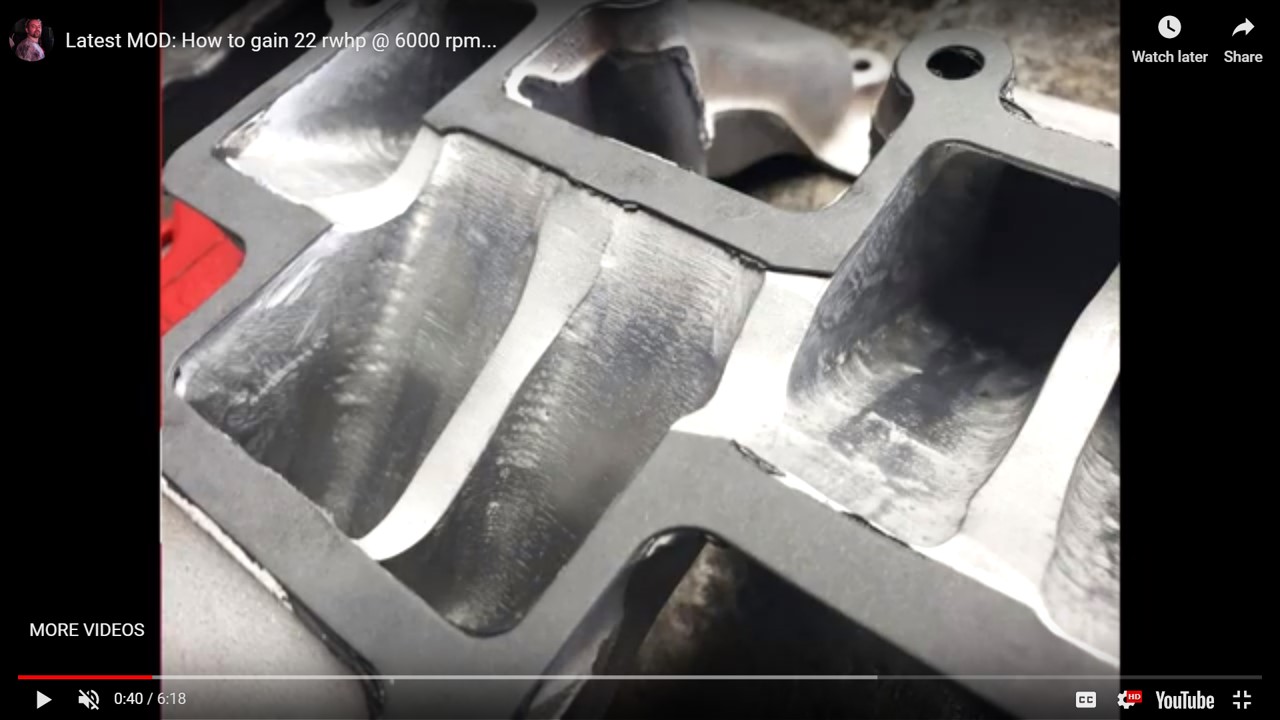
I cringed when I first saw it, but it's intrigued me. I suppose what this is doing is equalizing the air flow between the ports. Did you notice a significant difference? (it says 22hp), but just curious on your thoughts...
|
|
|
|
lou_dias
|
MAY 11, 10:38 AM
|
|
I lost something like 6 ft*lbs below 4500 (which I already had plenty of torque) but gained so much more power after 4800. The dyno I included speaks for itself. With a proper cam, the limitation isn't the heads as others will try to convince you otherwise. That said the heads are ported. I've made separate videos on my heads.
https://rumble.com/v2aonfa-...-v6-heads-redux.html
Follow the link to Fierosound's engine build about the roller lifters with iron heads. There's no needs to worry about the aluminum heads' splayed valves. The lifters go straight up and down, you just need shorter pushrods. They had to lower the height of the engine for FWD cars, hence they also use smaller valve covers. That's what pushed that design. If you look at LS3 heads, they are straight. Don't buy into the hype.[This message has been edited by lou_dias (edited 05-11-2023).]
|
|
|
|
Raydar
|
MAY 11, 12:09 PM
|
|
Having built a 3.4, I think you'll like the H272 cam. I used the Comp 1.52 rockers. Just be aware that you will need to machine the spring pockets in the heads, or use some different springs. Otherwise the springs will coil-bind. (If it's the same cam I'm thinking of, the valve lift is .454/.480, I/E, with 1.52 rockers.)
I would recommend the Dawg intake mod, and a bored throttle body and neck - at the very minimum. If you can find a Trueleo, that would be the stuff.
I used a Cloyes timing set that allowed for cam adjustment. I installed my cam retarded, relative to the crank, to help out the top end.
I had my heads ported and cleaned up, as well as the lower intake.
I also ran tuned headers.
So... how did it run? It felt almost as strong as my 4.9. (Tractor torque notwithstanding.  ) )

.JPG) [This message has been edited by Raydar (edited 05-11-2023).]
|
|
|
|