
 
     |
| smoke at start up? (Page 2/2) |

|
Patrick
|
JAN 13, 09:33 PM
|
|
| quote | Originally posted by 2.5:
Yeah the Iron Duke is known for a smoke blow at startup too, its oil from the valve seals, but it looks white.
If you arent having to add any fluids its likley not serious.
|
|
If it looks white, then it's condensation from the exhaust system that's being vaporized.
| quote | Originally posted by Gall757:
I've always had trouble with that 'blue' description. It's a little less white than burning coolant....but not much.
|
|
Honest to gawd, there's no comparison between burning oil and steam. Just takes a trained eye.  [This message has been edited by Patrick (edited 01-13-2014).]
|
|

|
georgie
|
JAN 13, 10:27 PM
|
|
|
Ok! Sorry for the white to blue change but It's realy a mix of both depending on the sun light an when you see it (if you know what I mean). I think that since I changed to syn/dino blend oil it's found it's way in the seal's. Thank's to all for the info an help.
|
|
|
|
hunter29
|
AUG 12, 10:10 PM
|
|
How about this, car sits for days, starts right up no smoke, drive seven miles, park for three hours.
Starts right up, puff of blue smoke.
|
|

|
Patrick
|
AUG 13, 03:30 AM
|
|
Try driving eight miles and see what it does. 
|
|
|
|
82-T/A [At Work]
|
AUG 13, 07:04 AM
|
|
Colors aside... there's a few reasons you'll get "smoke" on start-up...
- Water / dew collecting in the exhaust which burns (steam) as it's warming up. (to fix this, park the car in a garage)
- Valve guide seals are failing, allowing oil to leak down into the valves and burn when you first start it up. (to fix this, add ATF to your oil to swell the seals, or replace seals)
- Fuel injector(s) leak(s) when the car is off until line pressure is reduced, causing a puff of smoke on startup. (to fix this, replace the fuel injector)
- Rings are worn, and you're getting blow-by during heavy acceleration. (Nothing you can really do except check or PCV valve, or rebuild engine)
|
|
|
|
hunter29
|
AUG 13, 11:43 AM
|
|
Right, so I'll have to take a closer look at the smoke. If it was valve seals I would think it would smoke after sitting a few days, but it doesn't.
If it was fuel I understand it would smoke black. It does not look black. Going to have someone else start the car so I can be by the exhaust..
|
|
|
|
82-T/A [At Work]
|
AUG 13, 12:17 PM
|
|
| quote | Originally posted by hunter29:
Right, so I'll have to take a closer look at the smoke. If it was valve seals I would think it would smoke after sitting a few days, but it doesn't.
|
|
Not really... it depends on how worn the seals are. Hot oil is more viscous and will pass through holes much more quickly. When it's cold (unless synthetic), it will have less fluidity between the molecules. After a 6 hours or so... your car isn't going to continue to leak-down oil into the combustion chambers. You'd need to understand what the top of the cyl head looks like for that to make sense.
This is from one of my daughter's videos where she's re-assembling the cyl head on her Iron Duke (similar for the V6 and other pushrod motors).
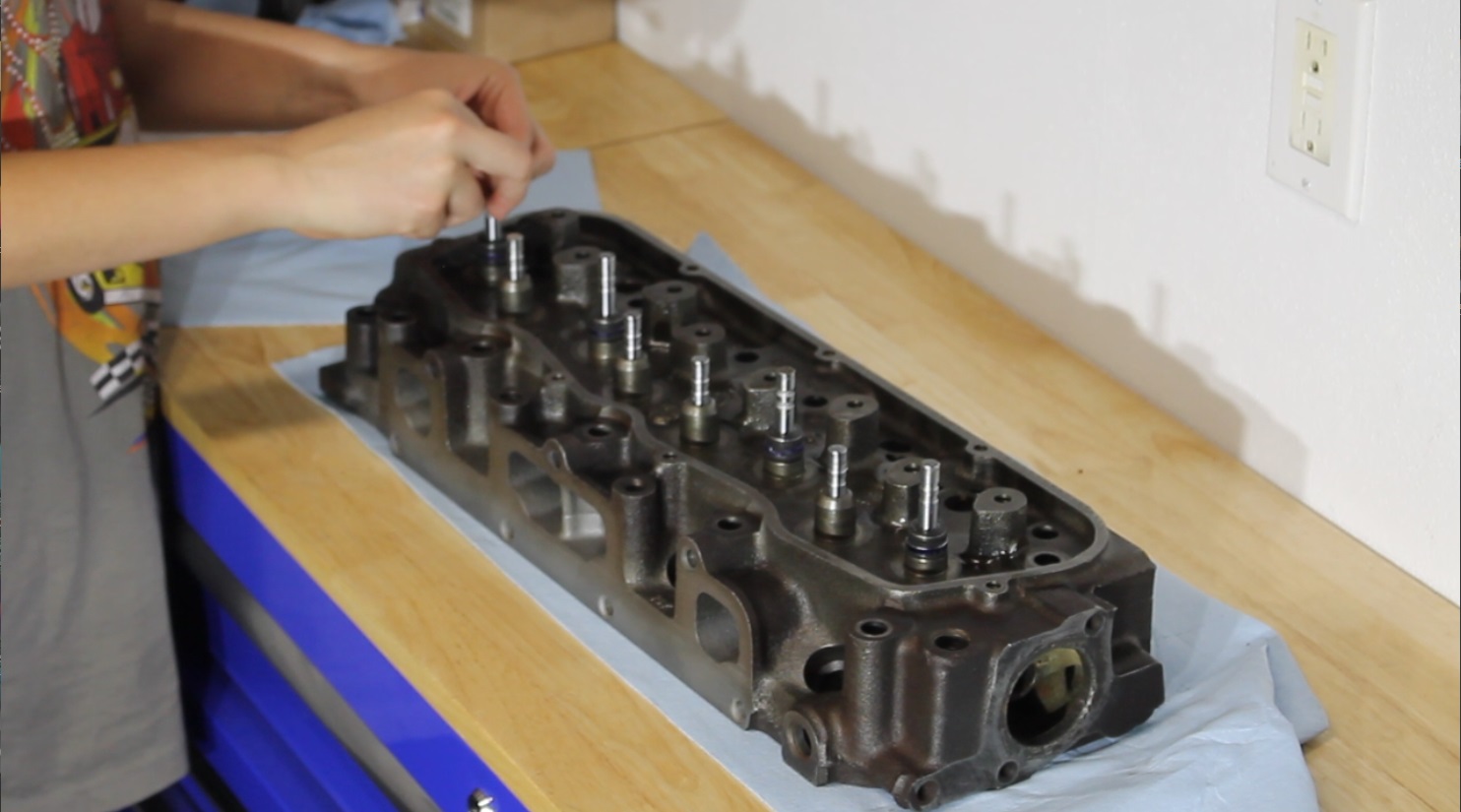
The valves and the valve seals are quit literally one of the highest components on the car's engine. Any oil that's leaking down in there is going to come from whatever is immediately sitting there on or around the valve seal from having been splashed with oil from the pushrods. Now, this is an Iron Duke motor which stands perfectly vertical, but in the V6/60, they sit at a 60 degree angle (give or take) and the only "other" oil you're going to get is whatever has pooled in the rocker arm once the motor stops, and any of that continuing to drain down onto the valve and the valve stem... all of that should have drained down by the time the car cools off.
So... really, you're going to see a puff of smoke... probably from having the car sit anywhere from 2-6 hours. I'd imagine some of the oil will burn off early while the engine is still sitting at core temperature for 20-30 minutes. But anything after that is just going to pool on top of the pistons.
EDIT: I don't know if this is an "old wives tale," but they say adding ATF / automatic transmission fluid can extend the life of your gaskets by causing them to swell. The automatic fluid won't hurt your engine because it's essentially just formulated hydraulic fluid.[This message has been edited by 82-T/A [At Work] (edited 08-13-2024).]
|
|
|
|
hunter29
|
AUG 13, 05:42 PM
|
|
| quote | Originally posted by 82-T/A [At Work]:
Not really... it depends on how worn the seals are. Hot oil is more viscous and will pass through holes much more quickly. When it's cold (unless synthetic), it will have less fluidity between the molecules. After a 6 hours or so... your car isn't going to continue to leak-down oil into the combustion chambers. You'd need to understand what the top of the cyl head looks like for that to make sense.
This is from one of my daughter's videos where she's re-assembling the cyl head on her Iron Duke (similar for the V6 and other pushrod motors).
The valves and the valve seals are quit literally one of the highest components on the car's engine. Any oil that's leaking down in there is going to come from whatever is immediately sitting there on or around the valve seal from having been splashed with oil from the pushrods. Now, this is an Iron Duke motor which stands perfectly vertical, but in the V6/60, they sit at a 60 degree angle (give or take) and the only "other" oil you're going to get is whatever has pooled in the rocker arm once the motor stops, and any of that continuing to drain down onto the valve and the valve stem... all of that should have drained down by the time the car cools off.
So... really, you're going to see a puff of smoke... probably from having the car sit anywhere from 2-6 hours. I'd imagine some of the oil will burn off early while the engine is still sitting at core temperature for 20-30 minutes. But anything after that is just going to pool on top of the pistons.
EDIT: I don't know if this is an "old wives tale," but they say adding ATF / automatic transmission fluid can extend the life of your gaskets by causing them to swell. The automatic fluid won't hurt your engine because it's essentially just formulated hydraulic fluid.
|
|
Thanks for this..
|
|
|
|