
 
     |
| The White Bug (Page 16/46) |

|
La fiera
|
JUN 11, 07:10 PM
|
|
| quote | Originally posted by pmbrunelle:
Rei, did you consider using a carburetor?
|
|
Never, ever, ever, never, never, ever never!!
Top fed ITB's throttle bodies I am considering.
|
|
|
|
claude dalpe
|
JUN 11, 07:17 PM
|
|
| quote | Originally posted by La fiera:
Never, ever, ever, never, never, ever never!!
Top fed ITB's throttle bodies I am considering. |
|
I can't wait to see it Rei! One day I would like to do that too, it seems that the response to the throttle is great when it is well matched.
And me to : Never, ever, ever, never, never, ever never!!
|
|
|
|
pmbrunelle
|
JUN 11, 07:40 PM
|
|
A throttle body with fuel injectors far from the valves, that's not a similar idea? 
Please explain! (I don't know what driving with a carburetor is like, I only read about it in books and on the Internet.)[This message has been edited by pmbrunelle (edited 06-11-2020).]
|
|
|
|
Will
|
JUN 11, 09:46 PM
|
|
|
A carburetor is a calibrated leak
|
|
|
|
wftb
|
JUN 11, 10:34 PM
|
|
|
I grew up with carbs. So much fun to have to tune something by bending rods and turning screws in and out. Never again.
|
|
|
|
claude dalpe
|
JUN 11, 10:40 PM
|
|
Will explained the difference between carburetor and fuel port : In a carb, when the throttle is opened aggressively, there's an amount of time required for the mass flow through the venturi to build enough that the venturi vacuum signal is strong enough to draw in fuel. That requires a mechanical (Acceleration pump) means requires to add the fuel the delta airflow needs until the vacuum signal from the venturi catches up.
Explication:
A carburetor is relatively simple to use but will always remain less precise than the injection even when it is well tuned and it detuned easily.
With a carburetor it's Very difficult to run the engine at the right mixture, it is often too rich or too lean with a carburetor. With a turbo you have to buy a blow in carburetor. With the injection there are many sensors to adjust the mixture. It is not necessarily more efficient at the wide open throttle but more precise.
|
|
|
|
Will
|
JUN 12, 06:19 AM
|
|
A well developed race carburetor/manifold combo *CAN* deliver better mixture QUALITY--in terms of droplet size and homogeneity--than port EFI... but EFI always has the edge in fuel metering precision.
|
|
|
|
La fiera
|
JUN 12, 07:43 AM
|
|
| quote | Originally posted by Will:
A well developed race carburetor/manifold combo *CAN* deliver better mixture QUALITY--in terms of droplet size and homogeneity--than port EFI... but EFI always has the edge in fuel metering precision. |
|
Also to add to this very precise explanation, a carburator cannot provide steady performance for long time span. If you let them sit a week, you have to re tune them again.
It used to frustrate me when tuning a Holley on a rotary engine to then find out it ran like junk by the time the customer came to pick the car up. I had to re tune it all over again!
|
|
|
|
Will
|
JUN 15, 02:44 PM
|
|
| quote | Originally posted by La fiera:
Also to add to this very precise explanation, a carburator cannot provide steady performance for long time span. If you let them sit a week, you have to re tune them again.
It used to frustrate me when tuning a Holley on a rotary engine to then find out it ran like junk by the time the customer came to pick the car up. I had to re tune it all over again! |
|
As soon as the weather changes, you need to smell like gasoline again. Barometric pressure and humidity both affect a carb's tune. STFT in EFI compensates humidity and the BARO reading taken from the MAP sensor before the engine turns compensates barometric pressure.
|
|
|
|
pmbrunelle
|
JUN 16, 10:29 PM
|
|
I worked on the injection timing in the last few days.
In the previous datalog I posted, you'll notice short-duration lean AFR spikes when I got back on the throttle after a shift.
No matter what I did with the acceleration enrichment settings, I could not tune out the lean spikes. I surmised that with the uniform 360° BTDC compression injection timing, the squirt (with the acceleration enrichment shot) wasn't making it into the cylinder on time, leaving the first cycle after a shift lean.
I played with the injection timing in 45° increments. Advancing the 3000+ RPM injection timing to 405° worked best:
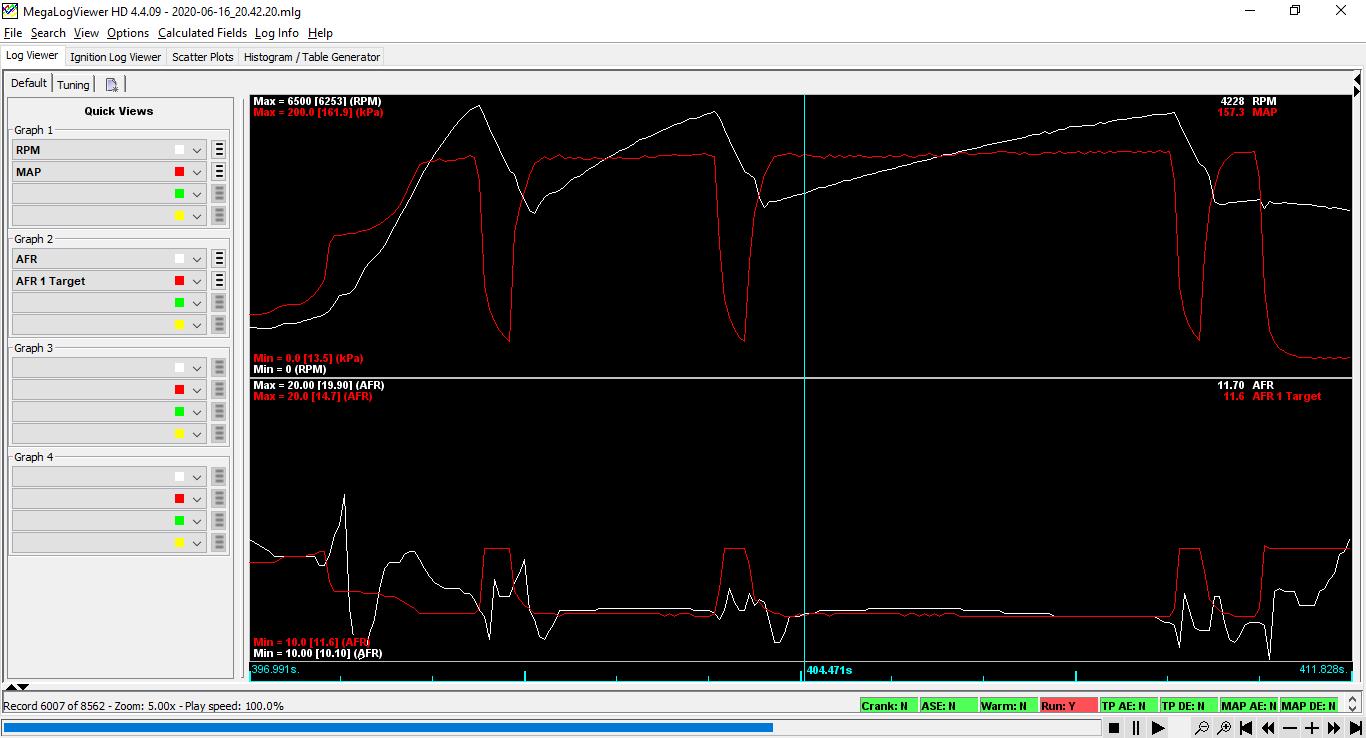
Advance beyond 405° was not beneficial. The more the fuel is advanced relative to the intake event, the more time there is for an airflow change to occur between the squirt (and thus fuel mass calculation) and the intake event. Transient response was less good with more advance.
At low speeds / idle, I retained the default 360° timing:
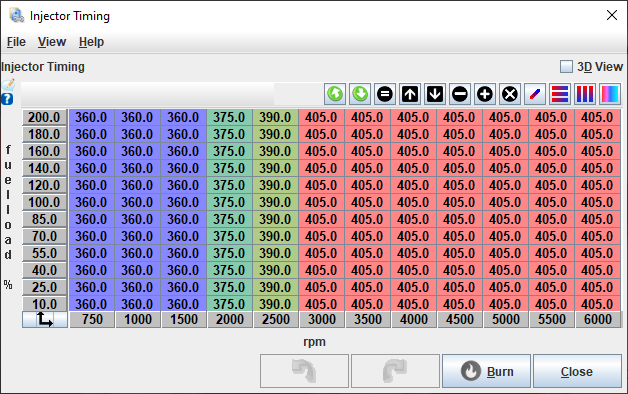
Initially, I thought that I should finish the squirt just before the intake valve closing. This would minimize the time during which a sudden airflow change could cause the injected fuel mass to be incorrect for the air mass that's about to be sucked into the cylinder.
Squirting on a wide-open intake valve gave lean spikes. I think that the fuel was entering the combustion chamber (on time) as large droplets, not burning completely, and then exhausted as unburned HC.
I think that my philosophy for injection timing is to do it as late as possible, while still finishing the squirt on a closed (or barely opened) intake valve. This would apply to the White Bug; other engines may react differently?
|
|
|
|