
 
     |
| Biden admin looks at ways to shield Earth from sunlight, as mandated by Congress. (Page 4/4) |

|
williegoat
|
FEB 09, 03:27 PM
|
|
| quote | Originally posted by rinselberg:
We Californians are already sold on it. After all, we are the state that elected a "Governor Moonbeam".
|
|
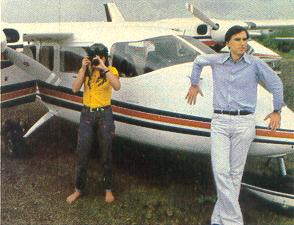
This guy, hanging out with a barefoot little hippy girl from Tucson?
|
|
|
|
rinselberg
|
FEB 09, 05:58 PM
|
|
| quote | Originally posted by williegoat:
This guy, hanging out with a barefoot little hippy girl from Tucson?
|
|
Oh yeah. I saw this earlier, but it didn't hit me until now... the girl from Tucson. "LR".
|
|

|
cliffw
|
FEB 10, 10:14 AM
|
|
| quote | Originally posted by rinselberg:
I don't know if this has any direct connection with the White House Office of Science and Technology's budgetary mandate, but some scientists are sizing up the idea of helping the Earth to keep its "cool" (so to speak) with moon dust.

|
|
How much money will it take to put a catapult on the moon, and the support industry to make it happen ?
Why Moon dust and not Kalifornia soil ?
|
|
|
|
rinselberg
|
FEB 10, 10:34 PM
|
|
| quote | Originally posted by cliffw:
How much money will it take to put a catapult on the moon, and the support industry to make it happen ?
Why Moon dust and not Kalifornia soil? |
|
I can't talk "money" but I can talk "moon dust".
"Why Moon dust and not Kalifornia soil?" is a question that is addressed in the PLOS Climate journal article:
| quote | | [Instead of trying to launch Kalifornia soil into orbit à la "cliffw"] a simpler approach is to ballistically eject dust grains from the Moon’s surface on a free trajectory toward L1, providing sun shade for several days or more. Advantages compared to an Earth launch include a ready reservoir of dust on the lunar surface and less kinetic energy required to achieve a sun-shielding orbit. |
|
A "simpler approach"... KISS. Having to use a lesser amount of kinetic energy is better, because energy isn't free.
"L1" is shorthand for Lagrangian Point 1 of the Earth-Moon orbital system. After being catapulted from the moon's surface, the moon dust drifts away from the moon until it reaches L1, where the dust is balanced between the gravitational attraction of the moon, which is trying to pull its dust back, and the gravitational attraction of the earth, which wants to glom onto the dust and pull it all the way to the earth's surface.
At the L1 gravitational equilibrium or balancing point, the dust is suspended "nicely" between the earth and the moon, so it kind of hangs there, at the L1 distance from earth, and orbits the earth, just as the moon orbits the earth.
This gives the dust its persistence as a "solar shield" for the earth, because the dust is going to spread out into a kind of Saturn-like ring all the way around the earth, and so there is always some dust between the earth and the sun to reflect a carefully calculated amount of sunlight away from the earth (by catapulting a carefully calculated amount of moon dust.) This counteracts the global warming effect of overabundant greenhouse gases in the earth's atmosphere.

A man-made satellite with solar panels is depicted as orbiting the earth at the L1 point of the earth-moon system.

The dust is seen crossing the face of the sun, as viewed from earth.[This message has been edited by rinselberg (edited 02-10-2023).]
|
|
|
|
cliffw
|
FEB 11, 06:17 PM
|
|
| quote | Originally posted by rinselberg:
After being catapulted from the moon's surface, the moon dust drifts away from the moon until it reaches L1, where the dust is balanced between the gravitational attraction of the moon, which is trying to pull its dust back, and the gravitational attraction of the earth, which wants to glom onto the dust and pull it all the way to the earth's surface.
At the L1 gravitational equilibrium or balancing point, the dust is suspended "nicely" between the earth and the moon, so it kind of hangs there, at the L1 distance from earth, and orbits the earth, just as the moon orbits the earth.
|
|
Your a funny guy.
The moon dust just drifts away from the moon ? Like a Chinese spy balloon ? What puts it over your house ?
| quote | Originally posted by rinselberg:
... it kind of hangs there ...
Suspended "nicely" between the earth and the moon ? |
|
What makes that drifting Moon dust hang in a "nicely" position ?
| quote | Originally posted by rinselberg:
... some scientists ...
|
|
Some science FICTION seems to become true, but, if it does, it will be after the Earth is flooded.
Speaking of history, if you ignore it, it will bite you in the azz later.
Do you remember the first [color]electric vehicle push ?
We were supposed to reach "peak oil" ?
We were told, in 1953, that by 2000 we would reach "peak oil". Peak oil is the hypothetical point in time when the maximum rate of global oil production is reached, after which it is argued that production will begin an irreversible decline.
Another failed attempt to make us buy an electric vehicle.
|
|
|
|
rinselberg
|
FEB 11, 07:15 PM
|
|
The lunar regolith or "moon dust" is hurled upwards from the surface of the moon by a powerful catapult. The kinetic energy that this imparts to the dust particles is sufficient for the material to overcome the opposing force of the moon's gravity and move far enough away from the moon to reach that Lagrangian point 1 or "L1" that I explained in my previous message.
The dust orbits around the earth at the Lagrangian 1 distance, which is closer to the moon than to the earth. Each catapult's worth of dust soon dissipates in space, and so to create an effective solar shield for the earth, the catapulting of moon dust has to be repeated "ad infinitum", or for as long as a solar shield for the earth is desired. I don't know whether that would be one catapult shot per minute, or one per day, or one per month. I guess it depends on the size of the catapult. Or there's a number of catapults.
The dust either falls (gradually) to the surface of the earth, or back to the moon, or gets pushed completely away from the earth and moon and into the solar system at large by the force of sunlight and the force of the solar wind.
Of all the solar shield options that I have presented in this forum thread, this lunar dust idea strikes me as the lowest risk option. It doesn't involve anything that would contaminate the earth's atmosphere or fall back on the earth's surface. Any of the moon dust would burn up in the earth's upper atmosphere before it could contaminate any of the earth's land or oceans
I think for it to work without backfiring, the fraction of this dust that ever reaches the earth's atmosphere would have to be very negligible, or spread out over so many years that it is negligible compared to the solar shielding effect. I think that is likely considered in the mathematical and physical analysis and computer modeling that's been set up as part of this research report for PLOS Climate.
"Global warming doesn't stand a chance"[This message has been edited by rinselberg (edited 02-11-2023).]
|
|
|
|