
 
     |
| Carbon dioxide hysteria (Page 131/170) |

|
cliffw
|
DEC 15, 08:19 AM
|
|
| quote | Originally posted by 82-T/A [At Work]:
... the chart was wildly misrepresented because it associated pollution |
|
| quote | Originally posted by cliffw:
Pollution ?  |
|
| quote | Originally posted by 82-T/A [At Work]:
... carbon dioxide emissions. |
|
| quote | Originally posted by cliffw:
What nature produces is pollution ? |
|
| quote | Originally posted by rinselberg:
There are natural processes that enrich the atmosphere with carbon dioxide.
Human exploitation of coal, oil and gas for energy also enriches the atmosphere with carbon dioxide, but these are not fundamentally natural processes. They are only "natural" to the extent that humans have evolved to learn how to do this.
Without the agency of humans, the carbon that is locked within coal, oil and gas would not be transformed into atmospheric carbon dioxide. It would remain locked within the world's natural deposits of coal, oil and gas—sequestered from the atmosphere "forever" in practical terms.
|
|
Without the agency of humans it wouldn't matter. Just like now.
|
|
|
|
rinselberg
|
DEC 15, 05:04 PM
|
|
Sky News' Tom Heap is offering a heap of optimism on YouTube about the possibility of China reigning in its planet-warming greenhouse gas emissions.
https://youtu.be/C1ynGNFeOrE?t=365
|
|

|
cliffw
|
DEC 16, 06:50 PM
|
|
| quote | Originally posted by rinselberg:
Sky News' Tom Heap is offering a heap of optimism on YouTube about the possibility of China reigning in its planet-warming greenhouse gas emissions.
https://youtu.be/C1ynGNFeOrE?t=365 |
|
That is great news rinselberg. Another Greenie prediction which will not come true.
|
|
|
|
rinselberg
|
DEC 17, 12:49 AM
|
|
"The Long Plateau" (excerpt)
| quote | Global sales of internal-combustion engine vehicles peaked in 2017. Investment in renewable energy has exceeded investment in fossil fuel infrastructure for several years running now. In 2022, 83 percent of new global energy capacity was green. The question isn’t about whether there will be a transition, but how fast, global and thorough it will be.
The answer is: not fast or global or thorough enough yet, at least on the current trajectories, which COP28 effectively affirmed. To limit warming to 1.5 degrees Celsius now requires entirely eliminating emissions not long after 2040, according to the Global Carbon Project, whose “carbon budget” for 1.5 degrees Celsius will be exhausted in about five years of current levels of emissions. For 1.7 degrees Celsius, it’s just after 2050, and for 2 degrees Celsius, 2080. And despite Al Jaber’s claim that COP28 has kept the 1.5 degree goal alive, hardly anyone believes it’s still plausible.
Instead, most analysts predict a global peak in fossil fuel emissions at some point over the next decade, followed not by a decline but a long plateau—meaning that, every year for the foreseeable future, we would be doing roughly as much damage to the future of the planet’s climate as was done in recent years. The expected result: end-of-century warming between 2 and 3 degrees Celsius.
Not very long ago, this was a future that terrified us—the world beyond the goals of the Paris agreement looking tremendously bleak. Now, we are not just coming to accept that future but, in some corners, applauding it as progress. |
|
"What No One at COP28 Wanted to Say Out Loud: Prepare for 1.5 Degrees"
David Wallace-Wells for the New York Times; December 16, 2023.
https://www.nytimes.com/202...enewable-energy.html[This message has been edited by rinselberg (edited 12-17-2023).]
|
|
|
|
cliffw
|
DEC 17, 08:34 AM
|
|
| quote | Originally posted by rinselberg:
Global sales of internal-combustion engine vehicles peaked in 2017. Investment in renewable energy has exceeded investment in fossil fuel infrastructure for several years running now. In 2022, 83 percent of new global energy capacity was green. The question isn’t about whether there will be a transition, but how fast, global and thorough it will be. |
|
There are lies, damn lies, statistics, and deception.
| quote | Originally posted by rinselberg:
Instead, most analysts predict a global peak in fossil fuel emissions at some point over the next decade, followed not by a decline but a long plateau—meaning that, every year for the foreseeable future, we would be doing roughly as much damage to the future of the planet’s climate as was done in recent years. The expected result: end-of-century warming between 2 and 3 degrees Celsius. |
|
Most Global Warming analysts / alarmists .
| quote | Originally posted by rinselberg:
"The Long Plateau" (excerpt)
"What No One at COP28 Wanted to Say Out Loud: Prepare for 1.5 Degrees"
David Wallace-Wells for the New York Times; December 16, 2023.
|
|
You pay money to read that Fake News, ?
The United Nations backed climate talks in Dubai, ? The grifting is world wide now.
|
|
|
|
Wichita
|
DEC 18, 02:31 AM
|
|
Leftists are posers.
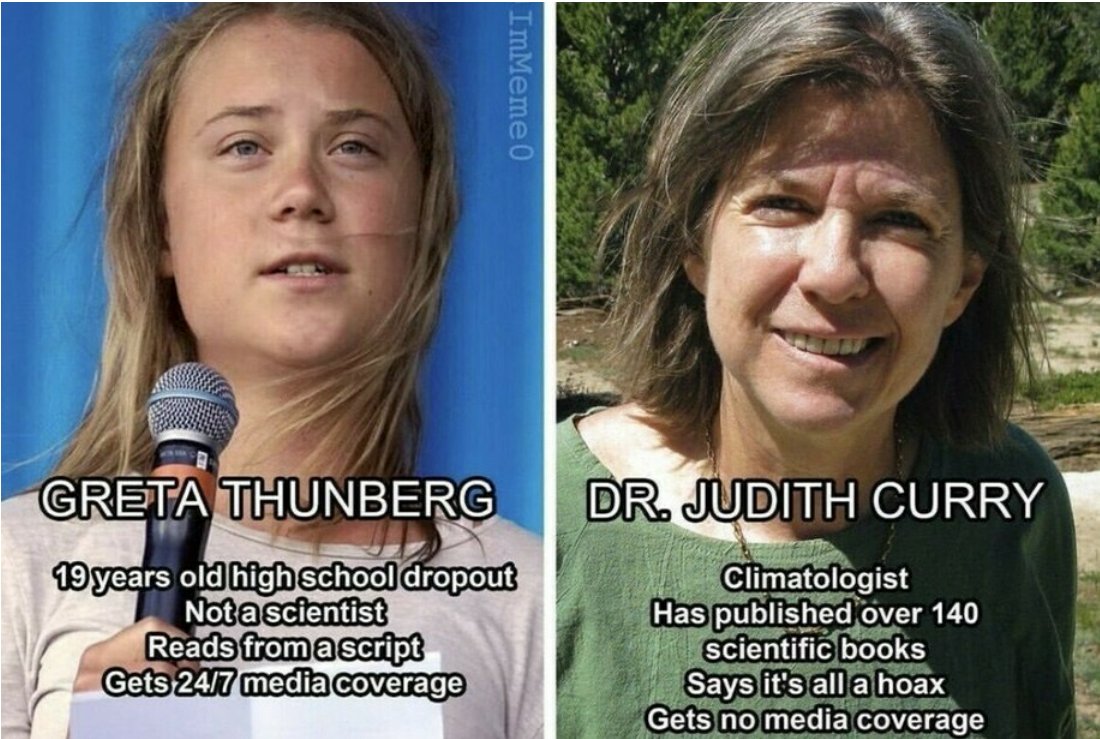 [This message has been edited by Wichita (edited 12-18-2023).]
|
|

|
cliffw
|
DEC 18, 09:12 AM
|
|
Climatologist Dr. Judith Curry explains ‘climate change’ in 5 minutes.
by Dr. Judith Curry
How would you explain the complexity and uncertainty surrounding climate change plus how we should respond (particularly with regards to CO2 emissions) in five minutes?
Last week I served on a panel for a summer school in Canada for engineering students. They are working on the energy transition, and their Professor wanted them to be exposed to the debate surrounding all this, and to think critically. I was the only climate scientist on the panel, the others were involved in renewable energy. Each panelist was given 5 minutes to make their main points. The essay below is what i came up with. 5 minutes is longer than an elevator speech, but it is still pretty short
Let me start with a quick summary of what is referred to as the ‘climate crisis:’
It’s warming. The warming is caused by us. Warming is dangerous. We need to urgently transition to renewable energy to stop the warming. Once we do that, sea-level rise will stop and the weather won’t be so extreme.
So what’s wrong with this narrative? In a nutshell, we’ve vastly oversimplified both the problem and its solutions. The complexity, uncertainty, and ambiguity of the existing knowledge about climate change are being kept away from the policy and public debate. The solutions that have been proposed are technologically and politically infeasible on a global scale.
Specifically with regards to climate science. The sensitivity of the climate to a doubling of carbon dioxide has a factor of three uncertainty. Climate model predictions of alarming impacts for the 21st century are driven by an emissions scenario, RCP8.5, that is highly implausible. Climate model predictions neglect scenarios of natural climate variability, which dominate regional climate variability on interannual to multidecadal time scales. And finally, emissions reductions will do little to improve the climate of the 21st century; if you believe the climate models, most of the impacts of emissions reductions will be felt in the 22nd century and beyond.
Whether or not warming is ‘dangerous‘ is an issue of values, about which science has nothing to say. According to the IPCC, there is not yet evidence of changes in the global frequency or intensity of hurricanes, droughts, floods or wildfires. In the U.S., the states with by far the largest population growth are Florida and Texas, which are warm, southern states. Property along the coast is skyrocketing in value. Personal preference and market value do not yet regard global warming as ‘dangerous.’
Climate change is a grand narrative in which manmade climate change has become the dominant cause of societal problems. Everything that goes wrong reinforces the conviction that there is only one thing we can do to prevent societal problems – stop burning fossil fuels. This grand narrative misleads us to think that if we solve the problem of manmade climate change, then these other problems would also be solved. This belief leads us away from a deeper investigation of the true causes of these problems. The end result is narrowing of the viewpoints and policy options that we are willing to consider in dealing with complex issues such as public health, water resources, weather disasters and national security.
Does all this mean we should do nothing about climate change? No. We should work to minimize our impact on the planet, which isn’t simple for a planet with 7 billion inhabitants. We should work to minimize air and water pollution. From time immemorial, humans have adapted to climate change. Whether or not we manage to drastically curtail our carbon dioxide emissions in the coming decades, we need to reduce our vulnerability to extreme weather and climate events.
With regards to energy. All other things being equal, everyone would prefer clean over dirty energy. However, all other things are not equal. We need secure, reliable, and economic energy systems for all countries in the world. This includes Africa, which is currently lacking grid electricity in many countries. We need a 21st-century infrastructure for our electricity and transportation systems, to support continued and growing prosperity. The urgency of rushing to implement 20th-century renewable technologies risks wasting resources on inadequate energy infrastructure and increasing our vulnerability to weather and climate extremes.
How the climate of the 21st century will play out is a topic of deep uncertainty. Once natural climate variability is accounted for, it may turn out to be relatively benign. Or we may be faced with unanticipated surprises. We need to increase our resiliency to whatever the future climate presents us with. We are shooting ourselves in the foot if we sacrifice economic prosperity and overall societal resilience on the altar of urgently transitioning to 20th-century renewable energy technologies.
We need to remind ourselves that addressing climate change isn’t an end in itself and that climate change is not the only problem that the world is facing. The objective should be to improve human well-being in the 21st century while protecting the environment as much as we can.
This was a pretty interesting discussion.[This message has been edited by cliffw (edited 12-18-2023).]
|
|

|
cliffw
|
DEC 18, 09:49 AM
|
|
| quote | Originally posted by rinselberg:
Human exploitation of coal, oil and gas for energy also enriches the atmosphere with carbon dioxide, but these are not fundamentally natural processes. They are only "natural" to the extent that humans have evolved to learn how to do this.
|
|
Exploitation. he he he.
Return on investment.
|
|
|
|
ray b
|
DEC 18, 12:06 PM
|
|
follow the MONEY
''Fossil Fuel Funding
As reported by DeSmog, in a 2022 deposition Curry said that Climate Forecast Applications Network’s clients included petroleum companies, electric utilities, and natural gas energy traders, and that she charged $400 an hour for her consulting services.
In 2015, Climate Wire reported that “Judith Curry, an atmospheric scientist who is often critical of dominant scientific views of climate change, is is being probed by Rep. Raúl Grijalva (D-Ariz.), who wants to know Curry’s funding sources. Curry runs a weather-forecasting business that supplies information to oil companies, among others.” 11
In 2010, Scientific American reporter Michael Lemonick questioned Judith Curry about potential conflicts of interest. She responded:12
“I do receive some funding from the fossil fuel industry. My company…does [short-term] hurricane forecasting…for an oil company, since 2007. During this period I have been both a strong advocate for the IPCC, and more recently a critic of the IPCC, there is no correlation of this funding with my public statements.”
OIL AND GAS MONEY PAYS HER BILLS
SHE QUIT GA TECK
EVER ANTI-WARMING NUT IS PAID BY OIL GAS PR COAL CORP-RATS
FOLLOW THE MONEY
NON OF THESE NUTS DO IT FOR FREE
THEY ARE ALL WELL PAID
|
|
|
|
ray b
|
DEC 18, 12:13 PM
|
|
| quote | Originally posted by Wichita:
Leftists are posers.
|
|
ONE IS A WELL PAID CORP-RAT SHILL
THE OTHER IS A WORLD WIDE HERO WHO IS A BETTER MAN THEN YOU ARE
|
|
|
|