
 
     |
| Carbon dioxide hysteria (Page 120/170) |

|
82-T/A [At Work]
|
NOV 10, 09:22 AM
|
|
| quote | Originally posted by rinselberg:
This writer says that it was changes in the Earth's orbit that brought about the warmer climate of the Last Interglacial. Not random changes, but periodic changes or cycles that astronomers have figured out. These periodic changes in the Earth's orbit cause changes in the distribution of sunlight across the planet's surface, and that is what caused the warmer climate of the Last Interglacial.
|
|
I had heard that this exact same cycle continues. Are you saying Earth's cycle is non-cyclical and did something weird once?
|
|
|
|
rinselberg
|
NOV 10, 09:38 AM
|
|
| quote | Originally posted by 82-T/A [At Work]:
I had heard that this exact same cycle continues. Are you saying Earth's cycle is non-cyclical and did something weird once? |
|
No.
|
|
|
|
82-T/A [At Work]
|
NOV 10, 11:09 AM
|
|
| quote | Originally posted by rinselberg:
No. |
|
So then why would you not think that something that's cyclical, wouldn't still be doing what it's done throughout Earth's history, also today?
|
|
|
|
olejoedad
|
NOV 10, 11:35 AM
|
|
| quote | Originally posted by rinselberg:
This writer says that it was changes in the Earth's orbit that brought about the warmer climate of the Last Interglacial.
(snip)
What (else) has changed since the start of the Industrial Revolution?
(snip)
Human greenhouse gas emissions.
|
|
NOTE - I edited the quote to be more inclusive. The quote, as originally typed, seemed so.....one-sided, even exclusionary.
Anyway...
Has anyone seen any research on the shifting of magnetic North, it's relationship to the orientation of the planets' core and geomagnetic field and how that ties in to climatic response?
Curious, I've not thought to investigate the topic. Maybe I'll get to it.
Just a thought....
Science continues to question, re-evaluate conclusions and seek answers. The new answers sometimes are in conflict with accepted thought.
The point here is, that science learns.
So many people don't conceive that concept.
|
|
|
|
rinselberg
|
NOV 10, 11:55 AM
|
|
| quote | Originally posted by 82-T/A [At Work]:
So then why would you not think that something that's cyclical, wouldn't still be doing what it's done throughout Earth's history, also today? |
|
Scientists have examined all kinds of influences on the earth's climate, including these orbital cycles.
Human greenhouse gas emissions are the only credible explanation for the amount of warming that has occurred in the relatively short period of about 200 years since industrialization and the concomitant scaling up of greenhouse gas emitting fossil fuels.
It's not just a correlation between greenhouse gas emissions and global warming. It's been tested in laboratory experiments. It's been confirmed in the atmosphere with precision measuring instruments. It's explained in terms of quantum mechanics, involving the interactions between the energy of sunlight and the chemical bonds that connect the atoms in greenhouse gas molecules. It's been translated into numbers that track with computer simulations of the sunlight and atmosphere.
There are other factors that are part of the explanation of why 2023, as it nears its end, is going to be recorded as the hottest year in the last 125,000 or so years, but the warming effect of greenhouse gases outweighs all the other factors in terms of numerical significance. Greenhouse gases are even farther above the other warming factors than Trump is ahead of the other Republican candidates in the polls.
There's clear evidence that it is humans and not Mother Nature that has been pushing up the concentrations of greenhouse gases in the atmosphere.[This message has been edited by rinselberg (edited 11-10-2023).]
|
|
|
|
82-T/A [At Work]
|
NOV 10, 12:55 PM
|
|
| quote | Originally posted by rinselberg:
Scientists have examined all kinds of influences on the earth's climate, including these orbital cycles.
Human greenhouse gas emissions are the only credible explanation for the amount of warming that has occurred in the relatively short period of about 200 years since industrialization and the concomitant scaling up of greenhouse gas emitting fossil fuels.
It's not just a correlation between greenhouse gas emissions and global warming. It's been tested in laboratory experiments. It's been confirmed in the atmosphere with precision measuring instruments. It's explained in terms of quantum mechanics, involving the interactions between the energy of sunlight and the chemical bonds that connect the atoms in greenhouse gas molecules. It's been translated into numbers that track with computer simulations of the sunlight and atmosphere.
There are other factors that are part of the explanation of why 2023, as it nears its end, is going to be recorded as the hottest year in the last 125,000 or so years, but the warming effect of greenhouse gases outweighs all the other factors in terms of numerical significance. Greenhouse gases are even farther above the other warming factors than Trump is ahead of the other Republican candidates in the polls.
There's clear evidence that it is humans and not Mother Nature that has been pushing up the concentrations of greenhouse gases in the atmosphere.
|
|
But, we only have ~150 years of data... and with the exception of the last ~25 years of it... most of it has been fairly limited. As I've said in the past, that's an absurdly small window to put so much focus and emphasis on. I'm not saying you're wrong, but I'm also not convinced.
|
|
|
|
rinselberg
|
NOV 10, 03:19 PM
|
|
We have about 150 years of systematic weather and temperature records.
Paleoclimatology is the science that reconstructs the earth's previous climate regimes, using evidence frozen within glaciers and polar ice sheets, marine sediments, differentiation of fossil species—diatoms and fossilized plant pollen come to mind—and tree ring growth analysis and the like. Even historical accounts for the more recent periods.
Paleoclimatology is what informs climate scientists to assert with confidence that 2023 will be recorded as the warmest-ever year since the warmer climate regime of the Last Interglacial. That's where this figure of 125,000 years comes from.
During the temperature extremes that were common across the U.S., from June through September, there's no doubt that people were greeting their neighbors on the street or across the fence with "Wow. Hot enough for you? It hasn't been this hot since 125,000 years ago." You can bank on it.
October 2023 has been recorded as the overall warmest October on record, breaking the previous record from October 2019.[This message has been edited by rinselberg (edited 11-10-2023).]
|
|
|
|
82-T/A [At Work]
|
NOV 10, 04:00 PM
|
|
| quote | Originally posted by rinselberg:
October 2023 has been recorded as the overall warmest October on record, breaking the previous record from October 2019.
|
|
Again, I say... this is a matter of statistical math.
If you only have 150 years (realistically) of data on a data set that encompasses over 4 billion years old... you're going to be constantly breaking records. Mathematically, this is what is called a Sigmoid curve...
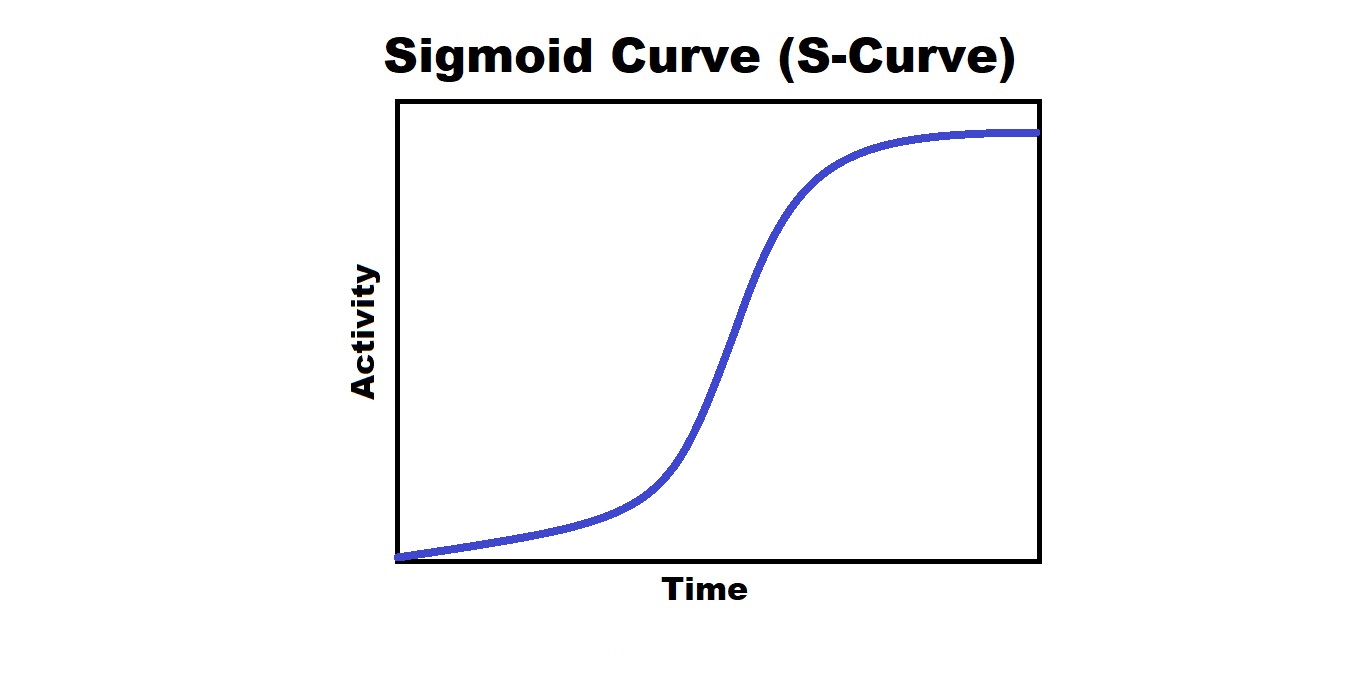
Essentially... in the beginning of data collection (which is where we are now), the changes and fluctuations are going to be exponential. This means that you can expect the records to change radically until the dataset is normalized.
Once you reach a common baseline... (which would take you at least 2 billion years), only then would you start to see a decline in the constant delta of weather records. Eventually, you'll get to the point where all records that could occur within the conceivable range, have already occured... and you're unlikely to ever break another record because every day would have had its coldest and hottest temperature set.
... I know this doesn't jive with what you want to believe... but I keep emphasizing it because it speaks to the absolute ridiculousness of what were expected to believe based on a mere 150 years of data from a 4 billion year-old planet.
|
|
|
|
rinselberg
|
NOV 10, 06:15 PM
|
|
| quote | Originally posted by 82-T/A [At Work]:
Again, I say... this is a matter of statistical math. If you only have 150 years (realistically) of data on a data set that encompasses over 4 billion years old... you're going to be constantly breaking records. Mathematically, this is what is called a Sigmoid curve...
Essentially... in the beginning of data collection (which is where we are now), the changes and fluctuations are going to be exponential. This means that you can expect the records to change radically until the dataset is normalized.
Once you reach a common baseline... (which would take you at least 2 billion years), only then would you start to see a decline in the constant delta of weather records. Eventually, you'll get to the point where all records that could occur within the conceivable range, have already occured... and you're unlikely to ever break another record because every day would have had its coldest and hottest temperature set.
... I know this doesn't jive with what you want to believe... but I keep emphasizing it because it speaks to the absolute ridiculousness of what were expected to believe based on a mere 150 years of data from a 4 billion year-old planet. |
|
You are not just "way out in left field" on this... you're on Waveland Avenue!
It's only the more recent periods of Earth's history that are relevant. If you try to go too far back in time, you are looking at a planet with major differences in the configuration of its land masses and oceans, because of plate tectonics and continental drift... an atmosphere that had considerably more or less oxygen, depending on what period you're in.... periods before there were flowering plants and before there was any animal life on land, which would greatly affect the Carbon Cycle... periods when the carbon dioxide and other kinds of gases and aerosols in the atmosphere from volcanic activity was 10 or even 100 times more than anything that overlaps with the most recent million or so years that takes us back to our earliest human ancestors... yada yada yada.
So you can't look back all that far into Earth's distant history to do climate comparisons, because of "apples and oranges."
The Last Interglacial, from 130,000 to 115,000 years ago, is about as far back in the Earth's history as you can go, before you start encountering serious "apples and oranges."
You are not thinking about this from a human perspective. Scientists are not saying that there won't be a time in the future when the climate becomes much warmer (or colder) than what we're accustomed to. Scientists are saying that if we leave it up to Mother Nature, that kind of change is unlikely for several more thousands of years. But if we do not address the human-attributable greenhouse gas concerns, that kind of change will be upon us much sooner... very possibly by year 2100, if not before.
Statistically, it's being argued that 2023 is the "game changer" that is going to demarcate the beginning of a radically warmer climate regime, unless human greenhouse gas emissions are seriously and rapidly curtailed. But I doubt that can actually be achieved, considering how much additional fossil fuel production is already in the works. So the climate "dice" are already being rolled, regardless of what people of my "ilk" like to think about it.
One of the more ironic possibilities is that continued, greenhouse gas-driven global warming will set off a chain of events that will shut down the Atlantic Ocean Meridional Current, which transports warm ocean water from the equatorial regions to the northern latitudes where it acts like a heating system for most of Europe. That could trigger the next Ice Age, almost before we could blink.[This message has been edited by rinselberg (edited 12-21-2023).]
|
|
|
|
olejoedad
|
NOV 10, 09:42 PM
|
|
|
It could happen as soon as the day after tomorrow!
|
|
|
|