Please forgive the extensive background, I can't be sure what's relative and what isn't: BACKGROUND AND SYMPTOMS: 1) I got the car in June from Idaho: 53k miles, mechanic checked it out and replaced front rotors/brake pads in Boise (the only thing he through was problematic) 2) Drove it down to Southern California. Clutch failed going up the Grapevine (steep incline, about 880 miles into the trip back home) 3) Brough the car to our family mechanic, he's really good but he had great difficulty getting enough travel to engage/disengage. Gave it new clutch, machined flywheel, new master/slave cylinders. Finally got it to work. 4) Been driving it for ~1500 miles, no complaints, successfully replaced leaky transmission seals (no, they were not leaking when I got it back from mechanic), and did a bunch of other unrelated work on it (new headliner, replaced vacuum lines, valve cover gasket, etc) 5) This week I noticed that the clutch is slipping sometimes: I see the tach go up too fast and hear the engine rev but don't get the acceleration. Mostly I've seen it in 4th gear and maybe 5th during freeway driving. 6) I've also noticed, and this may be unrelated, that the "SHIFT" light sometimes comes on when I'm in 5th gear. I don't remember seeing this before.
WHAT DOES THE FACT THAT THE NEW CLUTCH IS SLIPPING AFTER ~1500 MILES SAY? 1) I have many hundreds of thousands of miles driving manual transmission cars: 1998 Subaru Outback had it's clutch replaced at ~70k, and was traded in at ~200k 2) Even if I rode the clutch like Bronco Billy, I don't think I'd wear it out in 1500 miles if something else wasn't going wrong. 3) Even the original clutch going out at 53k seems a bit suspicious, though.
WHAT MORE CAN I DO TO FURTHER DIAGNOSE THE PROBLEM? 1) Are there pictures I could take that might help with diagnosis? 2) I've read somewhere that the clutch for Isuzu/Iron Duke is not "self adjusting". Could this be part of my problem? 3) I can't even find the instructions for clutch replacement in the MT2/Isuzu transaxle section of the Service manual.
I intend to locate the invoice so I can post the parts that the mechanic used to do the clutch.
Thanks in advance guys.
------------------ Geoff Gibbons 1988 4cyl Manual
[This message has been edited by gjgpff (edited 09-25-2020).]
Brought the car to our family mechanic, he's really good but he had great difficulty getting enough travel to engage/disengage. Gave it new clutch, machined flywheel, new master/slave cylinders. Finally got it to work.
This makes me a little suspicious as to whether your mechanic ever really got the clutch fully disengaging/engaging properly.
Did the clutch feel 100% normal when you got the car back from the mechanic with the new clutch? No slippage when engaged, and it disengaged fully?
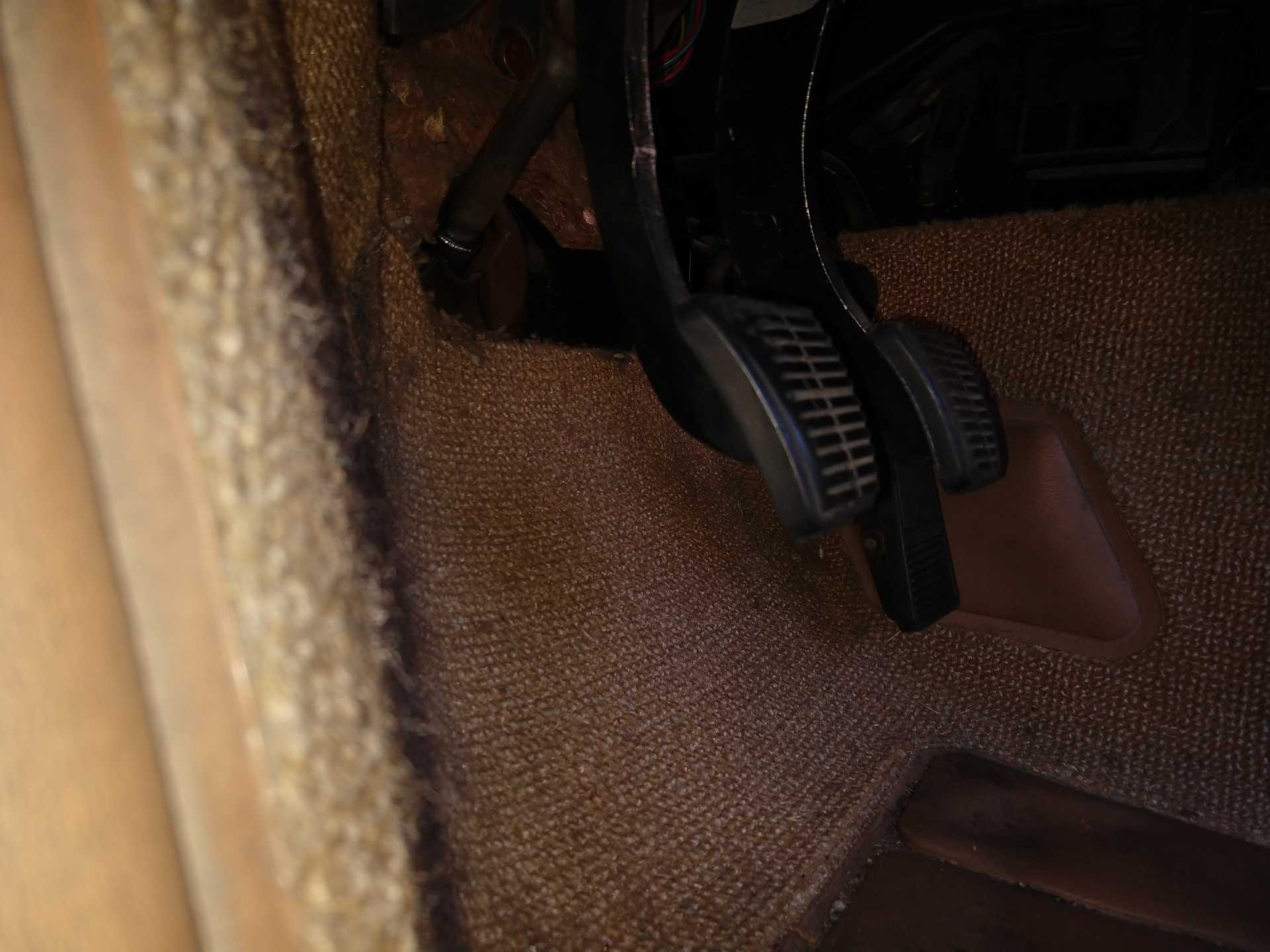
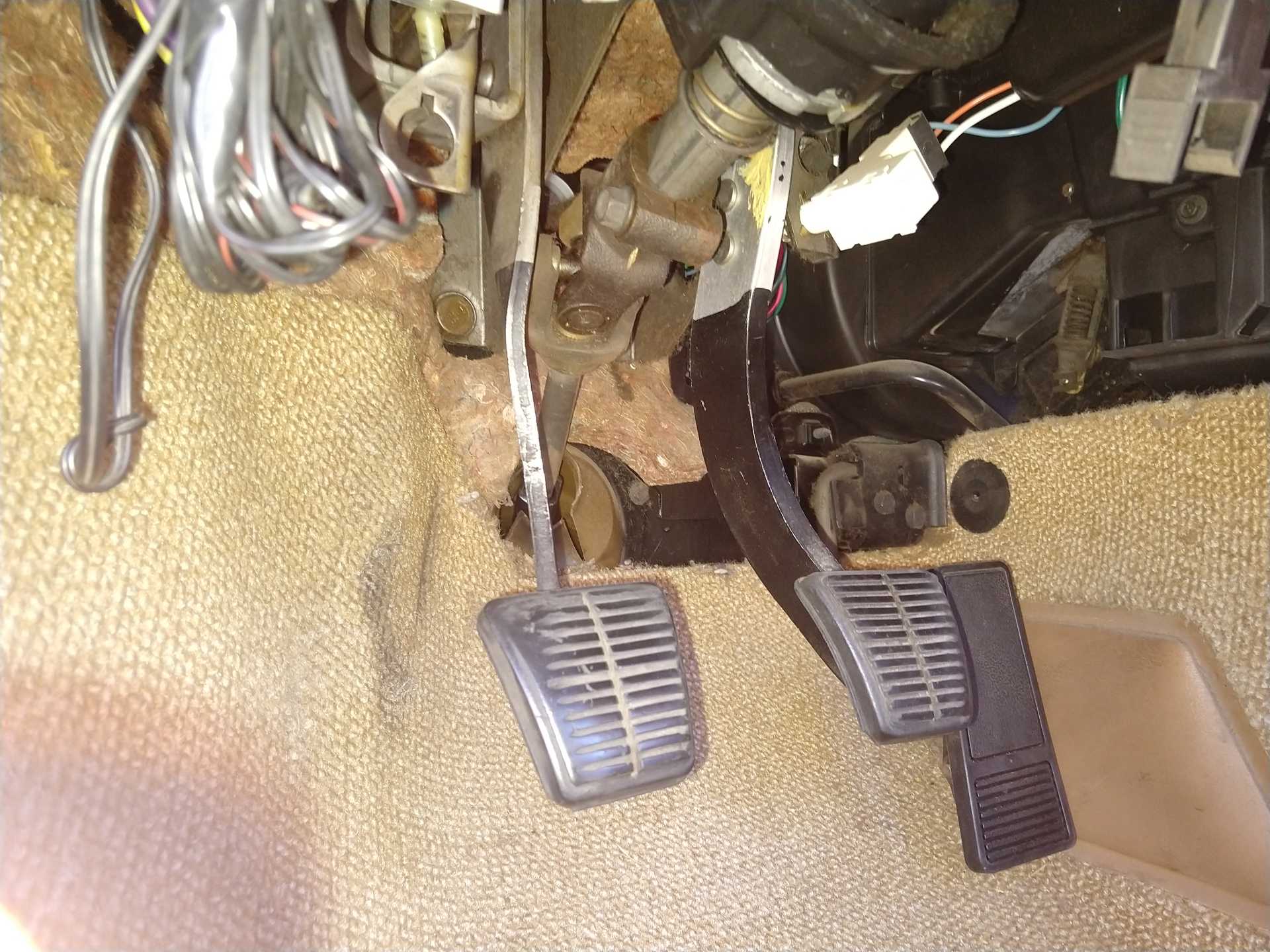
Just curious... does your clutch pedal sit above your brake pedal while at rest?
[This message has been edited by Patrick (edited 09-26-2020).]
This makes me a little suspicious as to whether your mechanic ever really got the clutch fully disengaging/engaging properly.
Did the clutch feel 100% normal when you got the car back from the mechanic with the new clutch? No slippage when engaged, and it disengaged fully?
Just curious... does your clutch pedal sit above your brake pedal while at rest?
The clutch felt the same as before and I didn't notice any slippage when engaged, and it does disengage fully (RPMs dropping immediately to idle when clutch is pushed all the way in and the accelerator is not pressed). Not sure if that's a great test but that's my reason for thinking it disengages fully.
Here's a couple of pictures of the clutch pedal and you're right: it should be about 1" above the brake pedal but it's pretty much level with it:
It's an 88 and the clutch pedal is all steel (checked with magnet), so it isn't one of the bendy aluminum ones. I'm willing to spring for a Fiero Store clutch pedal or Rodney Dickman's fix it kit (and his master/slave cylinders for that matter), but I'm wondering how a low/bent/improperly installed clutch pedal can, on one hand, engage/disengage the clutch enough to make driving possible, but on the other hand, cause the clutch to slip.
It would be great if I didn't have to replace the clutch after only 1500 miles!
It's an 88 and the clutch pedal is all steel (checked with magnet), so it isn't one of the bendy aluminum ones.
Keep in mind that the U-shaped bracket (that the banjo is attached to) is what often bends... and that part has always been steel. When that bracket is bent, clutch throw is reduced as the pedal hits the floor before full travel can be accomplished. The banjo itself can also be bent.
If you remove the clip and detach the banjo from the pedal, are you then able to pull the pedal up towards the pedal stop? If so, that distance is the amount of pedal travel/clutch throw that's been lost.
Before you detach the banjo, take note if the loop of the banjo is in the up position.
quote
Originally posted by gjgpff:
...but I'm wondering how a low/bent/improperly installed clutch pedal can, on one hand, engage/disengage the clutch enough to make driving possible, but on the other hand, cause the clutch to slip.
I obviously don't know anything about your mechanic. I don't know about his ability and/or his integrity. It's a red flag when there's something evident which compromises full clutch pedal travel. My concern is that possibly there was some "hack" done to get the clutch to fully disengage (despite lack of pedal travel) and that this resulted in the clutch never fully engaging. This could have led to continual slippage (perhaps not entirely noticeable) which then would've led to premature wear/failure.
Of course, this is all conjecture. I'm just making wild guesses.
Maybe the engine's rear seal has failed and the clutch disc is now all coated in oil.
[This message has been edited by Patrick (edited 09-29-2020).]
The bent pedal or air in the line etc would not cause it to slip, it would cause it to not release. So if that were your problem then I would look there. It looks like the pedal still needs to be fixed but that isn't what's causing the slipping.
Did your mechanic look at the old clutch disc to see if it was worn evenly, or what caused the failure?
Did he give you paperwork for machining the pressure plate or was it a new one? If he just reused the old one, it could cause faster failure. On mine, one of the springs was bad which I noticed when I tore it apart. A bad spring could cause slippage.
The strange thing is the high gear slippage. I would think it would slip more in low gear when the torque is higher. Even if the springs were bad or there were oil on the disc, it seems like it would be more prone to low gear, high RPM slippage. Is there no slippage when accellerating from low gears or if you keep it in 3rd and cruise at highway speeds?
If it's really perfect in 1-3 then I would think it has to be transmission related...something in the case?
I had an 87 Isuzu where the release fork broke which made the pedal feel funny and it didn't spring up. With your experience, it doesn't sound like that could be the issue.
The bent pedal... would not cause it to slip, it would cause it to not release. It looks like the pedal still needs to be fixed but that isn't what's causing the slipping.
If you're referring to something I posted, I never stated that the bent pedal itself was responsible for the clutch slipping.
quote
Originally posted by Patrick:
It's a red flag when there's something evident which compromises full clutch pedal travel. My concern is that possibly there was some "hack" done to get the clutch to fully disengage (despite lack of pedal travel) and that this resulted in the clutch never fully engaging. This could have led to continual slippage (perhaps not entirely noticeable) which then would've led to premature wear/failure.
The OP mentioned replacing seals in the transmission. I'm guessing the axle seals? Do you know if the input shaft seal was replaced? If it leaks, it will contaminate the clutch with oil. When you remove the clutch, check for signs of oil seeping out of that seal.
The OP mentioned replacing seals in the transmission. I'm guessing the axle seals? Do you know if the input shaft seal was replaced? If it leaks, it will contaminate the clutch with oil. When you remove the clutch, check for signs of oil seeping out of that seal.
Why is it only slipping in 4 & 5 though if oil contaminated?
It is normal for clutches to start slipping in the high gears. In lower gears it is easier to move the car than slip thr clutch, in the higher gears it takes much more torque to accellerate.
I suspect the bushings on the cross shaft for the clutch release bearing are dry and starting to bind. The 4cly pressure plate has a very light clamp load, so anything that keeps it from fully clamping the clutch disk will cause an issue.
I seen one instance where a bad distributor O ring leak caused some oil to find its way on the clutch and this caused a slip.
------------------ " THE BLACK PARALYZER" -87GT 3800SC Series III engine, custom ZZP /Frozen Boost Intercooler setup, 3.4" Pulley, Northstar TB, LS1 MAF, 3" Spintech/Hedman Exhaust, P-log Manifold, Autolite 104's, MSD wires, Custom CAI, 4T65eHD w. custom axles, Champion Radiator, S10 Brake Booster, HP Tuners VCM Suite. "THE COLUSSUS" 87GT - ALL OUT 3.4L Turbocharged engine, Garrett Hybrid Turbo, MSD ign., modified TH125H " ON THE LOOSE WITHOUT THE JUICE "
Why is it only slipping in 4 & 5 though if oil contaminated? AND Did your mechanic look at the old clutch disc to see if it was worn evenly, or what caused the failure?
Did he give you paperwork for machining the pressure plate or was it a new one? If he just reused the old one, it could cause faster failure. On mine, one of the springs was bad which I noticed when I tore it apart. A bad spring could cause slippage.
All, First of all, thanks for all the replies. Specifically with respect to slippage in the high gears I can't be sure it isn't slipping in lower gears, but the problem is intermittent and it may well be that I've noticed slippage in the high gears because the car spends most of its time in those gears, and also those are the gears for freeway driving where I have a little more time to monitor tach, oil pressure, temp, etc. I've only just started paying more detailed attention to gear changes, so I expect I'll learn more soon enough.
quote
Originally posted by fieroguru: I suspect the bushings on the cross shaft for the clutch release bearing are dry and starting to bind. The 4cly pressure plate has a very light clamp load, so anything that keeps it from fully clamping the clutch disk will cause an issue.
So, if this is the case, the transmission/engine will have to be separated, right?
quote
Originally posted by Blacktree: The OP mentioned replacing seals in the transmission. I'm guessing the axle seals? Do you know if the input shaft seal was replaced? If it leaks, it will contaminate the clutch with oil. When you remove the clutch, check for signs of oil seeping out of that seal.
Yeah, they were the axle/output seals. One was leaking pretty badly and the other was seeping. I was pretty stoked to get those seals replaced successfully. Unfortunately, I'm not really set up to do a clutch job, the garage needs to be cleaned out first, so I might have to outsource this. Is it possible to diagnose the larger problem of oil seepage from the input shaft without dropping, or hinging down, the subframe? Right now the car has no obvious oil leaks.
reinhart: Since you're in the OC, do you happen to know of any reputable transmission/clutch guys/gals that you would take your Fiero to? Also, you wouldn't happen to be the owner of the Yellow 88 GT I see on Euclid some mornings and Evenings heading in the opposite direction? I'd be white 88 notchback
Did you mean machining the flywheel? The flywheel was machined, but the pressure plate, clutch disk, and throw bearing were new: LUK... something. Do you have a brand you recommend? The Fiero Store Heavy Duty one is kind of pricey, and I'm not sure I really want a clutch like that if I'm trying to get the longest life out of my transmission, but maybe I'm wrong on that.
Right now I'm going to focus on the clutch system. It could be the transmission, but fixing the transmission is just fixing the clutch system + $500!
Hey, this reply is kind of a mess. I'm just gonna stop here! Again, thanks! I can't imagine owning my Fiero without having a site like PFF.
[This message has been edited by gjgpff (edited 09-27-2020).]
@gjgpff - You could remove the clutch inspection plate, and peek inside the bellhousing. If oil is seeping into the clutch, the spinning of the engine should fling some of it into the bellhousing.
@gjgpff - You could remove the clutch inspection plate, and peek inside the bellhousing. If oil is seeping into the clutch, the spinning of the engine should fling some of it into the bellhousing.
I'll do that, thanks!
quote
Originally posted by olejoedad While it's apart, replace the rear crank seal. Were you able to inspect the parts that were replaced? They can tell you alot.
I know i told the first guy to not replace the rear main seal unless it was leaking because the car has only 55k miles and the seal is pretty protected from the elements, but I might have it done this time.
[This message has been edited by gjgpff (edited 09-27-2020).]
This makes me a little suspicious as to whether your mechanic ever really got the clutch fully disengaging/engaging properly.
Did the clutch feel 100% normal when you got the car back from the mechanic with the new clutch? No slippage when engaged, and it disengaged fully?
Just curious... does your clutch pedal sit above your brake pedal while at rest?
This is definitely an area to review. One of the tricks I've implemented for troublesome Fiero clutch hydraulics as a result of difficulty getting a remanufactured part to work properly, was to increase the preload, by putting washers behind the slave cylinder mount, or even putting something inside the body of cylinder itself to increase travel. Go to the slave cylinder at the transmission and assess the preload on the release arm. You should be able to push the lever back toward the slave cylinder a small, but noticeable amount without serious effort. If it is firm and not easy to move, it's possible you may have too much preload on the clutch arm from a part mix up.
Replace the rear main seal if you're in there, they don't stop aging and drying out because the car hasn't been driven much and may deteriorate faster as a result, as did the clutch.
[This message has been edited by Joseph Upson (edited 09-28-2020).]
...it's possible you may have too much preload on the clutch arm from a part mix up.
Yep, that's the potential outcome of a possible hack repair job. Another example of this would be an excessively long "custom" length rod between the slave and clutch arm.
Ahhh, this has been observed! To the credit of our mechanic, he did show me that some guy before him had done exactly that with the slave cylinder using some really odd, like "found on the floor of the shop" washers. I checked and his fix doesn't have that specific issue, though I seriously regret not making him use the Rodney Dickman master and slave.
Right now I have a bunch of quotes for just diagnostics from various transmission shops. I'm leaning towards the guy who's charging $135 since he's said he "Doesn't like working on Fieros" and that seems to be an appropriate and legitimate response. Everybody else is like "Bring it in and we'll have a look".
I really wish I had a space where I could work on this right now, just so I could satisfy myself that I was getting proper travel and maybe get that clutch pedal sitting right, or know why it isn't. I might have some space to work on the car in about a month, so I might wait. This weekend I'll definitely check the travel, slave, etc and report back to the forum.
The other side of it is that the car has a slipping clutch but is driveable and I'm pretty sure that that is going to be a gold mine of information to a good transmission/clutch guy. If he lets me supply RD parts, I might go that way.
It is normal for clutches to start slipping in the high gears. In lower gears it is easier to move the car than slip thr clutch, in the higher gears it takes much more torque to accellerate.
THIS!! I think you'd surely notice a slipping clutch more in 1, 2 or 3 than you would in 4th or 5th. Maybe its harder to see the car reving in the low gears since that is what it normally does there, but you would surely feel the lack of acceleration as it revs.
But agree you shouldn't be having the problem after only 1500 miles.
THIS!! I think you'd surely notice a slipping clutch more in 1, 2 or 3 than you would in 4th or 5th. Maybe its harder to see the car revving in the low gears since that is what it normally does there, but you would surely feel the lack of acceleration as it revs.
But agree you shouldn't be having the problem after only 1500 miles.
Ahh, I owe you an update. Last time I drove it I noticed it slipping a little in 3rd, so it looks like it's working it's way down, and again, I can't say for sure that the slippage happens more in 4th and 5th, that's just where I've noticed it because I spend 70% of my time in those gears and when I'm in those gears I am expecting the tach to be steady so I'm going to notice slippage more in those gears. Now I've seen it in 3rd. I also don't want to drive it so much now because I think that it would be forensically valuable to a real transmission/clutch guy to have a driveable car. I have the feeling that, if it comes to it, it would make the diagnosis 100 times easier.
but let's say it isn't slippage, maybe something bad has happened to my transmission?
[This message has been edited by gjgpff (edited 09-29-2020).]
If you end up having to replace the clutch, get yourself a disk and pressure plate for a V6. Don't the clutch kit, but just the disk and pressure plate without a throwout bearing. It will bolt right up and the disk has a larger friction surface. The pushrod that came with your new slave should be used. Try grasping the slave pushrod and pushing it back into the slave. You should be able to. If something is amiss, it could be bottomed out at the bleeder end of the slave and not fully releasing the clutch.
Something that will keep the pedal from coming up to the proper level is that the master cylinder pushrod has the curl turned downward instead of upward. However, that would cause the clutch to have difficulty releasing, not make it slip.
In my experience, clutch slippage is always more noticeable in the higher gears. It takes a lot of torque to accelerate in the higher gears especially when you're in a high gear/low speed/ high throttle opening situation. The culprit is usually weak/inadequate spring pressure, oil contamination on the clutch surface, too little freeplay causing the clutch to be partially disengaged all the time ( which leads to clutch surface wear).
Forgot, yes that engine is DIS but it also has a rear main oil seal that can leak oil on the flyweel.
------------------ " THE BLACK PARALYZER" -87GT 3800SC Series III engine, custom ZZP /Frozen Boost Intercooler setup, 3.4" Pulley, Northstar TB, LS1 MAF, 3" Spintech/Hedman Exhaust, P-log Manifold, Autolite 104's, MSD wires, Custom CAI, 4T65eHD w. custom axles, Champion Radiator, S10 Brake Booster, HP Tuners VCM Suite. "THE COLUSSUS" 87GT - ALL OUT 3.4L Turbocharged engine, Garrett Hybrid Turbo, MSD ign., modified TH125H " ON THE LOOSE WITHOUT THE JUICE "